Saturday, September 5, 2026
SUBSCRIBE
22 GLOBAL MEDIA AWARDS
Food For Mzansi
  • News
  • Changemakers
  • Lifestyle
  • Farmer’s Inside Track
  • Food for Thought
No Result
View All Result
  • News
  • Changemakers
  • Lifestyle
  • Farmer’s Inside Track
  • Food for Thought
No Result
View All Result
Food For Mzansi
No Result
View All Result
in News

Sacau: Farmers and leaders call for inclusive agroecology

The shift to agroecology in Southern Africa isn’t a quick fix – it’s a transformation. At the Sacau conference, experts stressed the need for tailored strategies, youth involvement, and research that truly serves farmers

by Duncan Masiwa
1st September 2025
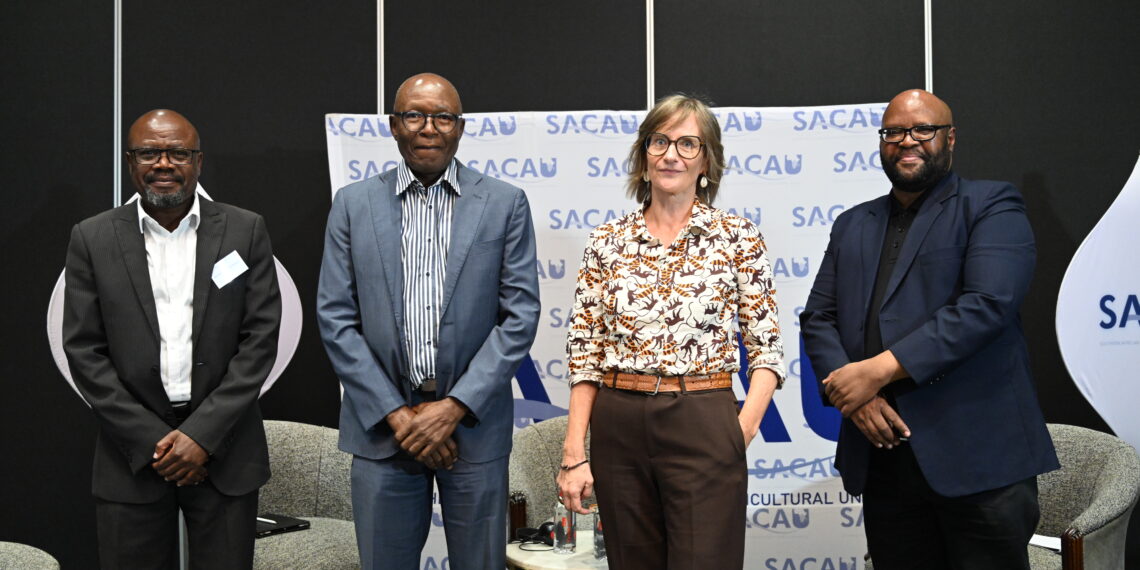
Dr Tshilidzi Madzivhandila, CEO and head of mission at the Food, Agriculture and Natural Resources Policy Analysis Network (FANRPAN); Ishmael Sunga, CEO of the Southern African Confederation of Agricultural Unions (Sacau); Katja Vuori, CEO of Agricord; and Prof. Cliff Dlamini, executive director of the Centre for Coordination of Agricultural Research and Development for Southern Africa (CCARDESA). Photo: Food For Mzansi

Dr Tshilidzi Madzivhandila, CEO and head of mission at the Food, Agriculture and Natural Resources Policy Analysis Network (FANRPAN); Ishmael Sunga, CEO of the Southern African Confederation of Agricultural Unions (Sacau); Katja Vuori, CEO of Agricord; and Prof. Cliff Dlamini, executive director of the Centre for Coordination of Agricultural Research and Development for Southern Africa (CCARDESA). Photo: Food For Mzansi

Share on FacebookShare on TwitterShare on WhatsApp

The transition to agroecology in Southern Africa is not a simple shift but a complex, multi-layered journey. It calls for deliberate scaling strategies, sensitivity to different stages of change, and approaches that respond to the diversity of farming systems across the region. 

That was the key message from a high-level panel on policy, research, and innovation at the Southern African Confederation of Agricultural Unions’ (Sacau) Conference on the Development of Agroecology in Southern Africa. The conference, which took place in Johannesburg, Gauteng, last week, was attended by farmers, researchers and policymakers from around the world.

Dr Tshilidzi Madzivhandila, CEO and head of mission at the Food, Agriculture and Natural Resources Policy Analysis Network (FANRPAN), urged delegates to think carefully about how progress in the transition towards agroecology should be measured. 

Bridging the gap

Drawing on the image of a butterfly in metamorphosis, he explained that each stage of transition carries its own requirements. “If we use the analogy of a butterfly in metamorphosis in terms of the transition of agroecology, the question is, where are we at? We need to think through the treatments, the requirements for each stage, and the environment in which this butterfly is living,” he said.

He further emphasised the need to bridge the gap between research, policy, and technological innovation. While acknowledging progress made, he noted that research must shift its focus. 

“We need to move from publishing to usable knowledge,” he said, underscoring that farmers must be better served by the outputs generated from agricultural research. 


Related stories
  • Agroecology: Make farmers profitable, not poor
  • Agroecology: Transforming agriculture with nature’s wisdom

An opportunity for young farmers

Meanwhile, Katja Vuori, CEO of Agricord, reflected on what she believes has been missing in the conversation on agroecology. She stressed the importance of recognising the diversity of production systems across the region. 

“There is large-scale commercial farming, there is very small-scale subsistence farming, and everything in between,” she said, noting that the transition towards agroecology will look very different depending on the type of farming system in question. 

She welcomed the fact that farmer organisations have begun to articulate these differences more clearly, highlighting that each system requires a tailored approach.

Vuori also praised Sacau’s efforts to bring young people to the centre of the conversation. “My main takeaway is that Sacau is doing a great job with the youth,” she said. 

Having met several youth farmer leaders, she described them as “very inspiring,” adding that the region’s demographics point to vast opportunities in agriculture. “When I hear these young agripreneurs, I start feeling really excited about what the future will bring and what these youngsters are going to show us,” Vuori said.

Scaling out, scaling deep, and scaling up

During the panel, Prof. Cliff Dlamini, executive director of the Centre for Coordination of Agricultural Research and Development for Southern Africa (CCARDESA), underscored the need to ensure that farmers remain at the centre of shaping the sector’s future. 

“The farmers have to inform the research agenda, especially for agricultural research,” he said, warning that policies that are overly scientific without grounding in farmers’ lived experiences can be counterproductive.

Dlamini stressed the importance of the science–policy interface, noting that research must balance scientific rigour with practical realities on the ground. He added that agroecology and other innovations will only thrive if they are backed by clear scaling strategies. 

This, he explained, requires scaling out through dissemination and education, scaling deep by transforming cultures and traditions, and scaling up through supportive policy, institutions, and legislation.

Dlamini argued that such a multidimensional approach is essential for developing a vibrant and thriving agricultural sector that is both sustainable and inclusive.

READ NEXT: Seed analyst: The unsung hero of your food supply

Sign-up to Farmer's Inside Track for the best farming tips, news and advice to thrive!

Duncan Masiwa

DUNCAN MASIWA is the assistant editor at Food For Mzansi, South Africa’s leading digital agriculture news publication. He cut his teeth in community newspapers, writing columns for Helderberg Gazette, a Media24 publication. Today, he leads a team of journalists who strive to set the agricultural news agenda. Besides being a journalist, he is also a television presenter, podcaster and performance poet who has shared stages with leading gospel artists.

Tags: agroecologyCommercialising farmerConservation agricultureInform meRegenerative agriculture
News

Aucamp outlines strategy for biosecurity, trade, and infrastructure

by Tiisetso Manoko
2nd September 2026

In an exclusive interview with Food For Mzansi, agriculture minister Willie Aucamp outlines his vision to accelerate the AAMP, tackle...

Read moreDetails
Tobias Doyer, CEO of Grain SA. Photo: Supplied/Grain SA Facebook

Rising costs, climate risk push Swartland wheat farmers to the brink

2nd September 2026
Sick spuds: No need to panic as SA’s potatoes are banned in Zim

Potato turning point ahead as onions double in price year-on-year

1st September 2026
Early calf care: Key growth targets every cattle farmer must track

Early calf care: Key growth targets every cattle farmer must track

1st September 2026

How to align your farming cycles with long-term financial success

1st September 2026

Strategic support sparks record-breaking growth at WC grape farm

Water rights alone won’t fix inequality in SA commercial farming

How Tebogo beat post-harvest losses with smart agro-processing

Gauteng farmers urged to harness massive urban market

How to align your farming cycles with long-term financial success

Join Food For Mzansi's WhatsApp channel for the latest updates!

JOIN NOW!
Next Post
Solar success: Poultry farmer turns setback into comeback

Solar success: Poultry farmer turns setback into comeback

THE NEW FACE OF SOUTH AFRICAN AGRICULTURE

With 21 global awards in the first six years of its existence, Food For Mzansi is much more than an agriculture publication. It is a movement, unashamedly saluting the unsung heroes of South African agriculture. We believe in the power of agriculture to promote nation building and social cohesion by telling stories that are often overlooked by broader society.

Honoured roots: A father’s legacy, a daughter’s farming dream

Gauteng farmers urged to harness massive urban market

Foot-and-mouth crisis hits SA dairy industry with R1-billion loss

Tough times, hardy cattle: Why Mzansi farmers are choosing Nguni

Dragon fruit thrives in KZN valley despite tough national season

Government hikes sugar import price, but industry warns of gap

  • Awards & Global Impact
  • Our Story
  • Contact Us
  • Cookie Policy
  • Privacy Policy
  • Copyright

Contact us
Office: +27 21 879 1824
News: info@foodformzansi.co.za
Advertising: sales@foodformzansi.co.za

Contact us
Office: +27 21 879 1824
News: info@foodformzansi.co.za
Advertising: sales@foodformzansi.co.za

  • Awards & Global Impact
  • Our Story
  • Contact Us
  • Cookie Policy
  • Privacy Policy
  • Copyright

Chat Options

I'm Lerato, your AI assistant!
No Result
View All Result
  • News
  • Changemakers
  • Lifestyle
  • Farmer’s Inside Track
  • Food for Thought

Copyright © 2024 Food for Mzansi

This website uses cookies. By continuing to use this website you are giving consent to cookies being used. Visit our Privacy and Cookie Policy.