
After more than two decades researching South African litchis, Regina Cronje of Nelspruit can celebrate recently receiving her doctorate in horticulture from Stellenbosch University about this subtropical fruit.
Her study is providing invaluable advice to local litchi farmers who have to adapt to environmental changes. Cronje is the first student in the country in the past 13 years to receive a PhD on this fruit, and the first ever who researched aspects around the production of the fruit, rather than the fruit itself.
She is also the first Matie student to receive a PhD degree for research about this juicy fruit with the characteristic red-pink peel.
Cronje has been working on litchis since her MSc years in the early 2000s at the University of Hohenheim in Germany. She graduated in 2002 after studying the effect of plant growth regulators and girdling on the retention and fruit size of South African litchis.
Hard work bears fruit
Since starting to work at the horticultural division of the Agricultural Research Council’s unit for tropical and subtropical crops in Nelspruit in 2004, she has done research on fruit like litchis, mangoes and citrus.
Her research has already been included in more than 50 journal articles and 15 book chapters and she regularly writes popular articles for the local agricultural industry. Locally, Cronje is very involved in the South African litchi industry and regularly addresses study groups and symposia. She has presented her work in countries like China, Australia, India, Italy and Vietnam.
In 2009, she also received the Lindsey Milne Litchi Industry Award from the South African Litchi Growers’ Association (Salga).
She has received ongoing funding for her research from Salga.
“Without the funding by the industry and the farmers on whose farms I am allowed to work, this research would not have been possible,” she says gratefully. “Although the South African litchi industry is very small, with a small research budget, they nevertheless decided to fund a large part of the molecular work for my PhD. I am very grateful to Salga for their support over many years.”
Over the years she has also developed a good relationship with researchers at the South China Agricultural University in Guangzhou in China which has led to many mutual visits. Professor XM Huang of this university was therefore one of her co-supervisors.
Her chief supervisor was Professor Lynn Hoffmann, previously of Stellenbosch University’s Department of Horticultural Sciences, with Professor Karen Theron, also of SU, as her second co-supervisor.
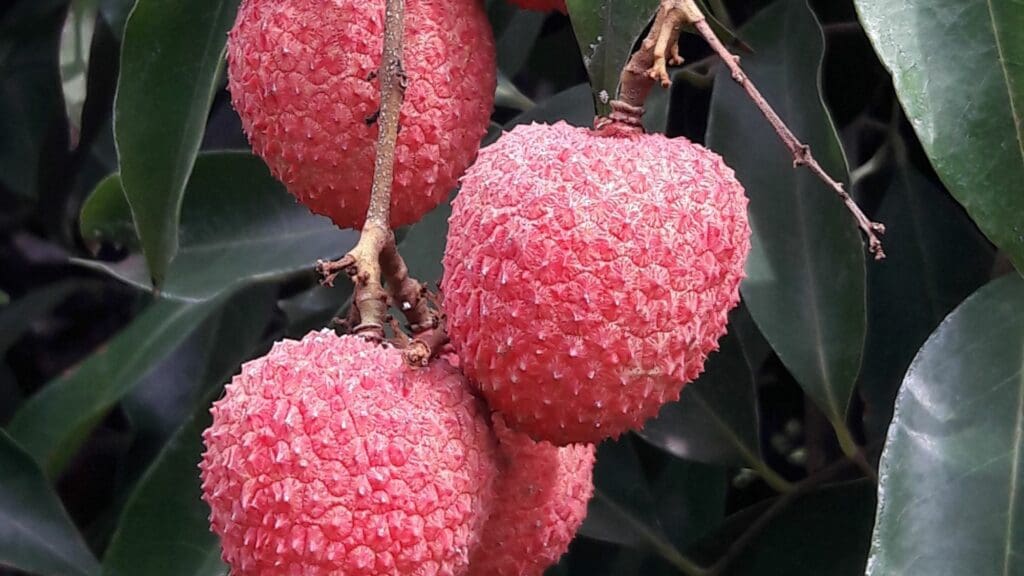
Litchi production in South Africa
Litchis have been cultivated in South Africa since 1875 after the first plants were brought from Mauritius. The subtropical fruit trees have their origin in China.
Three-quarters of all South African plantings are of the “Mauritius” cultivar. Total annual production only amounts to about 6 000 tonnes, but the crops are highly profitable and bring in as much as R185 million annually.
Currently, only about 1 500 hectares are cultivated in South Africa, especially in the frost-free parts of Mpumalanga and Limpopo, and to a lesser degree in KwaZulu-Natal. These regions are usually characterised by warm, wet summers and dry, cold winters.
“For good flower bud development, ‘Mauritius’ trees must preferably experience average temperatures below 20 degrees. As soon as panicles emerge, a gradual increase in temperature is required to ensure good flower panicle formation,” Cronje explains.
In the month before flower emergence, the trees should ideally already carry mature terminal shoots. Any vegetative shoots which emerge before the floral induction phase will not be able to produce flowers in time.
This all has an effect on flower formation, something which is an issue for litchi farmers – and not only those in South Africa. The poorer the flowering of trees in spring, the poorer the fruit formation and the smaller the eventual harvest.
Over the past two decades, a shift in seasonal climatic conditions has been experienced in South Africa’s litchi-producing areas, with dry summers and rain at the end of the summer and in early autumn. Winters are increasingly milder, and the coldest periods only occur in later winter months.
As a consequence, the essential “cold” spell that litchi farmers seek increasingly occurs later in the year, and no longer coincides with the right growth period in the tree. Shoot growth is increased before flowering, and as a result flower formation is becoming weaker.
Better use of plant growth regulators
The industry has for a long time applied the plant growth regulator ethephon to eliminate shoot growth in autumn which inhibits flower development. It is usually applied as a spot spray around April. Owing to the changing climate, ethephon applications no longer seem so effective.
“This all further exacerbates the existing problem of erratic flowering,” says Cronje.
Through her doctoral studies, she found, however, that ethephon is more effective when the whole tree is sprayed when the terminal shoots are mature and new shoots have not yet emerged. This works better than when spot sprays are applied to young immature shoots and prevent vegetative shoot growth before floral induction.
Such applications delay the development of panicles sufficiently until cooler weather arrives. The accumulation of carbohydrates is promoted, and the quality of inflorescences is improved. Consequently, the flowering percentage is better, as well as the eventual yield – without delays in fruit ripening.
The date of application and the concentration at which it is applied play an important role in the efficacy of ethephon.
High ethephon concentrations are more effective under warm conditions, such as early autumn, in areas which are generally hotter. Producers can get away with lower concentrations late in autumn and in early winter when temperatures have already started to drop.
“My studies have shown that small adjustments in application time and phenological growth stage can make a big difference in how effective ethephon can be used,” she summarises her findings.
“By preventing shoot growth and influencing the time of bud break, the use of ethephon on mature terminal shoots is better than conventional spot spraying.
“It can be a powerful tool to manage the time of floral development under less favourable conditions.”
Helping the litchi industry grow
As part of her studies, Cronje completed detailed studies on physiological and molecular changes in the shoots, buds and emerging panicles after ethephon application to improve floral induction in the “Mauritius” cultivar. Her gene-expression studies showed that ethephon causes dormancy in the buds. The result is that the buds develop later when the temperature is sufficiently low for good floral induction.
Recommendations emanating from her studies are already implemented in the local litchi industry. She hopes that her findings can assist the local industry to be more sustainable and to expand further.
She hopes that more opportunities will emerge to do further research on litchi flower formation and believes that further molecular studies on gene expression in litchis will contribute to the expansion of knowledge on the complex floral induction of litchis.
Currently, Cronje is studying ways to improve the colour of the fruit’s peel.
READ NEXT: Augsburg breeds hope in farming community
Get Stories of Change: Inspirational stories from the people that feed Mzansi.