Tuesday, September 8, 2026
SUBSCRIBE
22 GLOBAL MEDIA AWARDS
Food For Mzansi
  • News
  • Changemakers
  • Lifestyle
  • Farmer’s Inside Track
  • Food for Thought
No Result
View All Result
  • News
  • Changemakers
  • Lifestyle
  • Farmer’s Inside Track
  • Food for Thought
No Result
View All Result
Food For Mzansi
No Result
View All Result
in Lifestyle, Weird & Wonderful

Seaweed for livestock diets? Yes, it’s a thing!

Farming seaweed can not only help fix the climate but supply farmers with animal feed. No jokes. It is already being used for toothpaste and biofuel, anyway

by Zolani Sinxo
2nd February 2022
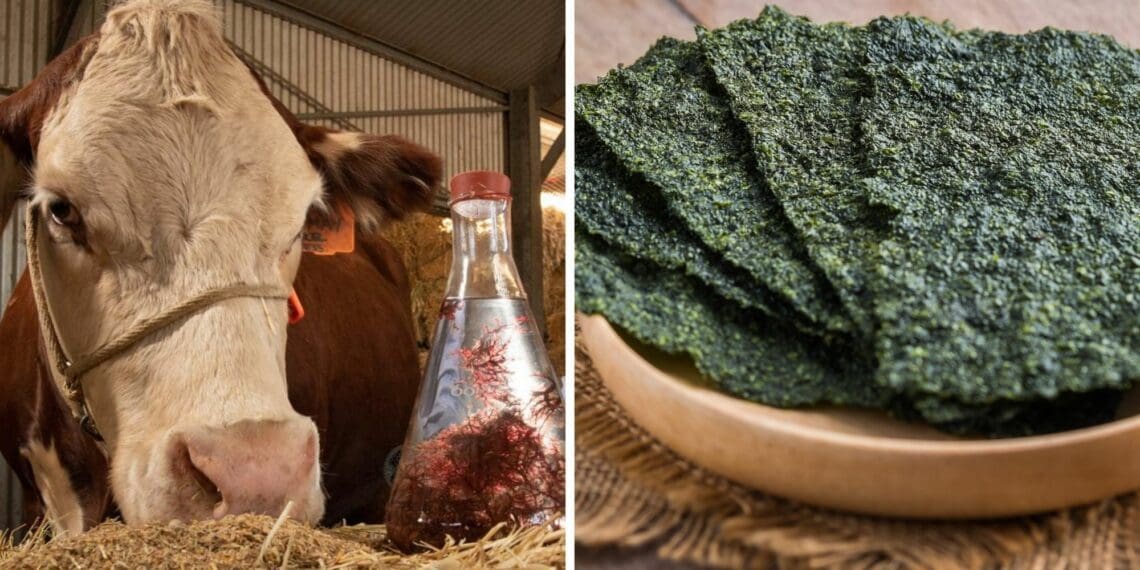
Many researchers have found seaweed to be an ideals solution to not only address climate change concerns, but rising animal feed prices. Photos: Supplied/Food For Mzansi

Many researchers have found seaweed to be an ideal solution to not only address climate change concerns, but rising animal feed prices. Photos: Supplied/Food For Mzansi

Share on FacebookShare on TwitterShare on WhatsApp

It’s probably something you’ve never considered, but seaweed can be a highly nutritious source for livestock feed – and it’s great for the environment too. Experts say it is a cool way to reduce the emission of cows’ planet-heating gases from their burps and farts.

Yes, we’re talking about the exact same seaweed normally washed to shore or found floating in the oceans. It adds to the protein and energy requirements of livestock, while the prebiotic compounds in seaweeds may help to enhance livestock production and health, according to ScienceDirect.

According to this research journal, seaweeds are macroalgae which come in many different shapes, sizes, colours and compositions. This include brown algae (Phaeophyceae), red algae (Rhodophyceae), and green algae (Chlorophyceae).

“Seaweeds have a long history of use as livestock feed,” writes Dr Harinder P.S. Makkar, an Italian researcher with the Food and Agriculture Organisation of the United Nations.

“They have a highly variable composition, depending on the species, time of collection, habitat, and on external conditions such as water temperature, light intensity and nutrient concentration in water. They may contain non-protein nitrogen, resulting in an overestimation of their protein content, and nitrogen-to-protein conversion factors lower than 6.25, normally used for feed ingredients, have been advocated.”

Seaweed is not only useful to animals but also humans. No, really. It has been used to produce a variety of products such as moisturisers, toothpaste and biofuel.

Promar International reports that it can also be used for food, providing a good source of amino acids, antioxidants and essential fatty acids.

Seaweed is already being used to produce a variety of products such as moisturisers, toothpaste and even biofuel. Photo: Supplied/Food For Mzansi

Can seaweed be farmed?

Seaweed farming is growing in the aquaculture industry across the globe, especially in the United States and the United Kingdom. In Alaska, more than 50 000 kg of sugar, ribbon and bull kelp were produced in 2019 alone. That’s a whopping 200% increase since the state’s first commercial harvest in 2017.

According to NOAA Fisheries, seaweed offers an opportunity to diversify a farming operation or start a new business. Seaweeds use the entire water column. “This means farmers can grow seaweed using a process known as vertical, or 3D farming and reap large harvests from a small area,” states the report.

Seaweed can be grown in the ocean with no inputs and, if farmed the right way, it will have minimum effect on local ecology. It has shown to be the food of the future, helping farmers sustainably produce beef and dairy products.

Another lovely thing about seaweed is that farmers don’t have to compete for agricultural land as there is an abundance of the seafloor for farming.

Seaweed kills bacteria too

Furthermore, many livestock farmers are faced with the problem of animal infections and bacteria that sometimes threatens biosecurity. As a result, scientists have been looking for ways to prevent infections in livestock farming.

The Arabian Journal of Chemistry reports that brown seaweeds synthesise a unique class of compound called phlorotannin as they grow. These compounds can kill bacteria that emerge among farm animals. How effectively these compounds can kill bacteria depends on the species of seaweed being used, with different species producing more potent bactericides.

The most interesting function of seaweed is that it is environmentally friendly and that it is one of the solutions that can help in the fight against global warming. Professor Tim Flannery, an Australian researcher, found that seaweed draws in a lot of carbon dioxide. This helps de-acidify the seawater around them and release oxygen. Long story short: it improves the health of sea life nearby.

ALSO READ: 10 tips to cut down on animal feed costs

Sign up for Mzansi Today: Your daily take on the news and happenings from the agriculture value chain.
Zolani Sinxo

Zolani is an award-winning journalist and holds a National Diploma and a B Tech in journalism, he is a journalist at heart with a particular interest in developmental journalism, politics, African development stories, environment, and global and national current affairs. He started to develop an interest in writing and storytelling at a young age after he co-authored a folk tales children’s book in 2005 titled Our Stories, Amabali Ethu. After graduating, Zolani worked at various government institutions where he worked in the marketing and communication departments specialising in media liaison and editorial management. His passion for developmental journalism saw him being a co-founder of a community newspaper in Stellenbosch, Umlambo News. He has also worked for the Group Editors as a journalist for the George Herald and is also the editor of Idinga community newspaper. Zolani loves books, especially on Africa’s politics, history, stories, and biographies of African leaders who have made a significate contribution to the continent’s socio-economic wellbeing.

Tags: Animal feedClimate changeSustainable agriculture
Tiger Brands CEO Tjaard Kruger addressed farmers at the Swartland Show in Moorreesburg in the Western Cape on Friday. Design: Food For Mzansi
News

Tiger Brands CEO calls for stronger food value chain

by Ivor Price
6th September 2026

Tiger Brands CEO Tjaart Kruger has called for a stronger, more connected agricultural and food value chain, warning that South...

Read moreDetails

Plant, pick, protect: The rising potential of urban foraging in SA

6th September 2026
From left: Jeremia Mathebula (vice-chairperson of Grain SA); Dr Jack Bloom (deputy minister of water and sanitation); Falon Mars (Mars Rossouw Attorneys INC); and André Cloete (award-winning Overberg farmer). All four are part of the lineup for the special emerging farmers’ programme at Nampo Cape. Photos: Supplied/Food For Mzansi

RSVP now: Emerging farmers’ programme at Nampo Cape

5th September 2026
Community-led farms boost food security and incomes in Limpopo

Community-led farms boost food security and incomes in Limpopo

5th September 2026
Farmers rethink water use as shortages threaten food production

Farmers rethink water use as shortages threaten food production

5th September 2026

Weaning calves: How to reduce stress for maximum weight gain

How Tebogo beat post-harvest losses with smart agro-processing

Rural safety under fire as stock theft and farm violence persist

Tiger Brands CEO calls for stronger food value chain

Young farmers need structured opportunities, not just open doors

Join Food For Mzansi's WhatsApp channel for the latest updates!

JOIN NOW!
Next Post
Pictured from the left are Denise Stubbs, Carmen Stevens and Francois Viljoen. They are among the winners announced during the 2022 SA Wine Harvest Commemorative Event. Photos: Supplied/Food For Mzansi

Wine industry honours Mzansi trailblazers

THE NEW FACE OF SOUTH AFRICAN AGRICULTURE

With 21 global awards in the first six years of its existence, Food For Mzansi is much more than an agriculture publication. It is a movement, unashamedly saluting the unsung heroes of South African agriculture. We believe in the power of agriculture to promote nation building and social cohesion by telling stories that are often overlooked by broader society.

Weaning calves: How to reduce stress for maximum weight gain

Grain markets slide: Temporary pause or start of a downturn?

Chilli farming: Why high-value crops are SA’s missed opportunity

SA pork industry builds resilience following disease outbreaks

Young farmers need structured opportunities, not just open doors

BenicaTheFarmer: The nurse who built an agricultural empire

  • Awards & Global Impact
  • Our Story
  • Contact Us
  • Cookie Policy
  • Privacy Policy
  • Copyright

Contact us
Office: +27 21 879 1824
News: info@foodformzansi.co.za
Advertising: sales@foodformzansi.co.za

Contact us
Office: +27 21 879 1824
News: info@foodformzansi.co.za
Advertising: sales@foodformzansi.co.za

  • Awards & Global Impact
  • Our Story
  • Contact Us
  • Cookie Policy
  • Privacy Policy
  • Copyright

Chat Options

I'm Lerato, your AI assistant!
No Result
View All Result
  • News
  • Changemakers
  • Lifestyle
  • Farmer’s Inside Track
  • Food for Thought

Copyright © 2024 Food for Mzansi

This website uses cookies. By continuing to use this website you are giving consent to cookies being used. Visit our Privacy and Cookie Policy.