Digitalising your farm operation is a journey, not an instant transformation. With guidance from Agritistics, you can organise scattered notes, WhatsApp messages, and spreadsheets into consistent digital formats to track yields and costs.
For many farmers, “going digital” can feel like a major, expensive step. It often suggests specialised software, complicated apps, sensors, dashboards and systems. Digitalisation does not have to start with advanced technology.
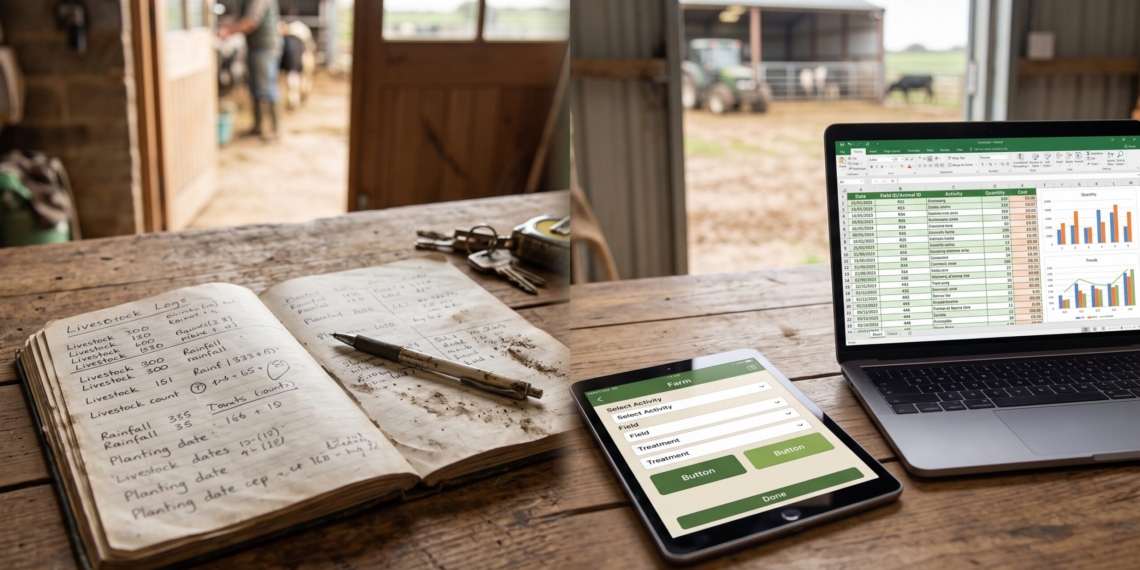
It can start with something as simple as improving how you record information in a notebook, creating a more structured Excel spreadsheet, or bringing already-collected information into one organised place.
Digitalisation isn’t about using more technology. The real goal is to make farm information easier to capture, find, compare and use so that it can support better management decisions.
Start with the decision, not the technology
Before investing in software or changing how you collect information, ask what you need to know about your business.
A livestock farmer may want to understand how many animals are on the farm, where mortality is occurring, how much feed is being used, which animals are performing best, and what production costs per animal are. A crop farmer may need to compare input costs, rainfall, planting dates, yield per hectare and profitability between different fields.
These questions should determine what information to collect. Collecting large amounts of data without knowing why you’re recording it can create more work without improving decision-making.
Improve the records you already have
A notebook is not necessarily a poor management tool. The problem usually arises when information is incomplete, inconsistent or recorded long after an activity has taken place.
A useful farm record should clearly show what happened, when it happened, where it happened, what or who was involved, and where relevant, the quantity or cost.
Capturing information as close to the activity as possible also reduces the risk of forgotten or inaccurate records.
Related stories
- Why simple farm records beat complex systems
- ‘No books, no loan’: How compliance unlocks farm finance
- The numbers every farmer should know
- Record-keeping: Know the ins and outs of your cattle
Move to structured digital records
For many farms, a structured Excel spreadsheet is a very practical next step. If you capture the data consistently, Excel can help you search information, calculate totals, compare periods, and identify trends. The important part is the information structure, not the software itself.
A livestock treatment record, for example, is far more useful when you enter animal ID, date, condition, treatment, product, and quantity in separate columns instead of typing it as one long sentence. When you capture information in a consistent format, it becomes much easier to analyse later.
Bring scattered information together
As an operation grows, information often spreads across several spreadsheets, notebooks, WhatsApp messages, photographs, and individual computers. At this stage, the problem is no longer a lack of data but rather that the information is difficult to access and compare.
A centralised platform can bring different types of farm information into one environment, so users can work from the same source.
Make data capture easier
Once you have structured the basic records, consider using customised digital forms or applications to simplify repetitive data capture. Staff can select predefined options such as an animal, field, date, treatment or activity rather than typing the same information repeatedly.
The best digital system isn’t necessarily the most advanced; it is the one that is practical enough to be used correctly and consistently.
Technology should reduce administration, not create more of it.
Turn records into useful information
Once farm data is accurate, consistent, and well organised, you can visualise it to spot trends more easily. Instead of working through hundreds of rows of information, you can capture it in a graph or chart to monitor things such as mortality, feed costs, yield per hectare, diesel consumption, production by hive, or sales by enterprise.
This is where farm records become management information, because you can move beyond knowing what happened and start to understand where performance is improving, where losses occur, and where attention may be needed.
Start where your farm is today
Digitalisation should happen in stages. For one farmer, the next step may simply be a better spreadsheet, while another may benefit from centralising information. A more advanced operation may be ready for custom applications, automated data capture or interactive dashboards.
Agritistics helps farmers identify which information is worth collecting, improve and structure existing records, develop customised Excel solutions, centralise farm data, create custom applications and visualise information through management reports and dashboards.
You do not have to digitalise your entire farm overnight. Start with the right information, create a system that suits the way your farm operates and build from there.
Contact Agritistics to discuss where your farm is today and the next practical step in your digital journey.
READ NEXT: Four simple records every smallholder livestock farmer should keep