South African maize farmers have been urged to improve compliance with refuge planting requirements to slow the evolution of insect resistance and protect the long-term effectiveness of Bacillus thuringiensis (Bt maize) technology.
The warning was highlighted by agricultural entomologist Prof. Johnie van Rensburg during a Bayer discussion on insect resistance management. Speakers emphasised that responsible technology use and collaboration across the agricultural value chain are essential to sustaining the benefits of genetically modified (GM) maize.
Emerging resistance to Bt maize
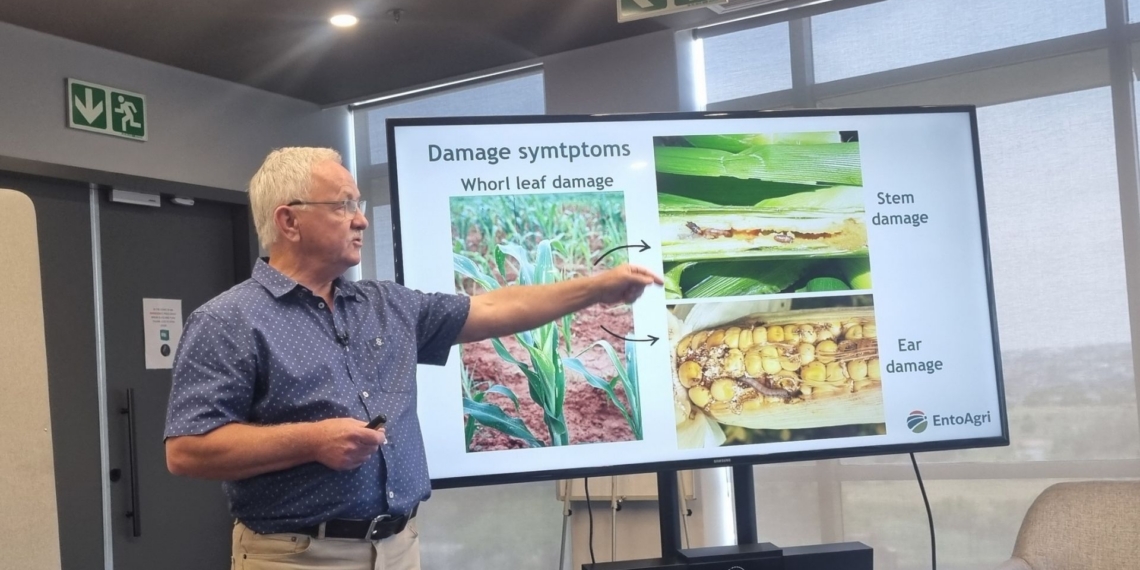
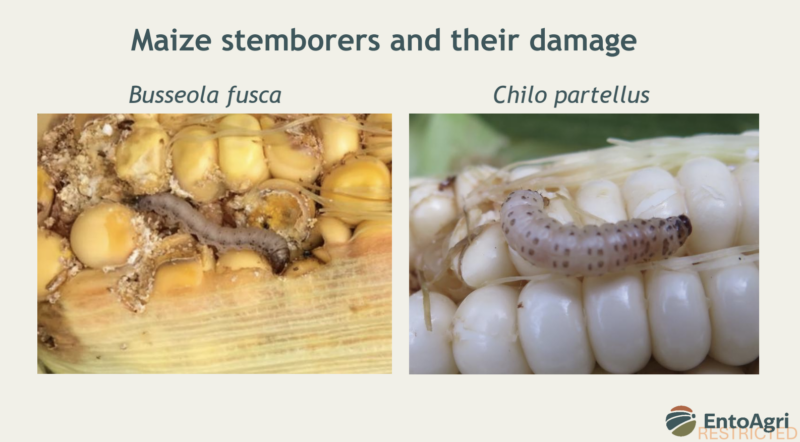
Van Rensburg said populations of the maize stem borer, Busseola fusca, are showing emerging resistance to Bt maize, although the problem remains geographically limited, particularly in parts of the Eastern Cape.
He explained that resistance is a natural evolutionary process in which insects carrying resistant genes survive and reproduce, gradually increasing the proportion of resistant individuals in a population.
“This is not the Bt maize hybrid that is becoming poorer or the toxin inside the maize that is deteriorating. It is the insect that is becoming stronger,” he said.
Related stories
- Beyond maize: Why neglected crops are SA’s climate-smart future
- Better seed technology strengthens SA’s grain future
- Maize: Choosing the right varieties for local conditions
- Seed technology: How innovation drives higher yields & success
Refugia critical to slowing resistance
Van Rensburg identified poor compliance with refuge planting requirements and potentially insufficient toxin expression as contributing factors to resistance evolution.
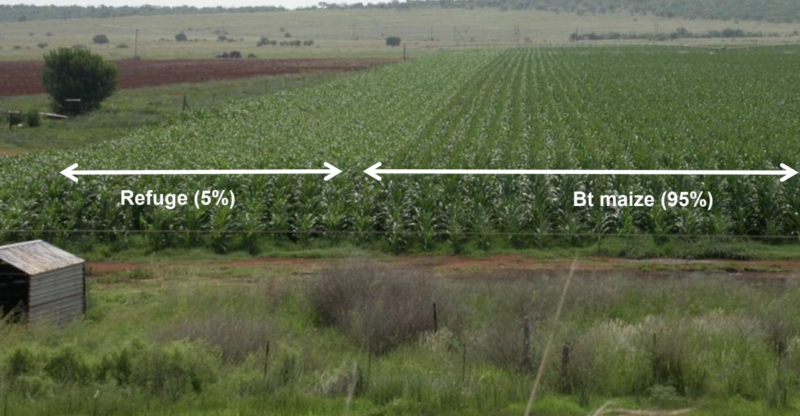
A refuge is a designated area planted with non-Bt maize alongside Bt maize. Its purpose is to provide a population of susceptible insects that can mate with potentially resistant insects emerging from Bt fields, reducing the likelihood that resistance becomes widespread.
He explained that the high-dose refuge strategy relies on two complementary components: Bt maize producing sufficient toxin to kill susceptible stem borers, and non-Bt maize providing a population of susceptible insects.
“If we keep on planting refuges, it slows down the rate of resistance evolution,” he said, adding that it also helps delay the geographical spread of resistance to other production areas.
Van Rensburg cautioned farmers to not abandon refugia simply because resistance has been detected in certain areas.
“Even if there is emerging resistance, it doesn’t mean that the Bt part of maize fields would suffer significant losses,” he said, emphasising that the technology still provides protection and that many production regions have not recorded resistance.
He added that Bt maize continues to offer control against other important stem borer species, making stewardship particularly important.
Protecting the value of Bt technology
The importance of maintaining the technology extends beyond pest control. Van Rensburg cited research showing that Bt maize delivered an average annual yield gain of 11% over 20 years, with aggregate income benefits of R21 billion for South African maize farmers.
The technology has also contributed to reduced insecticide use. Over a 15-year period, approximately 20 million hectares were not sprayed, representing a significant environmental benefit through reduced exposure of beneficial organisms to broad-spectrum insecticides.
He warned that widespread resistance could put these economic and environmental gains at risk.
Francois Wolvaardt, DEKALB seed and trait business portfolio manager for Africa, echoed the importance of refuge compliance, noting that biotechnology is already widely adopted in South African maize production.
Approximately 80% of South Africa’s maize hectares are planted with biotechnology products for insect control or herbicide tolerance, highlighting the industry’s reliance on these technologies.
“The most important thing we and our farmers can do to protect the technology that’s obviously providing a lot of value for them today is to have sufficient refugia,” Wolvaardt said.
Early reporting and control measures
The experts advised farmers to regularly scout their fields and report unexpected damage early, as stem borers are easier to control while larvae are still small.
After harvesting, disturbing or destroying maize stubble can also expose overwintering larvae to natural enemies and harsh environmental conditions, helping to reduce pest populations.
Maria Vnuchkova, Bayer’s value proposition lead, reinforced the need for collective responsibility, describing stewardship as a partnership between farmers, industry, researchers and the media.
“Stewardship is actually shared responsibility between all of us,” she said.
READ NEXT: Municipal failure drives up production costs for poultry farmers