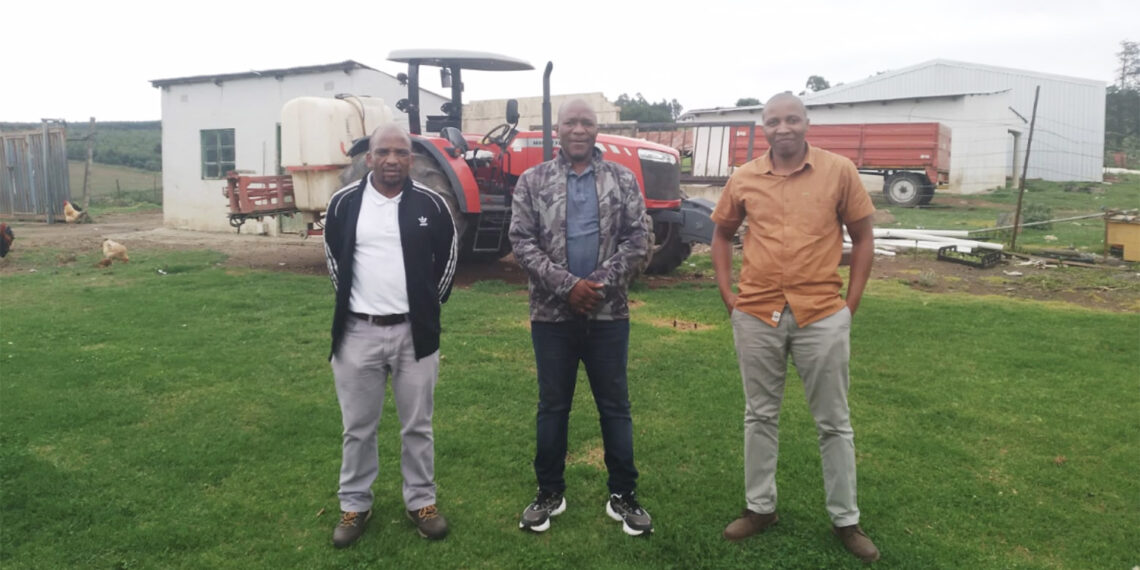
After waiting 10 years for their lease, the Shelembe family turned the vandalized Klewer Vlei Farm into a thriving 500-hectare enterprise. The ARC’s Dr Siphe Zantsi, and Khayelihle Mendu and Nomusa Zuma of the KwaZulu-Natal department of agriculture, share their insights following a visit to the farm.
Just outside Mooi River in KwaZulu-Natal lies Klewer Vlei Farm, a 500-hectare property that tells a remarkable story of perseverance, skill and delayed justice in South Africa’s land reform programme.
Originally 800 hectares before redistribution under the Proactive Land Acquisition Strategy (PLAS), the farm was purchased by the state in 2008. Yet, for more than ten years, it stood abandoned – its fields choked with blackwattle and its infrastructure vandalised.
At the centre of this story is Thanduyise Shelembe, a lifelong farmworker whose dedication and deep knowledge of the land convinced the previous owner to support his application for government assistance to acquire the farm.
“The previous owner told me to apply because I knew every corner of the farm,” recalls Shelembe. “He believed I could make it work.”
A decade in limbo
Shelembe, together with his son, Bheki, applied to the department of rural development and land reform to take ownership. But after the state purchased the farm, they were instructed not to settle there.
“We were told to wait,” he says. “I suspect officials had other plans for the land.”
For over a decade, the farm deteriorated. The farmhouse was vandalised, and once-productive arable land grew wild. Only in 2020 were the Shelembes finally given a 30-year lease, allowing them to take control of 500 hectares. The remaining 300 hectares were allocated to a communal property association (CPA) made up of 12 families, including some of the farm’s long-term workers and relatives.
Related stories
- Oakhill Farm: A land reform success story in Sunday’s River Valley
- Land reform farm blossoms under Lipali’s leadership
- Minister vows to fast-track land reform, axe bad CPAs
- Land reform failure: Ideas not the issue, delivery is
Private capital and hard work
Rehabilitating the farm was costly. Clearing bush and repairing infrastructure demanded about R500 000, a sum financed not by the government, but by Shelembe’s son, who had run a construction business and a pub in a nearby town. His investment in the family farm shows how off-farm income can be critical for land reform success.
Before receiving state support, the Shelembes planted 10 hectares of maize and kept 20 beef cattle. Later, government assistance – two tractors, implements and diesel money – enabled them to scale up. Today, 300 hectares are used for grazing 40 Beefmaster cattle, while 180 hectares are under maize and soybean cultivation.
Their maize yields average six tonnes per hectare, and soybeans produce about two tonnes per hectare – respectable figures given the short time since rehabilitation. Calves are sold at the Mooi River market at eight to nine months, while wool and castrated sheep are sold locally.

Building capacity and market trust
A key turning point was access to mentorship. Through the DRDLR programme, the family was paired with a successful commercial farmer who offered production and marketing advice. Even after the government-funded mentorship ended, Shelembe paid privately to retain this guidance.
“Mentors are important,” he says. “They teach you how to plan, how to manage, and where to sell. That’s how small farmers grow.”
The Shelembes also joined the TWK input credit scheme, which provides production inputs on credit to farmers with strong records of accountability. Joining such programmes requires careful record-keeping and financial discipline, qualities not always found in under-resourced farming operations.
Expanding opportunity and employment
Klewer Vlei now employs five permanent workers, two tractor drivers and three general assistants, and up to twenty seasonal labourers during harvest. The younger generation plays an active role: Shelembe’s eldest son manages the crop enterprises, ensuring continuity and intergenerational learning.
But challenges remain. Stock theft, especially of goats, is a constant threat. Transport costs are high, and capital remains a limiting factor. “With a bigger herd and our own truck,” says Shelembe, “we could sell directly to feedlots and save money. Transport alone costs R300 per calf for just ten kilometres.”
Lessons from Klewer Vlei
Klewer Vlei’s revival challenges the often-pessimistic narrative surrounding land reform farms. While many projects have failed due to weak support, mismanagement and lack of finance, the Shelembes’ success shows what can happen when experience, discipline and targeted support converge.
Several factors stand out:
- Local expertise and lifelong experience of the beneficiary
- Private investment and off-farm income bridging government delays
- Mentorship and market access through established networks
- Family involvement and intergenerational continuity
- Financial discipline and participation in credit schemes like TWK
- Government support through equipment and inputs once operations proved viable
When asked why he thinks some beneficiaries fail, Shelembe pauses, then says quietly: “It’s eating from hand to mouth. Farming is a long-term investment.”
His words capture a broader truth: successful land reform requires not only access to land, but patience, planning and persistence. The Shelembe family’s journey at Klewer Vlei Farm is a testament to what’s possible when commitment meets opportunity – even after a decade of waiting.
- This article was written by Dr Siphe Zantsi of the Agricultural Research Council (ARC), and Khayelihle Mendu and Nomusa Zuma of the KwaZulu-Natal department of agriculture. The views and opinions expressed in this article are those of the author and do not necessarily reflect the views or positions of Food For Mzansi.
READ NEXT: Seeds of love: Limpopo couple’s farming journey takes root