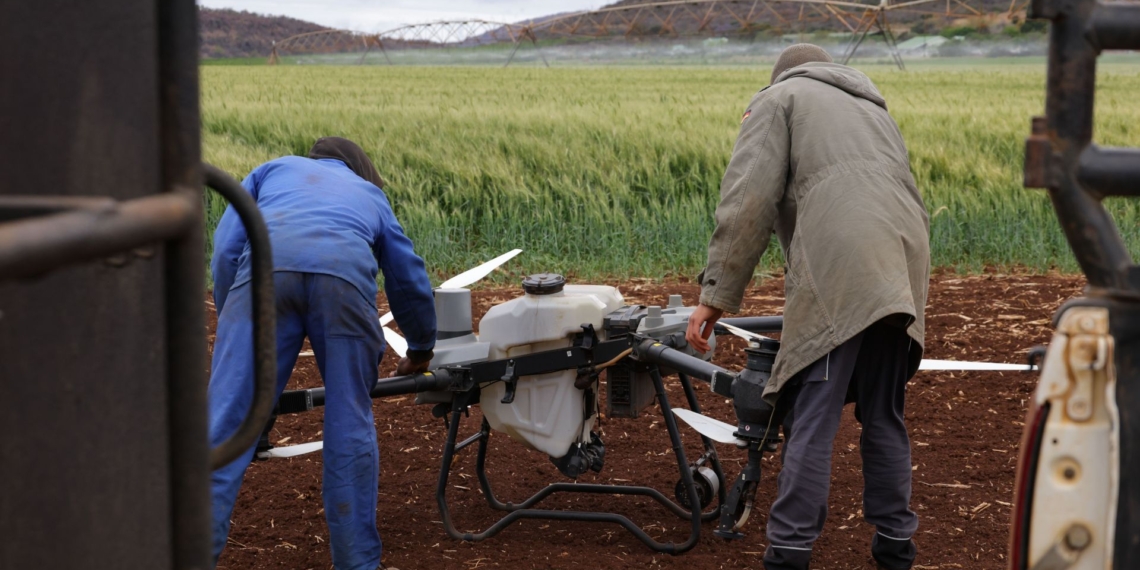
From drones and artificial intelligence to digital record-keeping and soil sensors, agricultural technology is expanding rapidly.
For many South African farmers, particularly smallholder and emerging producers, the challenge is often not understanding what agritech is, but understanding where to start, what is useful, and how to adopt technology without unnecessary cost or complexity.
Research conducted by the University of Johannesburg (UJ), supported by the National Research Foundation and others, titled The Use of Advanced Technology in South African Agriculture: Insights from selected sub-sectors, identifies precision agriculture as a growing force in modern farming, driven by tools that improve efficiency, support better decision-making, and reduce input waste.
To help producers navigate this rapidly changing landscape, Jeandré Johnston, project manager and agricultural consultant, alongside Lesego Sindane, agricultural economist at Agri Funda, break down eight foundational strategies for practical, cost-effective technology adoption on the farm.
Related stories
- New Bayer and Khula partnership to boost funding for 50 farmers
- Faster farm technology rollout could boost SA farmer profits
- Repo rate hike tightens noose on SA’s struggling economy
- How to use technology to fight farm security challenges
1. Do not assume agritech is only for large commercial farms
One of the biggest misconceptions around agritech is that it is designed exclusively for large-scale commercial operations, according to Johnston.
“Farmers often imagine that agritech is only for commercial farmers with large budgets. But it does not have to be expensive. Farmers need to shop around and find what works for their specific needs,” he says.
For farmers trying to enter the agritech space, the first lesson is understanding that technology adoption does not have to happen all at once. The right technology depends on the farm’s scale, production system, and operational challenges.
“It is whatever fits your need,” Johnston explains. “If you apply technology in the right way, it becomes a cost-saving tool because it helps you see where things are happening on the farm.”

2. Start with the problem, not the technology
Agricultural technology covers a broad range of tools, and not every technology will suit every farm. Some technologies focus on field management and monitoring, while others support livestock production, compliance, financial management, or decision-making.
The key, according to industry stakeholders, is to identify the farm problem first and then look for the technology that solves that specific issue.
Sindane advises farmers to focus on technologies that address their specific operational needs rather than attempting to adopt every available tool.
“Make sure that you are applying things that work for your specific needs. It is not all of agritech that is going to be applicable to your specific farm,” she says.
3. Overcome the fear of adopting new systems
For many farmers, particularly those accustomed to traditional systems, moving into digital tools can feel intimidating.
“So, first of all, it is very intimidating for smallholder farmers, especially,” says Sindane. “It is not just a cost thing; it is also an implementation thing. They often do not have the resources to implement a whole new system.”
She notes that many producers are still working with systems they know well. “Many farmers are used to pen and paper; that is how they did it, how their parents did it, and how they are still doing it.”
Yet, both Sindane and Johnston argue that fear of technology often becomes a bigger barrier than the technology itself. For farmers uncomfortable with software, Johnston suggests beginning with familiar entry points.
“It begins with small steps,” he explains. “If it starts with a WhatsApp tool, we integrate it into what the farmer is already familiar with.”
4. Use agritech to strengthen record-keeping and compliance
Agritech is not only about machinery, drones, or automation. Some of the most practical technologies available to farmers focus on record-keeping, compliance, and financial management.
According to Sindane, this is becoming increasingly important as farmers seek access to finance, land opportunities, and markets.
“Farmers need compliance to access opportunities,” she explains. “Whether it is financing, water rights, land access or market participation, compliance and record-keeping are becoming essential.”
Digital record-keeping tools can help farmers track:
- Production records
- Sales and purchases
- Inventory and inputs
- Financial performance
- Spray programmes and production activities
These systems can also strengthen market credibility and improve access to finance. “It is going to help farmers financially,” says Sindane. “It helps them access financing, but it also helps them keep track of the finances and production on the farm.”
5. Think of technology as operational support
One practical way of understanding agritech is not as a replacement for farming knowledge, but as an additional layer of support. For example, farmers facing labour shortages may benefit from monitoring technologies.
“They do not have the manpower to be walking around checking everything constantly,” says Sindane. “Technology can keep farmers updated continuously.”
She points to examples such as livestock monitoring systems and soil moisture tracking tools.
“Even the soil, there is technology that helps farmers keep track of moisture levels. Those tools take a lot of the worry off farmers because they have something else helping them keep track of what is happening on the farm,” she says.
Johnston offers a similar perspective, describing technology as a form of operational support, almost like a third employee that works around the clock, helping farmers monitor, manage, and track farm activities continuously.
6. Do not overspend, and make sure the technology makes business sense
While agritech can deliver efficiencies, stakeholders caution farmers against adopting technology simply because it is available.
“Be careful not to overspend on agritech,” advises Sindane. “You need to make sure that the technologies you invest in are useful and financially sensible. There needs to be a return on investment.”
Technology adoption should ultimately strengthen the farm business rather than create additional financial pressure. This is particularly important for farmers navigating tight margins, infrastructure challenges, and variable production conditions.
7. Use technology to connect, not farm in isolation
Another role of agritech is connection and collaboration. Many digital platforms now aim to connect farmers with peers, buyers, service providers, and support networks.
According to Johnston, this can be particularly valuable for smaller producers. “A lot of people work in isolation, but you cannot function in isolation in farming,” he says.
Rather than trying to solve every challenge independently, technology can help farmers build networks, share information, and improve access to opportunities.
“You do not necessarily always need the expert; you need the community, the local support network and people who understand your environment,” he says.
8. The future of agritech starts with practical adoption
Agricultural technology continues to evolve, but experts emphasise that successful adoption does not begin with adopting every new tool available.
“Do not be afraid of agritech,” says Sindane. “You need it on your farm, but you need to adapt in a way that makes sense for your operation.”
For farmers trying to navigate the agritech landscape, the practical starting point may be simpler than expected: understand the problem, start small, choose tools that fit the operation, and focus on technologies that deliver measurable value.
READ NEXT: Start small, grow big: Zen Teitge’s blueprint for sustainable farming