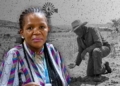
This week on Food For Mzansi’s #SoilSistas campaign, we meet Nobuntu Makhoa, founder of Ba ha Makhoa. Powered by Corteva Agriscience, we’re highlighting some of the extraordinary female farmers participating in Corteva Women Agripreneur Programme 2021, a year-long blended development programme at the Gordon Institute of Business Science (GIBS) Entrepreneurship Development Academy (EDA).

Born and raised in Aliwal North, Eastern Cape, Nobuntu Makhoa (50) had very limited opportunities growing up. Feeling constrained in her hometown, Makhoa moved to Johannesburg after matric to further her studies and look for opportunities.
“My parents didn’t have money to send me to university,” Makhoa shares. “So, I furthered my studies through distance learning until I acquired my Bachelor of Arts degree through UNISA.”
Farming was not an option that she considered as a career.
“My career spans from being a tea girl in Randburg, a technical administrator, and an events and hospitality specialist,” she lists. “And now I am a corporate social investment specialist at Cell C and Volkswagen South Africa.”
Journey to farming

“In 1986 my father, Sipanana John Lange, who was still working as a fulltime employee for Eskom, bought himself two pregnant cows, with a calf each,” Makhoa says. “Those four animals started my family’s livestock farming journey.”
Makhoa’s father did not own any land at that time and did not have any hope that he ever would.
“Times were different then,” Makhoa says. “But he didn’t allow that to stop him.”
He rented space on surrounding farms until he and a group of other black farmers were allocated a communal farm after the 1994 elections.
“He continued farming and provided for our family and neighbours with milk and meat from his cattle until he passed on in October 2020,” Makhoa shares.
And this is how her home became an informal dairy as she grew up. Every morning and evening people from the township would queue at their house to buy fresh and affordable milk. Those who couldn’t pay were not turned away either.

“When we were young, we didn’t like all the work,” Makhoa says. “To us it was just an unnecessary chore.”
When you sell milk, everything needs to be hygienically clean, she explains. So, there was a lot of unwelcomed work and cleaning for her to do as she grew up.
But she does realise that it was his passion and dedication to farming with these dairy cows that sustained her family as she grew up.
“His cattle sustained us for over 25 years after he retired from his formal employment,” Makhoa says. “His passion and love for farming, despite not having land of his own, inspired us.”
“We committed ourselves to ensuring that his legacy lives on and we reach the heights he was not able achieve in his lifetime.”
ALSO READ: Agriculture can greatly benefit from ‘a woman’s touch’
Makhoa’s own farming enterprise and future plans
In 2018 Makhoa and her husband purchased a farm, Klippan Farm, just outside Vredefort in the Free State.
Ba ha Makhoa is a 95 ha mixed-production farming business which comprises of a piggery, a herd of Nguni Cattle and cultivatable land which is used to plough maize, lucerne, smutsvinger and some vegetables. They have four permanent employees and also get seasonal workers during maize harvest time.

According to Makhoa, the piggery is their main focus because of its quick production cycle and big litters. Pork is also one of the most popular and affordable sources of protein in South Africa. Their piggery supplies porkers, cutters and baconers to an abattoir in Viljoenskroon.
“We currently run a 24 sow, farrow to finish, unit,” Makhoa says. “We are looking at upgrading to a 100-sow unit as soon as we obtain our environmental impact assessment certificate.”
Makhoa’s vision for Ba ha Makhoa is to grow the piggery from smallholder farm to becoming one of the profitable middle-commercial pig farmers in the next two years.
“Our plan is to expand the piggery operation starting with improving the existing infrastructure and extend it to accommodate 100 breeding sows by end of the year.”
This expansion will enable Ba ha Makhoa to breed the best quality pork and send to market an average of 50 porkers or baconers per week over the next 12 months, she says. In future they want to include free range chickens as well.
Because Makhoa is working with a small farm area, they have to use the land optimally. That’s why they made the decision to focus on pigs and broiler chickens.
Both chickens and pigs can be operated in intensive housing and do not require too much land like other livestock such as cattle and sheep, she says. Both have a quicker cash flow turnover cycle and quicker feed-to-meat conversion than cattle, so the farm will be generating more of its revenue from the pigs and chickens on a weekly basis.
ALSO READ: How one advert changed Thalita Zondi’s life
Makhoa’s advice to future farmers and SoilSistas
There are so many lessons that Makhoa wants to share with future farmers.
Every day presents a lesson in agriculture and you should be open-minded and ready to learn, she says. There are a number of exclusive considerations and routines to adhere to in each industry so, without further ado, here are Makhoa’s three tips for future farmers:
1. Take time to educate yourself about the industry and field of agriculture that you are in.
“Mistakes can be very costly,” Makhoa warns. “Learn from other farmers who have walked the path.”
In most cases there is no need to re-invent the wheel – there is a lot of research and information (best practice models) which have been carefully crafted. Just give yourself time to learn from the best. If there is room from improvement or innovation, by all means do so but learn from what is there already.

2. Do not cut corners.
“Cutting corners can be very expensive,” Makhoa says.
Feed constitutes the biggest cost (about 70%) of Makhoa’s operations and at the beginning there was some temptation to buy cheap and skimp on rations. Makhoa learnt the hard way that buying quality feed and not skimping on rations is the best thing that they could do.
“Correct and adequate feeding ensures efficient reproduction, fast growth of piglets, better feed conversion ratio, and good quality pork after slaughter.”
3. Secure a market for your produce or livestock before you start.
Find out what your customer wants and produce accordingly, Makhoa advises.
“When we started, we were scammed by someone who acted as an agent and promised to connect us to the agents at the abattoir to buy our pigs,” Makhoa says. “We delivered the pigs at the abattoir as per arrangement, he received the money and disappeared without paying us.”
“That nearly cost us our piggery,” she says. “That month we didn’t have any money for feed or medication.”
Luckily, they were saved by Makhoa’s income from her full-time employment and the other business that her husband runs. The scammer made it seem so difficult to approach abattoirs directly that they fell for the scam because they hadn’t done their own homework.
“After that I approached the abattoirs directly and found out for myself how it works,” Makhoa says. “Now I supply the abattoir directly and I have learnt that there are so many other opportunities.”
ALSO READ: How Mokgadi traded heels for gumboots to build a legacy