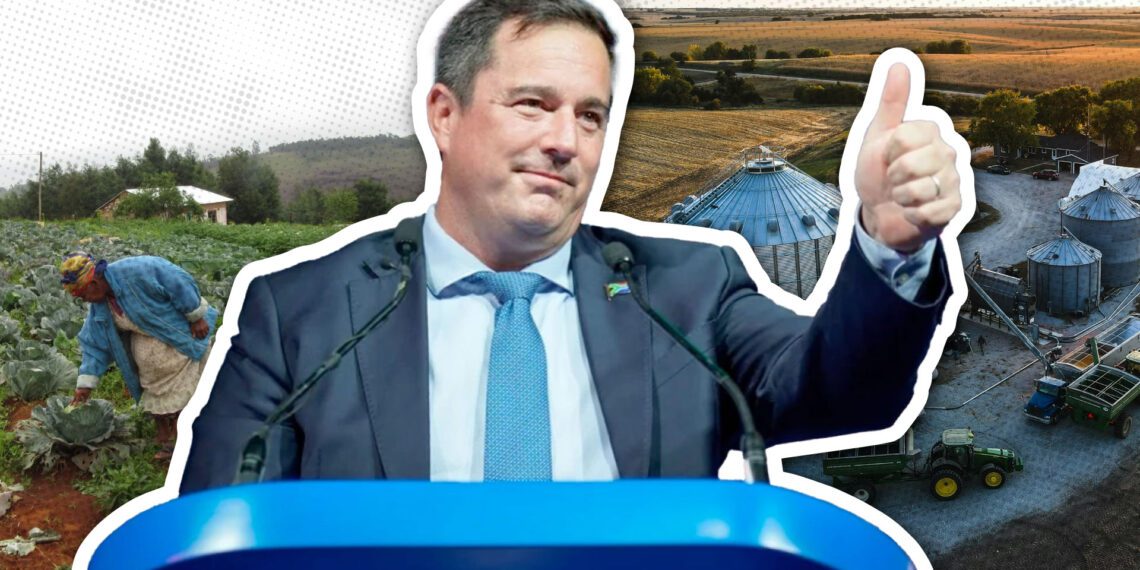
President Cyril Ramaphosa’s appointment of DA leader John Steenhuisen as minister of agriculture has sparked debate. Dr Qinisani Qwabe of Nelson Mandela University stresses that the ministerial appointment’s race should not provoke concern about apartheid-era inequalities. With this opportunity, Steenhuisen can build on the positive trajectory set by former minister Thoko Didiza, advancing agriculture with integrity.
Friend or foe? Many are asking this question after president Cyril Ramaphosa appointed John Steenhuisen, leader of the Democratic Alliance (DA), as the new minister of agriculture.

This follows the establishment of the multi-party government known as the government of national unity after the African National Congress (ANC) failed to secure a majority in the 2024 elections.
As the minister of agriculture, Steenhuisen will oversee the development and regulation of the agriculture sector, a crucial aspect of South Africa’s economy and social fabric.
Steenhuisen has held numerous leadership positions in the DA and is known for his strong advocacy for economic development. His appointment as the minister of agriculture presents potential for positive change, offering hope for a more inclusive and prosperous future for all South Africans.
Is there cause for concern?
While there was a commotion on X (Twitter) when the nation learned of Steenhuisen’s new role, it’s important to remember that change often brings uncertainty. In one of the groups on Facebook, many expressed concerns that black farmers will never benefit from South Africa’s government if whites are given power over land matters.
Although this statement is premature, considering that agriculture, and land reform and rural development are now two different ministries, it signifies a fear that most people of colour have regarding matters of land and those that govern it.
Case in point, a few decades ago, before South Africa transitioned into democracy, many land-related policies benefited the white minority and deprived the black majority. Many still believe that the reason why there is a significant economic divide between whites and blacks is because of the unjust policies and practices of the past, which gave little to no recognition to a black man.
Hence, the dualistic agricultural economy comprises well-resourced and predominantly white commercial farms and poorly resourced, predominantly black smallholdings. Such experiences are not easily forgotten and often leave permanent scars on those affected.
Vision for a sustainable future
Care must be taken, though, that South Africa is governed by a constitution that protects people’s rights.
Whether the ministerial seat is occupied by a white person like Steenhuisen or a black person like Didiza, it should not be frowned upon. It is highly unlikely that we may start witnessing a recurrence of the apartheid regime where only the white minority benefits from the system.
Considering the history and current standing of South Africa’s agriculture, Steenhuisen has an excellent opportunity to advance the agriculture sector in a positive trajectory that the former minister of agriculture, Thoko Didiza, had already started and held with great integrity.
What South Africans expect from the agriculture sector in the current era is sustainable agricultural development that will enable job creation, inclusive economic growth, food security, and responsible resource management.
The latter, in particular, is crucial for the long-term sustainability of our agricultural practices.
Furthermore, having been a part of Nampo Harvest Day earlier this year, it would be wise for Minister Steenhuisen to also live up to his words, which he shared during the event: “…a plan to make the lives of farming communities safer, and to drastically improve and upgrade the infrastructure crucial to this economic sector.”
We wish minister John Steenhuisen all the best in his new portfolio. We are optimistic about his leadership potential to address these concerns and lead the agriculture sector towards a more inclusive and prosperous future.
- Dr Qinisani Nhlakanipho Qwabe is a lecturer in the department of agricultural sciences at Nelson Mandela University. He also serves as the chairperson of the Australia-Africa Universities Early Career Researchers Network (AAUNECRsN).
READ NEXT: Agriculture seeks renewal: Agri SA calls for focus on AAMP
Sign up for Mzansi Today: Your daily take on the news and happenings from the agriculture value chain.