Great farming is not just about what happens in the field, but also what happens in the books. This was the resounding message on the final day of the Food For Mzansi Young Farmers Indaba, as financial experts pulled back the curtain on why so many funding applications fail.
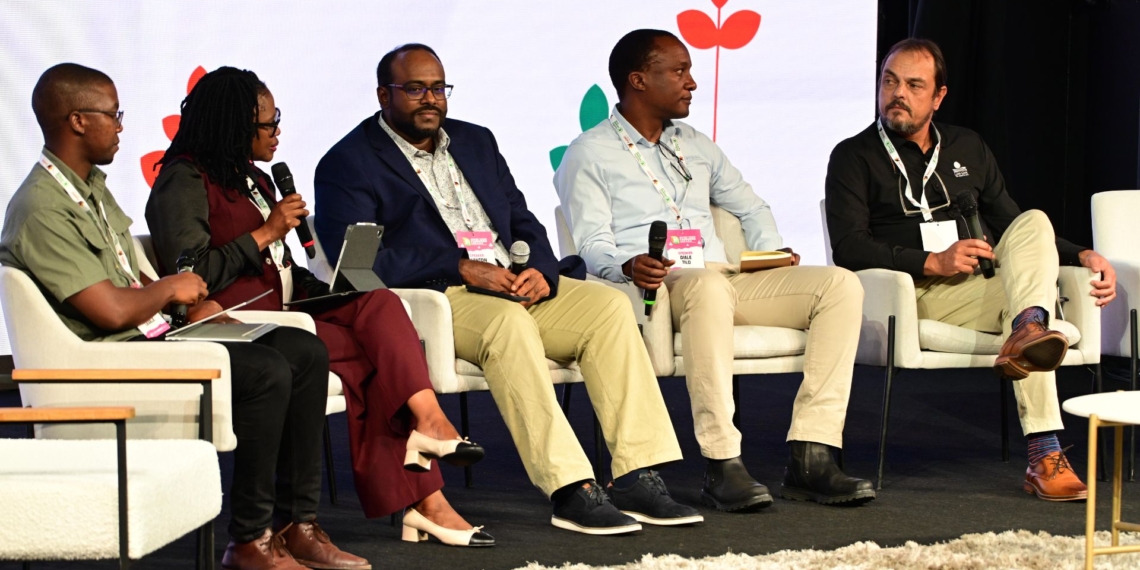
The second day kicked off with a high-stakes panel of “money moves, funding and finance hacks”, where industry leaders from the Public Investment Corporation (PIC), Kagiso Trust, and major banks dismantled the myth that there is a shortage of capital in South African agriculture.
Moderated by broadcaster and producer Mmatsheko Mosito, the discussion shifted the focus from the science of farming to the business of production, highlighting that the primary barrier to entry is often a lack of readiness rather than a lack of funds.
Related stories
- Land reform: How the private sector can bridge the funding gap
- Rethinking farm funding: MEC calls for smarter financing models
- Agri leaders urge farmers to think beyond production
- Energy and innovation ignite 5th Mzansi Young Farmers Indaba
The compliance hurdle
Addressing the common perception that funding is difficult to access, Keneilwe Nailana-Mabona, agriculture sector specialist at the PIC, shared that capital is plentiful.
“Funding is not a problem; South Africa has enough capital. Unlocking that funding is actually the challenge because there is compliance,” she said.
Nailana-Mabona warned that many young farmers approach institutions before their paperwork is in order. “You find that by the time you approach an institution, your paperwork is not in place, financials are not in place, and water licenses are not even ready.”
She advised farmers to ensure every department of the farm meets compliance checks before seeking investment.
For Desry Lesele, senior manager at Nedbank, the transition from farmer to business owner begins with a mindset shift. He challenged delegates to ask themselves if they truly regard their operations as “bankable”.
“Bankability needs an understanding of your core structure, taking your farm as a business instead of a hobby,” Lesele stated. He added that banks scrutinise financial behaviour, such as whether a farmer pays themselves a salary. “The willingness to improve over time assures the banks that one is to be trusted.”
Getting numbers and readiness in order
Smit de Wet, relationship manager at Land Bank, simplified the banker’s perspective, noting that applications usually get stuck at the documentation stage.
“A banking decision for a banker is simple: we check if you can repay, if there is security, and what your debt is going to be,” he said.
He added that blended financing schemes, partnerships between government departments and banks are increasingly available to help new entrants navigate this journey.
Quinton Naidoo, socio-economic development head at Kagiso Trust, echoed these sentiments.
“What I have seen is that we do not reject farmers we end up having to reject a non-structured idea. And it’s a case of readiness, I think. We looked at the majority of the farmers that succeeded in our system, they are part of a group they do not succeed as one; they have support systems that help them with compliance and with getting these things done,” he said.
Meanwhile, Diale Tilo, executive director of the Kgodiso Development Fund, explained that starting a farming business requires a proper assessment to ensure it can provide a good standard of life.
“Farming needs to be approached as a family business to the extent that it is generating income for sustainable livelihoods,” Tilo said.
He encouraged young farmers to use industry experts to help put their objectives on paper. “Once you’ve figured all that out, you can start determining what resources, mechanisation, and infrastructure you need to achieve the objectives of the crop and the farm.”
READ NEXT: No market access, no future: The heavy cost of FMD