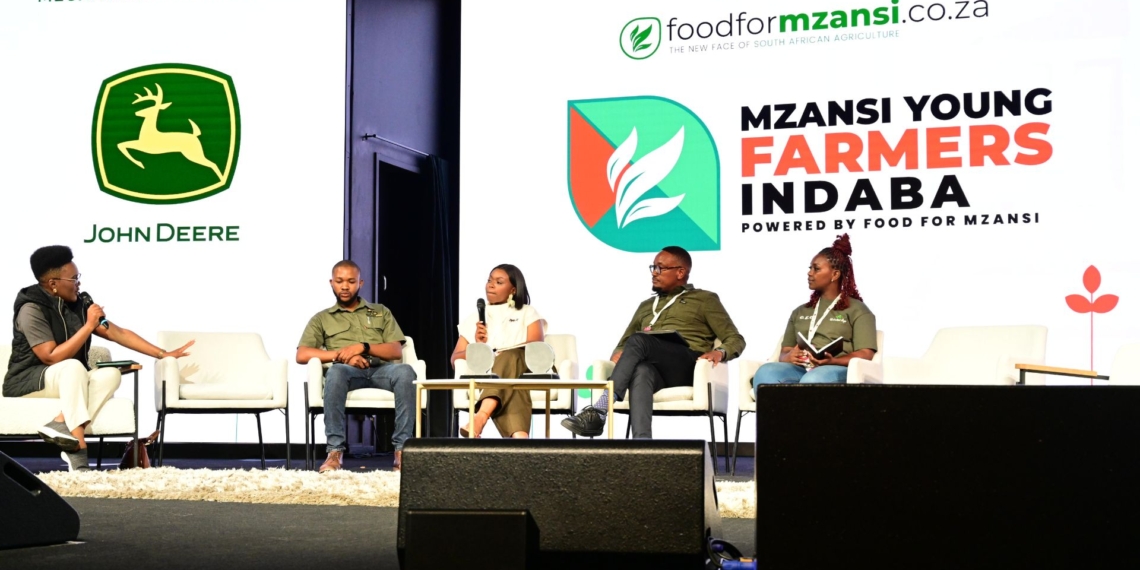
The struggle to secure land, find mentorship, and penetrate competitive markets took centre stage on the first day of the Food For Mzansi Young Farmers Indaba, in Moretela Park, Pretoria East. A panel of trailblazing agripreneurs discussed the grit required to turn ambitious dreams into thriving businesses.
The opening session, titled “Young, bold and farming forward”, highlighted the real-world breakthroughs of producers navigating a sector where structural barriers often stall growth.
The discussion focused on how new-era farmers like Motshidisi Modise, Dibesho Serage, Nompumelelo Sibalukhulu, and Thabo Dithakgwe are claiming their stake in the industry.
The battle for land and tenure
Addressing the complexities of land ownership, Modise, who currently operates her business on leased plots, called for more robust institutional support. She said that when discussing land, Land Bank and other similar institutions need to intensify their efforts in assisting young people to transition from beneficiaries to owners.
Related stories
- Energy and innovation ignite 5th Mzansi Young Farmers Indaba
- Lesotho farmers are joining the 2026 Mzansi Young Farmers Indaba
- What a ride! Young farmers hail life-changing indaba
- SA citrus industry eyes record season amid global headwinds
Modise added that her ultimate goal is to become a “title deed girl” because of the inherent risks of leasing. She shared a recent experience where her crops were hit by hail, noting that despite the financial loss, the landlord still required rent.
“I needed to think of how I cover that up,” she said.
Similarly, North West cattle farmer Dithakgwe, who is commercialising his operations on land funded by Land Bank, noted that the cost of running a commercial business is a constant hurdle.
He said the challenges include managing high operational costs with minimal livestock numbers. “Farming is a numbers game; you need to push numbers, and you need to be realistic.”
Sibalukhulu said that while she is still leasing the land she works on, she is hopeful that soon she will operate on the land she owns. She advocated for young farmers to be given a fair chance at being food producers.
Serage, who transitioned from a corporate career at companies like SAB to founding the Groundstone Group, emphasised the importance of bringing professional experience to the field. He said he entered the sector knowing farming was a “production business” and utilised his previous experience to ensure operations were handled correctly.
“When I started my farming enterprise, I was still in corporate because I had to wait for the trees to grow and I had to put food on the table,” he said. He eventually left his corporate role to focus on farming full-time, noting the importance of having a strategic plan rather than entering the sector blindly.
Managing rising operational costs
To combat the pressure of rising input costs, the panellists highlighted the need for financial discipline and collaboration. Modise added that being critical of financial planning, detailed budgets, and cash flow projections is essential for survival.
She shared that her farm had created a community with neighbouring farmers to bulk-buy seedlings, seeds, fertilisers, and chemicals to reduce costs.
“We also hire each other’s machines and equipment that we need,” she said, adding that they also focus on fuel efficiency through better machinery scheduling.
Rounding off the technical advice, Serage stated that attention to detail was a key differentiator in the market. He noted that simple factors, such as maintaining consistency in the size and colour of packaging, should never be overlooked by young producers looking to compete.
READ NEXT: Competition Commision report: Prices drop at farm, but not at tills