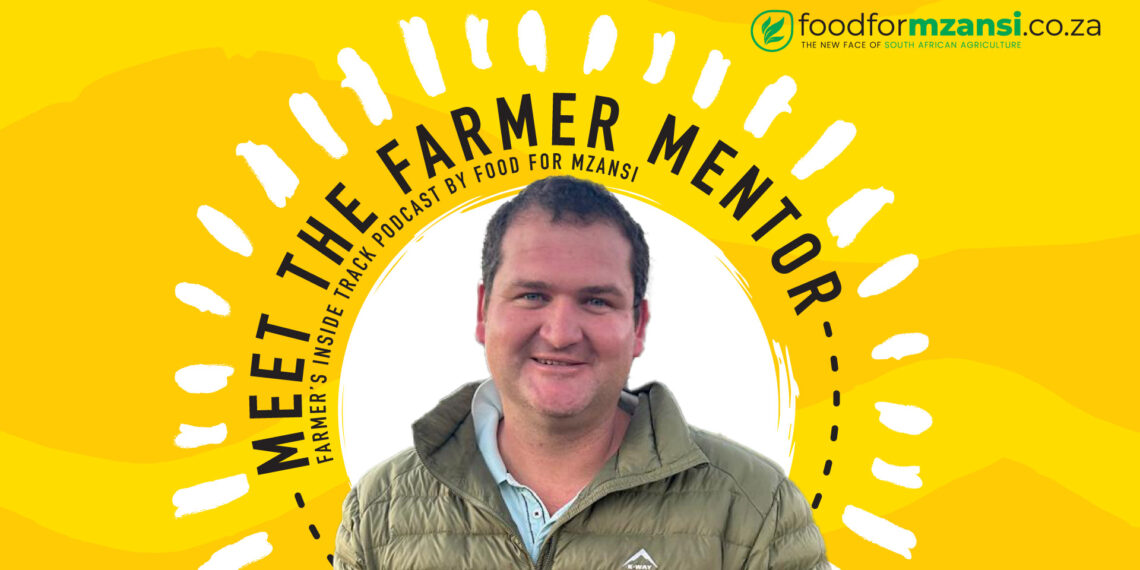
Meet Jurie Giliomee, the man who treats farming like fine art. With a “seven-day rule” and a dash of FOMO for data collection, he’s farming smarter, not harder. He shares his innovative approach to farming in our Farmer Mentor podcast series on Farmer’s Inside Track.
Jurie Giliomee, a fourth-generation farmer rooted in the rolling fields of Bredasdorp in the Western Cape, lives by two steadfast principles on his farm. His approach might strike some as a bit obsessive, but there’s logic behind it.
His family farms canola, wheat, barley, and oats. His aim is simple yet ambitious.
“One of my goals is to try and do everything in that optimum seven days, and then farm as predictably as possible. If I know what my yield is going to be at the end of the year, then I know exactly what I can spend on the crop to not overspend or underspend.”
Giliomee lives by a “seven-day rule”. He believes there are three days to act too early and three days to act too late, leaving a critical seven-day window for each major task.
“If you can make all your big decisions within those seven days, you’re likely to succeed,” he says. “This applies to everything: the day you plant, the day you harvest, the day you spray, the day you market your grain, the day you wean your lambs.”
Success, he explains, isn’t about spending the most money; it’s about making each decision or taking action as close as possible to the ideal time.
Weather changes may prevent perfect timing, he admits, but staying within that seven-day window greatly increases the odds of success.
A bittersweet legacy from two brothers
Giliomee farms alongside his father on their family-owned and operated farm. Their story goes back to 1947 when his great-grandfather bought the property.
“It was actually a bittersweet beginning: the farm was originally run by two brothers, but one pursued accounting instead of farming while the other, who had taken charge of the farm, was tragically killed in World War II.”
With neither brother able to continue the operation, they put the farm up for auction after the war, and that’s when his great-grandfather stepped in and bought it.
“Today, I handle about 90% of the daily work myself. But when it comes to business planning, it’s a joint effort between my dad and me – a true 50-50 partnership. Any decision to try something new is made together, but the day-to-day running of the farm is mainly my responsibility,” Giliomee explains.
Related stories
- Piet’s 40-year odyssey: From adversity to canola innovation
- Growing with God drives Happy to great heights
Every day feels like a seaside holiday
Farming five kilometres from the sea comes with its own set of challenges and advantages.
“Every day is like a sea holiday for me,” Gillomee jokes. “The main positive about it is that we are a bit cooler than the guys farther from the sea.”
If a hot day is forecasted for the weekend, it is typically two or three degrees cooler where he farms. During the grain fill stage, those slightly cooler temperatures help maintain yield even if they get a few warm days. However, this also means a shorter window to harvest the crop at the right dryness, which can be challenging.
“A normal harvest day for us would be from, say, 11 in the morning till maybe six or seven at night, where the guys 10 or 20 kilometres from us will probably start at nine o’clock and continue until 11 o’clock in the evening,” he explains.
In most years, his challenge is not too little water; it’s waterlogging – getting too much water.
Fear of missing out
Giliomee is excited about what data holds for the future. Data, he believes, is the new gold.
“I have a bit of FOMO when it comes to collecting data. I’m constantly worried I might miss something important. I’d hate to look back in five years and realise we could have used certain data, only to find we didn’t collect it. So, right now, I’m saving everything I possibly can,” he shares.
Their main focus right now is on soil data and yield data. Weather data, he explains, is tricky. It gives information but it’s hard to act on it directly.
“Data really helps with decision-making. In the old days, you’d drive through the field on a bakkie or quad, but you might miss certain issues.
“With satellite images, you can spot problem areas more easily and go directly to those ‘hot spots’ when scouting for issues like disease, pests, or nutrient deficiencies. Then you can take targeted action to address the problem,” he explains.
Giliomee has spent 13 years on the farm and enjoys using new gadgets and technology. He has tried to modernise their operations as much as their budget allows.
“Right now, I don’t have a specific goal to expand by another 1 000 hectares in ten years, although that would be lekker,” he laughs. “My main objective is to be more efficient each year than I was the previous year.”
“So far, we’ve made progress – maybe not always as much as I’d hoped, but I’m confident we’re headed in the right direction,” he says.
Want to know more? Listen to the full episode of Farmer’s Inside Track.
Option 1: Click here to listen on Spotify (all mobile and other devices).
Option 2: Click here to listen on any Apple device.
READ NEXT: Zabion’s master plan: Diversify to thrive and reach the top
Sign up for Farmer’s Inside Track: Join our exclusive platform for new entrants into farming and agri-business, with newsletters and podcasts.