While the ban on flights from South Africa to countries across the globe is not expected to affect agricultural trade, it will be another bad blow to agri tourism. It is also expected to restrict South Africans from taking advantage of job opportunities abroad.

Christo van der Rheede, executive director of Agri SA, says the travel ban will not impact imports and exports to and from South Africa. He explains that trade continues despite lockdowns thanks to agriculture being considered an essential service.
“The only issue we have is the logistical issue in many of our harbours that is caused by the shortage of shipping containers.”
Dr John Purchase, chief executive of the Agricultural Business Chamber of South Africa (Agbiz), concurs that travel bans will not impact trade.
“The only thing affecting our exports is the shortage of shipping containers and vessels globally.” As China had experienced a massive blockade because of onerous and strict Covid-19 regulations, the subsequent unavailability of shipping containers, especially in South Africa, will negatively impact the upcoming export season for table grapes and stone fruit.
“Vessels are also being held up in ports because the ports can’t manage the flow of goods,” says Purchase.
Impact on tourism industry and farmworker interns
“[Although] the banning of flights from South Africa to other countries or the other way around won’t have an impact on trade, it will have an impact on tourism,” Van der Rheede warns.
He says farmers who run guesthouses, wine farms and game reserves will particularly be impacted by the travel ban because they usually look forward to an influx of international guests this time of year.
They will be among the tourism destinations that have already lost over R1 billion in travel bookings for December through to March, according to a snap survey of 600 members of the Federated Hospitality Association of South Africa (Fedhasa).
Fedhasa and Satsa, representing the local tourism industry, say if travel bans remain in place, based on the cancellations to date, respondents would lose 78% of their previously expected business levels for the period December to March.
In the Western Cape, premier Alan Winde said in a press statement on Wednesday (1 December 2021) that 77% of more than 600 tourism destinations in the province have had cancellations from clients for December 2021, 59% had cancellations for January and 31% had cancellations for February.

Meanwhile, farmworker interns who were meant to travel to the USA, Australia and New Zealand for training may also not be able to acquire visas to those countries if the travel ban is extended, says Judy Stuart, founder of the Future Farmers Foundation.
The number of visa cancellations expected to the United States is unsure, but travel to Australia and New Zealand is definitely off the cards, she says.
“It’s not something we are particularly delighted about. On the other hand, those countries are trying to protect themselves against the variant. But I also don’t think it is a ban that will be in existence for very long because I think they just want a couple of weeks to learn about the Omicron variant,” she says.
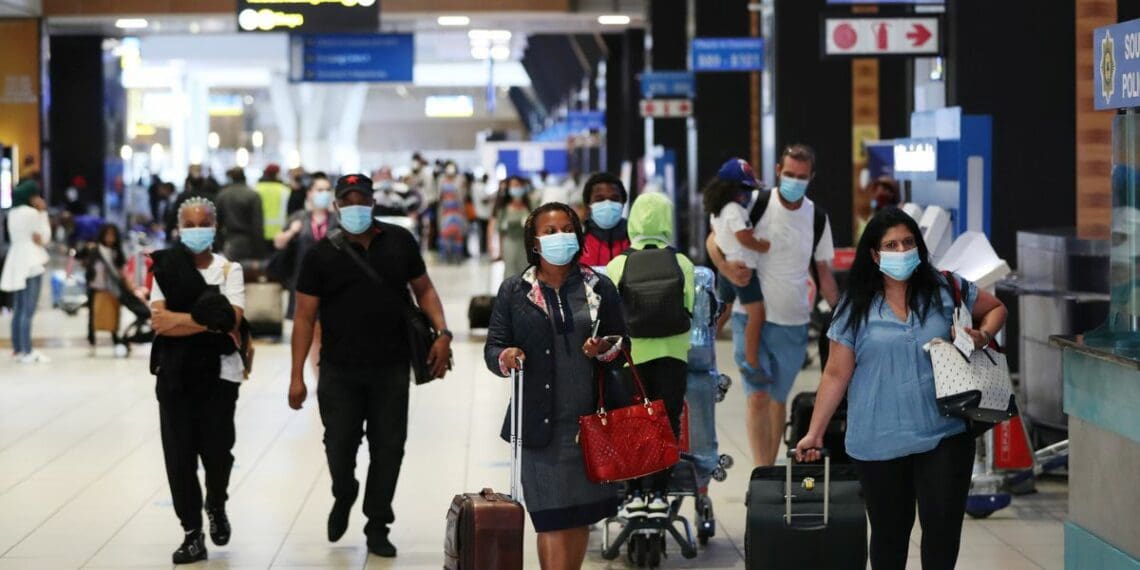
South African travellers were banned from travelling to dozens of countries after the detection of the new Covid-19 variant Omicron.
A ban by the United Kingdom was followed by bans by the United States, European Union, Seychelles, Japan, Turkey, Singapore, Israel, India, Germany and the Netherlands. Also on the list is Canada, Australia, Sri Lanka, Oman, Thailand, Brazil, Guatemala, the United Arab Emirates, the Philippines, Rwanda, Angola, Egypt and Mauritius.
South Africa’s department of international relations and co-operation (Dirco) announced on Sunday (28 November 2021) that the UK High Commission had informed them that British Airways would resume direct flights to SA from Tuesday. The remaining countries are maintaining their ban for now.
ALSO READ: Job losses: a need for farmworkers with specific skills
Sign up for Mzansi Today: Your daily take on the news and happenings from the agriculture value chain.