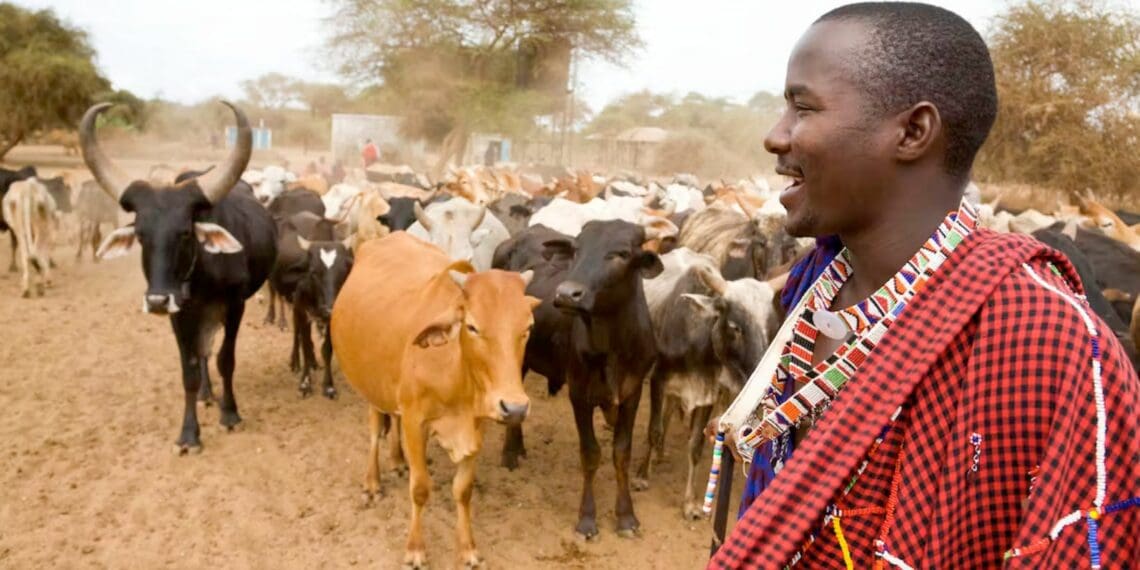
Pastoralists are livestock keepers who are frequently on the move, sometimes across huge distances. Following mobile lifestyles and living far from centres of power, they are often inaccurately dismissed as backward and in need of modernisation.
Many policies are directed at transforming mobile pastoralists into settled agriculturalists or urban dwellers. This aims at recasting them into the dominant image of “civilised” living. And, despite their positive contributions to livelihoods, economies and the environment, the world’s many millions of pastoralists have been vilified as contributors to climate change and destroyers of the environment.
I am a social scientist with a background in ecology. For more than 30 years I have been researching land, livelihoods and agrarian change, mostly in sub-Saharan Africa. Contrary to the dominant, negative views on pastoralists, research in six countries across three continents over the past five years has shown how pastoralism is an innovative, flexible and productive system that can handle uncertainty and adapt to change while contributing to climate change mitigation and improving biodiversity.
Our research is explored in a new open-access book, published with my co-researchers from across the world. It highlights how effective pastoralists are at living with variability and responding to uncertainties. Of course, there are limits to such flexible and adaptive responses. Pastoralists are vulnerable to exclusions due to land grabbing, energy projects and urbanisation. Political decision-making can also marginalise them.
1. Embracing uncertainty and change
We live in a complex and uncertain world. Whether it’s due to climate change, market volatility or pandemic outbreaks, we don’t know what the future will hold. Old certainties have disappeared, and expectations of stability, order and control are no longer tenable. This requires a very different approach centred on flexibility, improvisation and adaptability.
It means shifting from “seeing like a state” (or a corporation, bank or development agency) to “seeing like a pastoralist”. This involves embracing uncertainty, complexity and dynamic change.
2. Mobile lives
Mobility is central to pastoralists’ production strategies. With highly variable resources over space and time, moving between grazing patches is essential. This requires skilled herding, the training of animals and intelligence on where fodder and water can be found. Traditional practices are combined with modern technologies for scouting and gaining information, based on deep knowledge of animals and the environment. Overall, the ability to respond flexibly to changing circumstances is essential.
The result is that pastoralists make use of otherwise unproductive rangelands across more than half the world’s land surface and they are immensely skilled at living with diverse environmental, market and political uncertainties.
Our work shows that flexible mobility is crucial for everyone, everywhere in today’s uncertain, turbulent world. We argue that learning from mobile pastoralists – from the savanna plains of Africa to the semi-deserts of the Middle East and North Africa, the steppes and high mountains of Asia and the hills and mountain areas of Europe – enhances our ability to be mobile.
3. Global markets and trade
Pastoral systems are always embedded in markets and trade. Many of the great historical trade routes – across the Asian steppes, through the Sahara desert and from eastern Africa to the Arabian peninsula, for example – have been facilitated by pastoralists.
Pastoralists are no strangers to cross-border trade and globalisation, contrary to negative narratives that suggest that they reject markets and commercialisation. However, the markets that are so central to pastoralists’ livelihoods are not the simple ones described in economics textbooks.
Our work in Sardinia, Italy shows how pastoralists engage with informal “real markets” to confront market volatility and uncertainty. Such markets are forged through networks of social relationships, allowing for flexibility when the formal markets for sheep’s milk face price crashes.
Important lessons emerge more generally. In surprising ways, pastoralists’ responses to market volatility echo those of bankers and financiers facing financial crises. Instead of technical risk protocols and regulations, a more social, networked basis for trust-building as the basis for managing economic uncertainty, and so averting financial crises, is required.
4. Disaster and emergency management
Pastoral areas face constant shocks and stresses ranging from drought, floods, heavy snowfalls, diseases, conflicts and more. In northern Kenya, networks of highly skilled pastoralists mobilise knowledge, technology and finance during times of crisis, helping to prevent disasters. Such people may include local forecasters who give a sense of what weather might be in store. They could be scouts on motorbikes scoping out new grazing areas, checking for conflict and other dangers.
Further work in northern Kenya demonstrates how pastoralists survive, thrive and respond to uncertainties through asset redistribution, comradeship, diversification and collective responses to protect their livelihoods from external threats. All this suggests new ways of going about disaster planning and humanitarian response.
5. Rethinking land access
The urge to demarcate, register and control land is strong, as this is the model frequently used in settled agricultural contexts. But this can be disastrous in pastoral areas, restricting movement and so undermining the very basis of pastoral production.
The obsession with private property, individualisation and a market-based approach to land management is anathema to pastoralists, where hybridity, collective arrangements and continuous negotiation of resource use are central.
As our work in Amdo Tibet in China finds, taking such an approach to land governance seriously disrupts the standard models that dominate policy-making.
A lifeline to the future
A world without pastoralists would be a poorer place materially, environmentally and culturally. And we would lose a lifeline to the future, where we can learn how to live with and from uncertainty, just like pastoralists have always done.
This article was first published on The Conversation and written by Ian Scoones.
READ NEXT: Not enough farmers are drought resilient
Sign up for Mzansi Today: Your daily take on the news and happenings from the agriculture value chain.