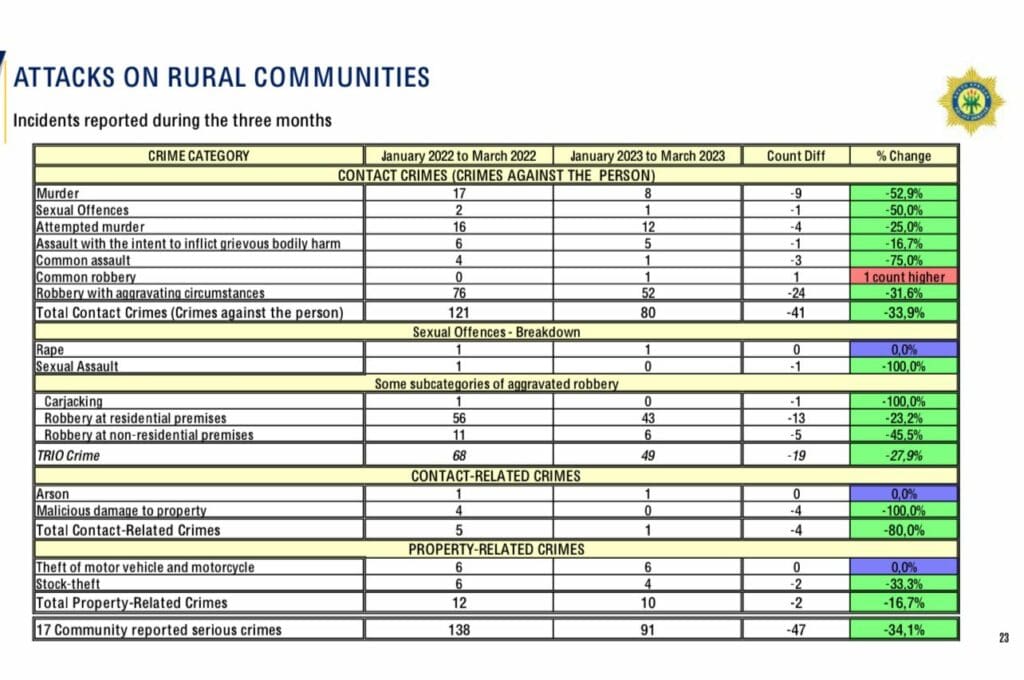
South Africa has seen a rise in farm murders and attacks in the past few months. The latest statistics revealed that over five provinces in South Africa have experienced farm violence in the last week of July.
Petrus Sitho, who heads the organisation PPS Stop Farm Murders, said farm attacks in the country have been on the rise for the past months and the government needs to be actively involved in stopping the attacks to safeguard jobs and food security.
According to Sitho, the Economic Freedom Fighters leader Julius Malema’s recent chant of “Kill the Boer, Kill the Farmer” has made matters worse, and he has called on President Cyril Ramaphosa to act on the matter.
Sitho told Food For Mzansi that South Africans need to be educated and not brainwashed by politicians who “advocate” hate speech, racial discrimination, and murder.
“We need our farmers and farmworkers. If we continue down this path, we will be heading into food shortages, starvation, and more crime as a result of this. I will continue raising awareness, and exposing this evil, and it is working, we are seeing that our message is reaching other countries who are starting to take note of what the reality is for the people living in this country,” he added.
ALSO READ: Agri sector sees red as EFF celebrates ‘vile’ song
What government should be doing
Meanwhile, Southern African Agri Initiative (Saai) chief executive officer Theo de Jager said that he and his team believe that the government treats farm murders as if it is a mere extension of the runaway murder rate in South Africa.

“That is a mistake. There are important angles to farm murders that distinguish them from other murders. A specialist unit should be established that can also take pre-emptive action through intelligence linking,” De Jager said.
“It is unforgivable that after 15 years no progress has been made with regard to the commitment by the police following the dissolution of the commandos, namely to establish a reservist force,” he added.
Expectations from government
Agri SA centre of Excellence rural safety chairman Uys van der Westhuijzen said that the issue of farm attacks on farmers and workers in South Africa is a complex and sensitive one, with significant implications for the affected communities and the country as a whole.
He told Food For Mzansi that the importance of addressing and stopping these attacks is multifaceted and involved humanitarian concern, food security, economic impact, social cohesion, rule of law and justice, and international reputation.
“Agriculture plays a vital role in South Africa’s economy and food production. Attacks on farmers and farmworkers can disrupt agricultural activities, potentially leading to a decrease in food production and affecting food security in the country.
“Farm attacks can deter investments in the agricultural sector, leading to reduced productivity and economic growth. Furthermore, the destruction of property and theft of assets can have severe financial consequences for affected farmers and workers.
“Ensuring justice for victims of farm attacks is crucial to upholding the rule of law and maintaining public confidence in the country’s legal system. It sends a message that violence will not be tolerated, and perpetrators will be held accountable,” he said.
Government urged to step up efforts
Agri SA has called on the government to step up their efforts in addressing the farm attacks as they have got a likelihood of creating uncertainty and fear in the country.

“To effectively address farm attacks, it is essential for the government to implement comprehensive strategies that focus on improving rural security, enhancing law enforcement efforts, and addressing underlying socio-economic issues that may contribute to crime,” said Van Der Westhuijzen.
“Additionally, promoting dialogue and understanding between different communities can contribute to reducing tensions and preventing violence.”
He said it was important to note that discussions around farm attacks are often sensitive and can be influenced by political, social, and historical factors.
“Any comprehensive approach to tackling this issue should consider the complexities and involve various stakeholders, including farmers, farm workers, communities, law enforcement, and government representatives. Exactly as stated in the National Rural Safety Strategy,” he said.
Farm attacks are becoming too common
Van der Westhuijzen added that farm attacks in South Africa have been a matter of concern for many years. These attacks often involve robbery, assault, and, in some cases, murder.
“While farm attacks are not unique to South Africa and can happen in other countries as well, they have been a specific point of concern in the context of South Africa due to various factors, including the country’s history of racial tensions and socioeconomic inequalities.
“One of the main differences between farm attacks in South Africa versus elsewhere is the brutality of some of these attacks. People are sometimes tortured for hours and then murdered. This matter is of grave concern to Agri SA,” explained Van Der Westhuijzen.
Extensive to-do list
“It is Agri SA’s view that a few key aspects of the National Rural Safety Strategy as discussed at the summit in June 2023, must be agreed on as the starting point in implementing it more effectively,” he added.
According to Westhuijzen in addition to the reservist system, there is a need for more effective criminal investigations, an emphasis on suspect detention paired with the opposition of bail by the police, effective crime intelligence and crime analysis, and the creation of police task teams and rapid response units in hot spot areas.
“Until these measures are implemented, it is unconscionable to expect more from rural communities when the government has not come to the party,” he said.
READ NEXT: Cry for help: Extension officers ‘thrown under the bus’
Sign up for Mzansi Today: Your daily take on the news and happenings from the agriculture value chain.