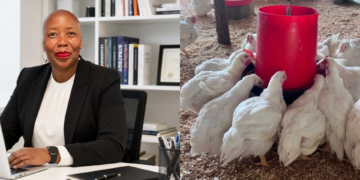
How do you build a resilient farm? In this Farmer Mentor episode, Jeremiah Jotham, founder of Basadi Agribusiness, shares how diversifying into rabbit production, horticulture, and abattoir services created a circular, profitable model in Gauteng.
For Jeremiah Jotham, a career in agriculture was not part of the original plan. His journey began in 2012 when, while studying social work, he took a job as a general worker at an abattoir, carrying out basic temperature control and quality checks. That experience eventually changed the direction of his career.
After working at both larger and smaller abattoirs, Jotham gained experience across production, dispatch and quality management, while developing an interest in owning a black-owned abattoir.
Today, he is the director of Basadi Agribusiness, a diversified operation in Carletonville, Gauteng, that combines livestock processing, rabbit production, horticulture, abattoir services and consulting. The business was registered in 2019 and gained momentum after Jotham took over a leased abattoir around 2023.
Rather than relying on a single product or market, Jotham has focused on developing complementary income streams around the business’ infrastructure and resources.
Related stories
- Scaling to success: Moleke Maphila’s path from student to farmer
- Simphiwe Hlubi: Why multi-stream income is the future of farming
- Matjee Mokgoadi is turning Limpopo farming into serious business
- No limits: Charlotte Mosena builds farm-to-table legacy in Gauteng
Diversification drives profitability
Rabbit production remains an important part of the operation, but the facility can also process ducks, quails, turkeys and chickens. The abattoir is open to the public, creating an additional income source that helps sustain the facility.
The roughly nine-hectare property also includes spinach and kale production. Water and by-products from the abattoir are incorporated into the broader farming operation, supporting what Jotham describes as a more sustainable and circular approach.
For farmers looking to grow, Jotham says the first step is understanding the volumes required for an enterprise to become profitable.
“If it is going to take you two or three years to reach a point where you can scale up and become profitable, look at what else you can do with the resources you already have.”
At the abattoir, for example, water is used in processing while the available land supports horticulture. Developing related activities can shorten the time before a business becomes profitable, rather than waiting for one enterprise to carry the entire operation.
Jotham has also identified niche markets for rabbit products, including the pet food market, where demand for raw and specialised ingredients has created an additional outlet for rabbit production.
Related stories
- Rabbit farming: How to get started and hop into success
- Understanding the Meat Safety Act: What farmers must know
- Poultry farmers: A guide to selling to abattoirs
Value of partnerships and agroprocessing
Partnerships have also helped expand the business. Jotham says one client provided a loan of less than R100 000, which enabled the business to service its delivery truck and establish irrigation.
The arrangement benefited both parties: the client gained access to fresh meat and vegetables while the farm received support to strengthen its operations.
While value addition can create new markets, Jotham cautions farmers against rushing into processing before the primary enterprise is profitable.
Advanced processing requires appropriate infrastructure, hygiene and sanitation systems, protective clothing, audits and certification. These requirements bring additional costs that must be sustained over time.
“Become profitable in your primary agriculture first and then move into secondary processing,” he advises. “Processing can be more rewarding, but the risk is also higher.”
For Jotham, a processing facility should therefore be viewed as a tool for generating income rather than the business itself.
“Volumes, volumes, volumes,” he says, stressing that a facility can only remain viable if there is enough throughput to cover wages, maintenance, certification and other fixed costs.
Continuous improvement for growth
Jotham identifies three principles that have guided his business: continuous improvement, operational efficiency and partnerships.
The operation currently supplies spinach and kale to clients, with demand reaching about 1 500 bundles a week. To strengthen year-round supply, the business has acquired four greenhouses through a partnership, while considering increasing production and eventually supporting further value addition.
For Jotham, growth ultimately comes from building a track record, using available resources efficiently and forming partnerships that strengthen the business.
“Once you are able to become fundable and you are funded, you are in a position to scale up your business,” he says.
READ NEXT: African swine fever: Biosecurity rules every pig farmer must follow