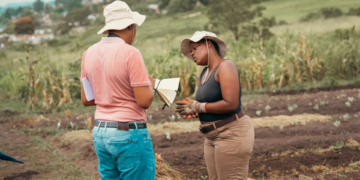
Amid growing concern over the abandonment of field cultivation in rural South Africa, a new research report by Dr Mzingaye Brilliant Xaba and Dr Siphe Zantsi shines a spotlight on one of the country’s more promising interventions.
Titled “Back to the fields: The implementation and impact of government efforts to revive field cultivation in Ndabakazi in the Eastern Cape”, the study closely examines the Zanentlutha programme. This is a maize cultivation initiative that has been quietly sustaining farming in the Ndabakazi villages for more than a decade.
The programme, which began in 2014 with over 60 members and now comprises 32, operates as a primary co-operative. It combines government mechanisation support with member contributions to revive maize farming in the region.
According to the researchers, the state covers approximately 60% of production costs, while members pay a yearly fee of around R3 000 per hectare.
“The Zanentlutha programme has been able to stimulate field cultivation for eight years and seems to be making a modest contribution to household income, food security and local youth employment,” write Xaba and Zantsi in the Journal of Southern African Studies.
Related stories
- Eastern Cape: Unlocking the agri potential of the land of legends
- Eastern Cape farmers’ day empowers through collaboration
Zantsi is a researcher at the Agricultural Research Council and a scholar in sustainable food systems at the University of the Free State. Xaba is based at Stellenbosch University and the National University of Lesotho, focusing on health equity and inclusive development in Southern Africa.
“Although all these contributions are seasonal, it could arguably be regarded as one of the few promising success cases of government initiatives aiming at revamping field cultivation.”

Bottom-up, not top-down
Unlike previous state-led programmes like Fetsa Tlala and the Massive Food Production Programme, which the researchers criticise for being largely top-down, Zanentlutha has fostered local ownership.
“What also comes out strongly from the Zanentlutha programme is its members’ sense of agency and proactively taking charge of their own development,” say Xaba and Zantsi.
They credit the programme’s relative success to “the passion for farming from its leaders” and a hybrid governance approach that integrates community effort with state support. Members are not passive beneficiaries; they co-finance and co-manage the operations, hold regular meetings, and plan future activities.
However, the researchers caution that the programme is not without its flaws.
“Zanentlutha does not appear to be pro-poor, a trait it shares with other smallholder initiatives,” they argue. With its high member contribution threshold, many poorer households – who mostly rely on state grants – are excluded. “Founding members and those with higher incomes tend to have more hectares than poorer households.”
The report recommends differentiated support from the government to cater to both middle-income and poorer rural households. Drawing on the work of agricultural scholar Ben Cousins, the authors stress the importance of targeting the 150 000 to 200 000 commercially oriented smallholders rather than the millions of subsistence farmers.
Limited youth participation a looming threat
One of the most significant threats to the sustainability of Zanentlutha, the study finds, is the lack of youth involvement.
“Despite Zanentlutha’s modest contribution to household livelihoods, the fact that youth participation is very limited jeopardises its sustainability as current members are all over 50 years old,” note Xaba and Zantsi.
They suggest that attracting young people to farming in the Eastern Cape will require “100 per cent start-up capital, appropriate practical training, and linkage to markets so that initiatives can create decent and sustainable livelihoods comparable to work in the non-farm sector.”
More support, smarter subsidies
One of the core recommendations from the researchers is to introduce input subsidies that ease the financial burden on participants. “We observed that high input expenditure cripples dividends or profit margins,” they state. They propose bulk input procurement – especially of seed and pesticides – and linkages with agri-parks to enhance the local economy.
Using Malawi’s subsidised smallholder maize production as a case in point, the authors argue that “if South African smallholders residing in the former homelands and on transferred land produced the same amount of maize (or alternative crops) as Malawi in 2021, the value generated… could have been in the region of R12 billion, equivalent to half a million pensions.”
READ NEXT: Maize: Choosing the right varieties for local conditions
A case for bottom-up reform
Ultimately, the success of Zanentlutha – though limited and uneven – offers valuable insights into how state-supported agricultural projects might better serve rural communities.
“We emphasise bottom-up approaches as a way of stimulating and sustaining agricultural production because people want to be at the centre of projects that are meant to empower them,” Xaba and Zantsi conclude. “Properly calculated interventions anchored on consultation and clear understanding of communities stand a good chance of succeeding.”
As South Africa continues to grapple with food insecurity, unemployment, and deagrarianisation, the findings from Ndabakazi suggest that revitalising rural cultivation isn’t just about returning to the land, but rethinking how the journey back is paved.
READ NEXT: Black dairy farmers build legacies, but face market crisis
Sign up for Mzansi Today: Your daily take on the news and happenings from the agriculture value chain