Yvette Abrahams has an interest in indigenous life. It started when she was very young. After completing a doctorate in indigenous knowledge systems at the University of Cape Town, she decided to put all she learned into practice by starting her own business with indigenous personal care products.
“I was researching indigenous economic transit at the University of Cape Town, or to be more precise, I was writing on the history of western science from the point of view of indigenous knowledge systems. Nobody really cared. I mean, that was 20 years ago,” she laughs.
“I got a bit tired of just reading about the plants. I didn’t feel like producing any more papers, and so, somewhere around 2005 I said, ‘Well, let me actually do this. I want to plant the plants. I want to make these products that I’ve been reading about’. And so that’s how it started. I left the university and bought a farm in Gordon’s Bay.”

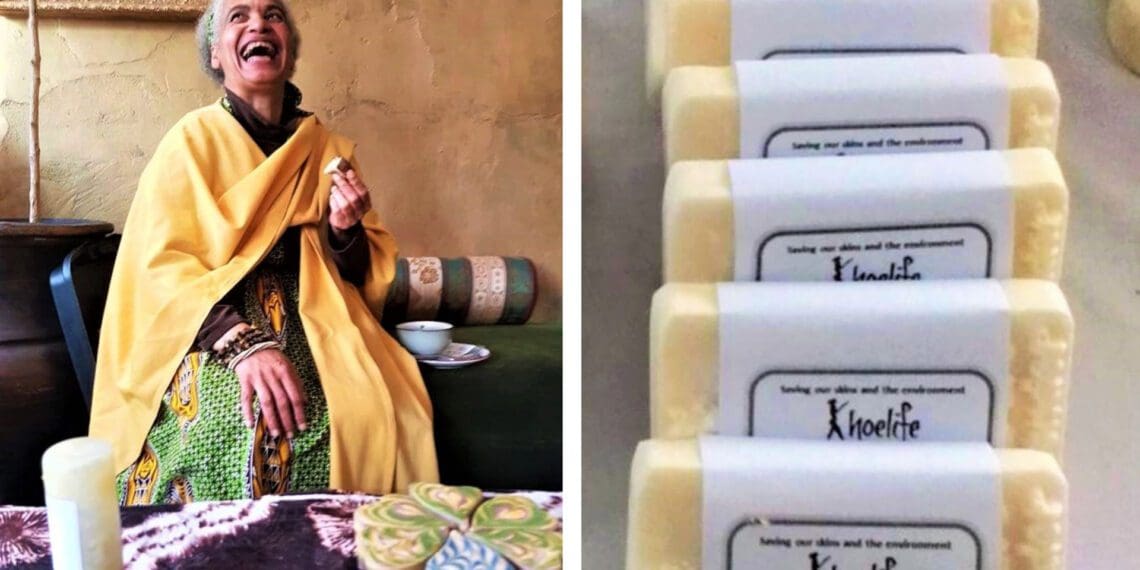
Abrahams’ business is based in the Western Cape and is called Khoelife. From her smallholding, she produces soaps, hand sanitisers, body oils and other personal care products. The products are all natural and are made up of plants she farms herself, as well as plants she sources from other producers.
“I couldn’t possibly grow all the plants. I mean, some just don’t like my climate. Like buchu for instance. Buchu likes to grow on the mountains. It’s just not happy in Gordon’s Bay. I killed 35 buchu plants, arguing with it and saying, ‘You can make a plan’.”
Abrahams says that her knowledge of plants did not just come from her studies. Even though she was always reading books on indigenous foods, arts and medicines – especially in relation the Khoi and San – she also grew up with a mother who had a lot of plant knowledge.
“My mother loves to garden, so when I got much older, I started to realise how much I actually learned just through my mother. That’s how indigenous knowledge communicates. Often it’s totally wordless.”
Yvette Abrahams, owner of Khoelife
“People just do things in a particular way and then you grow up and you do it in a particular way. And then you realise, ‘Oh, it’s an indigenous knowledge system.’”
Challenges in the indigenous plant market
But it is challenging business, even to Abrahams with her vast knowledge of the subject.
One of the more frustrating issues is that many of the indigenous plants are no longer widely available. She explains that while she does her utmost to source plants grown in the country, she does not always have that option.
“There’s a tree called Cape chestnut that produces an oil that the Khoisan would use to make soap from. And now, most of the world’s production comes from Uganda and Kenya, although it’s indigenous to here. The other example is sweet thorn sap. The sweet thorn tree produces a sort of a sticky gum, much used in the pharmaceutical industry for cough mixtures, thickeners of various kinds, cosmetics and so on.
“The world’s production is dominated by Somalia and Ethiopia, although this is a South African tree. We used to export ’til the 1880s and then we stopped. And I kind of look and I go, ‘Maybe South Africans don’t really want jobs?’”
Yvette Abrahams, indigenous plant expert and agripreneur
Abrahams adds that the governmental structures around indigenous knowledge and medicines leave a lot to be desired. She recounts an attempt by the department of environmental affairs to register all of those benefitting from indigenous knowledge systems s few years back.
“I had a bit of a run in with an inspector from the department of environmental affairs. They wanted to inspect and have a declaration and I said, ‘That’s great. That’s wonderful, but I am indigenous? I mean, how are you going to try and regulate me? And how does that work with my constitutional right to practise my culture and tradition? You can come inspect, but there’s no way that you could possibly follow [up on] the inspection, because you would then be preventing me from practising my culture and tradition?’
“I think it’s a very important constitutional matter. [The question remains] ‘Do you, in terms of the constitution, have the right to inspect me? And if you did, what could you possibly do with that?’”
Abrahams also wants to register as a traditional healer, but says that the Western Cape governmental structures make the process very difficult.
“I have a log of unanswered phone calls and unanswered emails where I’m trying to contact them to say, ‘Please, can I register to operate with a traditional healer’s licence?’ And they haven’t gotten themselves together to respond yet. It’s been about three years that I’ve been trying to do this.”
ALSO READ: Plant sciences: young game changers needed
Sign up for Mzansi Today: Your daily take on the news and happenings from the agriculture value chain.