Sunday, September 6, 2026
SUBSCRIBE
22 GLOBAL MEDIA AWARDS
Food For Mzansi
  • News
  • Changemakers
  • Lifestyle
  • Farmer’s Inside Track
  • Food for Thought
No Result
View All Result
  • News
  • Changemakers
  • Lifestyle
  • Farmer’s Inside Track
  • Food for Thought
No Result
View All Result
Food For Mzansi
No Result
View All Result
in Agripreneur

Agripreneur 101: Meet a ginger beer maker

When you have a well-developed strategy, try not to worry about what others do. This is some of the business advice shared by ginger beer entrepreneurs and siblings Mosibudi Makgato and Rosemary Padi

by Nicole Ludolph
25th April 2022
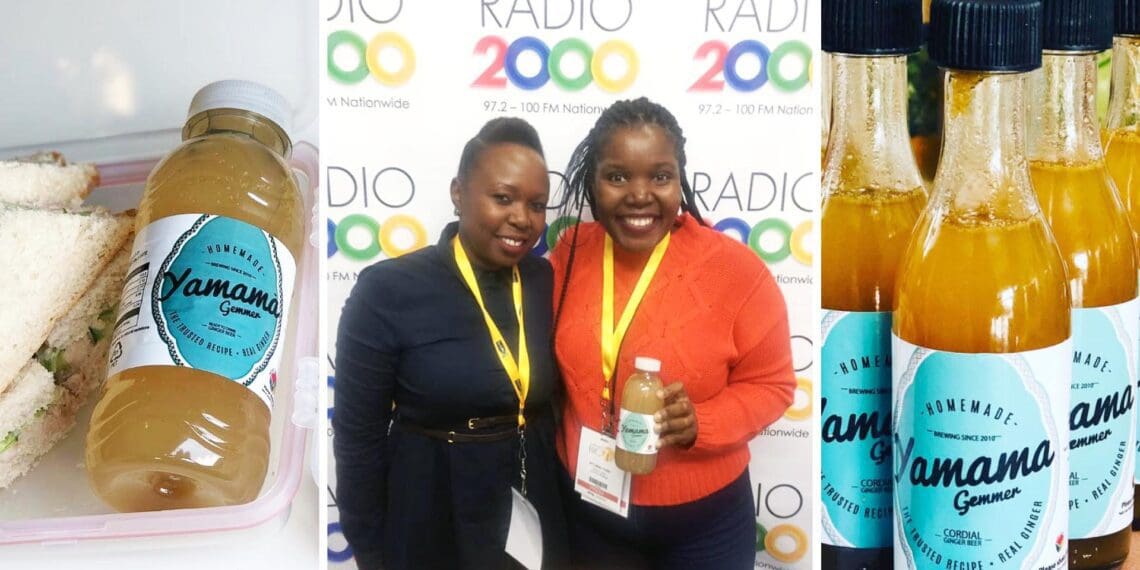
The sisters behind the Yamama Gemmer ginger beer brand, Mosibudi Makgato and Rosemary Padi. Photos: Supplied/Food for Mzansi

The sisters behind the Yamama Gemmer ginger beer brand, Mosibudi Makgato and Rosemary Padi. Photos: Supplied/Food for Mzansi

Share on FacebookShare on TwitterShare on WhatsApp

Born and bred in Pimville, Soweto, Mosibudi Makgato is a marketing executive by trade. She founded her company, called Yamama Gemmer, with her sister Rosemary Padi, and took over the full-time running of the company in 2016.

“The business was started by us from our mother’s recipe. We commercialised a homemade traditional ginger beer commonly known as gemmer, or gemere, depending on which part of Msanzi you are from.”

Through Yamama Gemmer, the sisters offer three ginger beer products; a concentrate, a beer cordial, and “ready-to-drink”.

Yamama Gemmer ginger beer is available in four different products. Photo: Supplied/Food for Mzansi

Available in five- and two-litre bottles, the concentrates require dilution with water to make 20 litres and 8 litres respectively. The 500ml cordial also requires water, whereas the “ready-to-drink” can be consumed as is.

On their website, the sisters describe themselves as the “heart and soul” of the business, which is based in Midrand, Gauteng. The sisters currently employ four people, and Makgato says they have some manual components to their production process.

“We are currently still using manual elements with some automation. Ideally, we would like to be fully automated.”

Like with many small businesses in the country, Covid-19 had adverse effects on Yamama Gemmer. Makgato explains that their current production staff is actually reduced, and that they have not recovered enough to bring back their original team.

“Currently, [our] challenge is the market we lost in the last two years. This means sales have dropped. We are however, currently working on getting into markets that are a bit more traditional.”

Leaving a legacy

The theme of tradition is one that runs throughout the business. With Yamama Gemmer, the sisters hope to bring not just “the nostalgic original taste of traditional home-crafted ginger beer, but also a convenient element to traditional ceremonies”.

Having developed the recipe they inherited from their mother, Makgato explains that with their business, they also want to pass that inheritance along to their children.

“A rewarding aspect [of the business] is the legacy we are creating for our kids. We want our kids to go to school and have work immediately after.”

Makgato also explains that their legacy is not just limited to their children but is also one they hope to share with other women in their community.

“Our mother used to empower women in the community to grow food from their garden. We want to continue with that legacy to ensure that we employ the women who head their households, as we know that not only do they feed their families, but [also] the bigger community.”

Makgato’s tips for other agripreneurs are simple:
  • Focus on your passion. Because it’s your passion, it will feel a lot easier.
  • When you have a well-developed strategy, try not to worry about what others do.
  • Always be open to learn. Trends change all the time, so be open to try new things.

WATCH: There is ubuntu in farming for agripreneur Sabatha Segoba

Get Stories of Change: Inspirational stories from the people that feed Mzansi.

Nicole Ludolph

Born and bred in Cape Town, Nicole Ludolph is always telling a story. After a few years doing this and that, she decided that she might as well get paid for her stories. Nicole began her journalism career writing science articles for learner magazine Science Stars and interning at Getaway Magazine.

Tags: Covid-19EntrepreneurshipGautengGinger Beer
The future of Mzansi's sugar industry hangs in the balance
News

Government hikes sugar import price, but industry warns of gap

by Staff Reporter
3rd September 2026

South Africa’s government has adjusted the sugar import reference price from $680 to $785 per tonne to curb surging imports....

Read moreDetails

Chicken is booming, but the real money is in the supply chain

2nd September 2026
How Tebogo beat post-harvest losses with smart agro-processing

How Tebogo beat post-harvest losses with smart agro-processing

2nd September 2026

Aucamp outlines strategy for biosecurity, trade, and infrastructure

2nd September 2026
Tobias Doyer, CEO of Grain SA. Photo: Supplied/Grain SA Facebook

Rising costs, climate risk push Swartland wheat farmers to the brink

2nd September 2026

Strategic support sparks record-breaking growth at WC grape farm

Foot-and-mouth crisis hits SA dairy industry with R1-billion loss

Potato turning point ahead as onions double in price year-on-year

How to align your farming cycles with long-term financial success

Farmers rethink water use as shortages threaten food production

Join Food For Mzansi's WhatsApp channel for the latest updates!

JOIN NOW!
Next Post
The existence of these two systems; large-scale commercial and small-scale farmers remains a sign of injustice and inequity. Photo: Supplied/Food For Mzansi

Mzansi's two-part farming system a sign of injustice

THE NEW FACE OF SOUTH AFRICAN AGRICULTURE

With 21 global awards in the first six years of its existence, Food For Mzansi is much more than an agriculture publication. It is a movement, unashamedly saluting the unsung heroes of South African agriculture. We believe in the power of agriculture to promote nation building and social cohesion by telling stories that are often overlooked by broader society.

RSVP now: Emerging farmers’ programme at Nampo Cape

Community-led farms boost food security and incomes in Limpopo

Farmers rethink water use as shortages threaten food production

Honoured roots: A father’s legacy, a daughter’s farming dream

Gauteng farmers urged to harness massive urban market

Foot-and-mouth crisis hits SA dairy industry with R1-billion loss

  • Awards & Global Impact
  • Our Story
  • Contact Us
  • Cookie Policy
  • Privacy Policy
  • Copyright

Contact us
Office: +27 21 879 1824
News: info@foodformzansi.co.za
Advertising: sales@foodformzansi.co.za

Contact us
Office: +27 21 879 1824
News: info@foodformzansi.co.za
Advertising: sales@foodformzansi.co.za

  • Awards & Global Impact
  • Our Story
  • Contact Us
  • Cookie Policy
  • Privacy Policy
  • Copyright

Chat Options

I'm Lerato, your AI assistant!
No Result
View All Result
  • News
  • Changemakers
  • Lifestyle
  • Farmer’s Inside Track
  • Food for Thought

Copyright © 2024 Food for Mzansi

This website uses cookies. By continuing to use this website you are giving consent to cookies being used. Visit our Privacy and Cookie Policy.