The willow tree is known for its ability to bend, rather than break under boisterous, stormy winds. This is thanks to its pliability and an openness to whirl and dance on the airy gusts, instead of scornfully resisting them.
It’s almost ironic then, that Ntombizethu Busakwe, who embodies this metaphor to the tee, was in fact raised in Willowvale, Eastern Cape, and continues to farm there today. Just as the willow tree, Busakwe has weathered many a blustery gale and her ability to survive the hard-hitting storms is due to unbeatable flexibility and adaptability. Over and over again, she has adjusted her sails, bent with the wind and withstood the blows.
Memories of her father
When Busakwe’s migrant worker father, Lindela, took early retirement from the mines in 1986, he went home to Willowvale, bought a tractor and opened up a trade store. He returned to farming, just as he had done before leaving for Johannesburg all those years ago, when a watchful Busakwe was just a little girl.
“My parents loved mixed farming. They would grow anything that could sell and I observed it all.”
Along with her siblings, she helped work the farm and family business before matriculating in 2006, the same year her father died. She then enrolled for a course in office management and technology at Walter Sisulu University in Butterworth.
In 2011 however, Busakwe decided to abandon her studies in exchange for salary prospects and left to live in Cape Town with her supportive older sister, Masandiswe.
For three years Busakwe jostled and wrangled her way through various jobs within the insurance and banking sector, receiving only a commission-based income at some. When her salary stretched only as far as covering transport costs, Busakwe had to be realistic about the grating conditions in Cape Town and so reassessed, readjusted and redirected her steps down a winding path to Willowvale once more.
ALSO READ: R350 Covid grant got mixed farmer back on her feet
Answering the entrepreneurial call
“My studies were about pleasing my parents, but I’ve always had an entrepreneurial spirit and eventually had to ask myself how long I was going to work for someone else instead of being my own boss,” she acknowledges.
Armed with renewed determination and vigour, Busakwe decided to return to what she knew best and to what came naturally to her and received her mother, Nokwakha’s blessing to revive the family business.
A choice to make
“My father’s trade store was now unoccupied as many people had left the village in pursuit of urban living and those who remained in the village preferred to do their shopping at the bigger supermarkets in town,” says Busakwe.
She adds, “The structure was already in place so I could either carry on with the trade store, or I could explore chicken farming.”
The latter proved a more viable option and so the sedulous Busakwe converted her father’s old trade store into a poultry house. She took to her new career like a duck to water and with no formal training or education, relied on instinct and experience. This skills set, combined with an innate resourcefulness and flexibility, was integral in overcoming the many stumbling blocks, some of which included a lack of funding, financial resources and infrastructure.
Such was her resourcefulness, that Busakwe would even use an enamel mug as a make-shift irrigation solution. “I had no irrigation system. You use what you have to make it work!”
“I used sawdust as bedding for the chickens and soon discovered that mixed with chicken waste, it made for excellent manure to fertilise the land. I then decided to plant crops and they thrived with the sawdust fertiliser.”
Busakwe mentions that while the initial aim was to plant crops for personal consumption, she soon realised that there was a market for fresh produce.
Evolving is integral to business survival

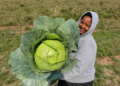
“People had stopped growing their own vegetables and had succumbed to convenience, opting to buy off the shelf instead. I had a surplus of crops and so began selling produce to Boxer Supermarket and to the local village community and just like that, became a mixed farmer,” she beams.
With the support of a farming consortium, Busakwe has now established a good rhythm to balance and optimise her process. They work together to supply the market and take turns in rotating and supplying various products like eggs, chicks and umleqwa. This ensures that there is always stock for sale and makes each farm more sustainable.
Busakwe’s farming journey has certainly been peppered with pivot points. And she’s been up to the task, evolving and adapting her business to suit every circumstance.
She has overcome a debilitating leg infection, a wipe-out accident which destroyed her truck, and the outbreak of a destructive chicken disease early this year. Through it all she remains resolute about leaving a legacy for her four children. A single mother to her eldest son, her daughter and a set of twin boys, Busakwe is white-knuckling her way to carve out a bright future for her children.
Extending a hand to the community
In addition to caring for her own offspring, however, she has a passion to assist the community at large. “There are many unemployed people living in the area. I would love to develop and employ more of them,” she says.
Future plans also include trucks to transport produce to larger markets which are further away, as well as cultivating more land, purchasing equipment, drilling a borehole and installing irrigation. These are well within reach, especially since the registration of a cooperative with a group of five lady friends who are eager to learn about farming and to grow a lucrative business.
Busakwe adds, “I would love the opportunity to help other emerging farmers create successful businesses too. There is a need for education in this sector. A return to the old ways will empower the community and enable them to survive and even flourish. By making use of the land they’ll be able to feed their families and sustain themselves financially.”
Busakwe is walking the talk. She’s returned to the old ways and come full circle. She’s riding the sharp winds, sun on her face and feet planted firmly on saw-dusted, fertile soil.
ALSO READ: New farmers: 5 reasons you need a crop production plan
Get Stories of Change: Inspirational stories from the people that feed Mzansi.