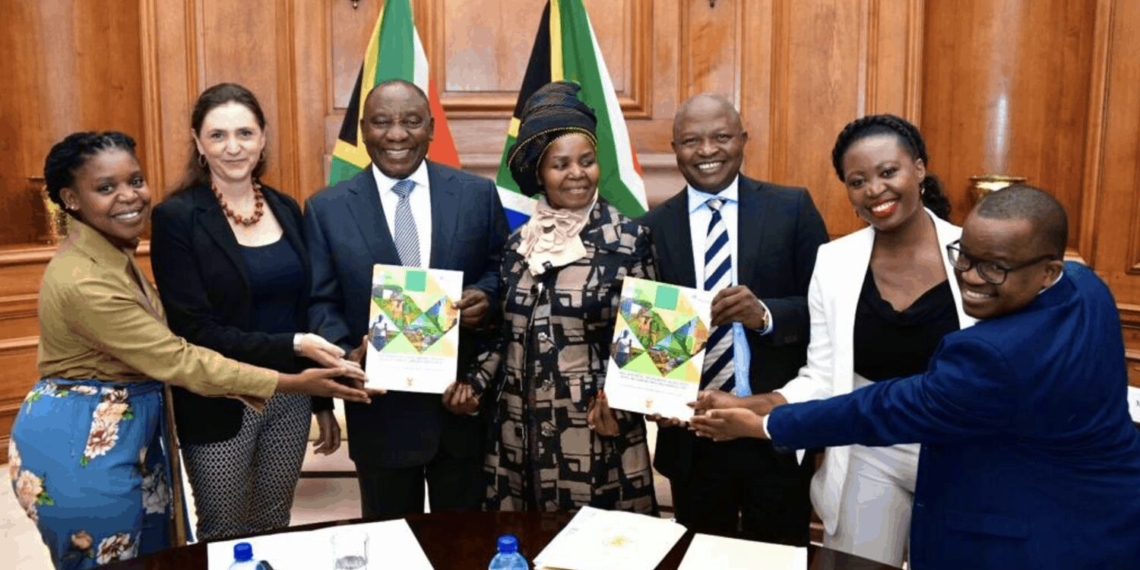
 Pres. Cyril Ramaphosa’s advisory panel on land reform says they are seriously concerned about the state’s capability to “implement the land reform process at a pace that matches the socio-economic developmental needs of society”.
The panel’s much-anticipated report of 144 pages was released moments ago during a media briefing led by Thoko Didiza, the Minister of Agriculture, Land Reform and Rural Development. In attendance was various land reform panellists, including Wandile Sihlobo, a leading agricultural economist, and Dr Vuyo Mahlati, a member of the National Planning Commission and president of the African Farmers’ Association of South Africa (AFASA).
Ramaphosa appointed the panel in September 2018 to support the work of the inter-ministerial committee on land reform. Their report was tabled before Cabinet before being released to the public this morning. The panel was mandated to review, research, and suggest models for the government to implement a fair and equitable land reform process.

In their concluding remarks the panel says, “Through this report the Panel has explored options that can assist government in reconfiguring the state machinery to deliver relevant programmes enabled by clear legislation and policies. Of importance is the recognition that land reform is everyone’s responsibility – public and private sector including civil society, NGOs and communities.”
The panel, led by Mahlati, also strongly warns government that policies and laws cannot reach their potential without the political will to implement and a state that has the capacity and heart to function and deliver to its people.

The report says, “It is important that the land reform process is not captured by individuals or families, monopolies or private sector corporations. Hence why corruption has been an area that was well discussed and researched as it is a major risk that can derail and dishearten citizens who desperately need solutions. Frameworks and policies should have feedback mechanisms that are open and transparent.
Other concluding remarks from the report:
Central land value system
It is clear that South Africans need to undergo an exercise which will galvanise amongst citizens a central land value system that will message a unified voice on the land reform process. This central land value system should reflect the needs and hopes of society in terms of their economic, social and spiritual attachment to land.
Land as an economic tool
Citizens need to understand the responsibilities associated with being custodians and stewards of land in order for the country to realise development and deal with the pressures of a growing population in a developing country. The aim of land as an economic tool should be a catalyst that shifts South Africa from a developing country into a developed country and to cope with the rising pressures of industrialisation and migration. The land reform process should also be seen as a tool for social reform if it has an aim to benefit those that are marginalised and previously disadvantaged.
Spiritual and cultural importance of land
The land value system should also capture the spiritual needs associated with cultures and religions in order for policies to respect the customs and traditions of communities that view themselves as custodians and stewards while keeping the integrity and spiritual connection that land offers our citizens. It is important that one reflects on the social, spiritual and cultural importance on the implications of land and the access to security. These have to be shared with citizens so they can have access to the information and be able to make decisions on how they interact with the process.
Property clause
The panel recognises the social elements that are associated with a process of rearranging the ownership patterns of land and how land reform has become an emotive topic to the people of South Africa. This has led to debates around the property clause and the protection the constitution has for land owners. The message of the land reform process is not to undermine the property rights of individuals but to realise the constitution’s mandate to deliver land reform as a corrective and restorative measure to historical issues. The underlying message should be: what is the responsibility of those who have property to those that do not?
Ramaphosa’s advisory panel on land reform concludes that the constitution is the blueprint on how South Africans should conduct themselves. They say it is not fair on society when individuals seek the protection of the constitution without understanding their responsibility to the constitution.
“Even if land reform is the mandate of government to framework and implement, it is upon citizens who are in a privileged position to find ways in their own control and understanding for how land can be redistributed and shared. Citizens and land owners should come forward with their wishes and ways on how they can in their personal capacity assist the communities in which they reside. The constitution has given citizens a clear mandate to realise equality and socio-economic inclusivity and citizens have left the process to government.”