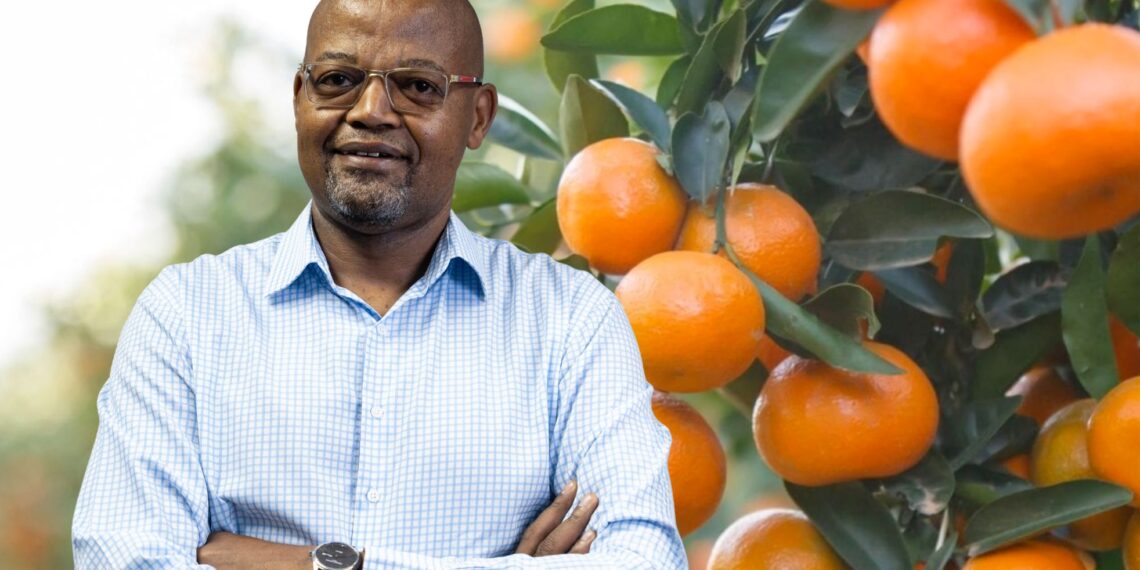
Reflecting on his first year as CGA CEO, Dr Boitshoko Ntshabele shares the challenges and achievements, emphasising endurance, collaboration, and long-term vision as key to realising the CGA’s Vision 260 goal by 2032. He also highlights the quiet resilience of farmers investing in the future of rural South Africa.
When I had the privilege of assuming the role of CEO of the Citrus Growers’ Association (CGA) in February 2025, the industry was grappling with how best to balance the imperative of growth amid an increasingly uncertain operating environment.
Long-term goals such as Vision 260, which outlines the potential to export 260 million cartons of citrus by the year 2032, sat alongside immediate pressures – shifting global trade dynamics, tariff uncertainty, logistical pressures, and the daily realities of moving South African fruit out of the country into highly competitive international markets.
It was a year and environment that demanded strategic clarity, but also adaptability – as it continues to be.
I am a runner. I ran my first Comrades Marathon a few years ago – and what has stayed with me is not the distance itself, but the discipline it demands: pacing yourself, resilience, and the deep understanding that endurance matters more than speed.
A demanding, but fulfilling year
In many ways, this past year has required that same mindset from the CGA and our growers. Pacing matters because the citrus industry is fundamentally playing the long game. Vision 260 is one expression of that: an ambition that can only be met through a sustained focus across expanding production, improving logistics, and enhanced market access.
At the same time, the year demanded careful judgment in the face of immediate pressures, most notably from tariff uncertainty all the way to infrastructure constraints. And yet, in 2025, South Africa’s citrus industry delivered more than 200 million cartons to global markets. It was a record year for the industry: more than 38 million cartons more than was shipped in 2024.
Above all, it underscored the resilience and skill of our growers. I saw this resilience most clearly on the ground.
Some of my clearest moments of reflection this year have come while running through citrus-growing regions, passing orchards and the protective netting that now spans so many valleys. Seeing that level of investment up close brings into focus not only the scale of the industry, but the responsibility it carries – for communities, livelihoods and the long-term development of rural areas.
Related stories
- Asia’s appetite fuels new growth for South African citrus
- Robust citrus exports drive SA’s agricultural export boom
- Citrus industry eyes growth through new market access
- Eastern Cape citrus study reveals women farmers still left behind
Investing in fruit and people
Across South Africa, citrus farmers continue to invest, often quietly and without any fanfare, despite ongoing uncertainty. It was evident in the rapid expansion of protective netting and in the care taken to ensure our fruit remained of the best quality.
Beyond the orchards themselves, the investment made by citrus farmers has a wider footprint. Citrus production remains deeply rooted in rural communities, where farms are often among the most stable sources of economic activity, skills development, and long-term opportunity.
The contribution of the industry extends far beyond jobs alone. From the orchard, it stretches to logistics companies, agricultural suppliers, and local service businesses. And this is above and beyond the direct community contributions of so many citrus farms and enterprises – like the education and childhood development initiatives, transport programmes, and many other ongoing projects.
Furthermore, the number of young people entering the industry, asking the hard questions about the future and showing a willingness to take responsibility for it, speaks to an industry that is not standing still, but adapting, learning, and preparing for what comes next.
I came into citrus as someone who has spent a lifetime at the intersection of agriculture, policy and trade. Years of work in government and regulatory environments, including representing South Africa in international forums, shaped how I approach complexity, risk and long-term decision-making.
What struck me most this past year was how deeply leadership is shaped by systems. Logistics, port operations, and market access are not abstract constraints, but forces that influence daily decisions and determine outcomes.
At the same time, this perspective reinforced the importance of listening closely to those on the ground. In a sector where outcomes are shaped as much by systems, relationships and timing as by what happens on the farm, effective leadership depends on bridging policy realities with the lived experiences of those who know it best.
A vision for 2026
Looking to 2026, the year sharpened my sense of what will be required to sustain growth in South Africa’s citrus sector. Expanding trade access – whether in existing markets such as the United States or in growth markets like China and others across Asia – will depend on close cooperation between industry and government.
Continued progress will rest on strengthening the logistics backbone that underpins the entire value chain, from ports and cold chains to transport infrastructure. The coming year will demand alignment across these fronts if the industry is to build on recent momentum and realise its long-term potential.
It is difficult to predict the future, but the very complicated process of broadening market access will be defining for our industry. But, just like endurance running, this work is defined not by speed, but by consistency and long-term commitment: to the industry, to the people it supports, and to consumers around the world who value our high-quality citrus.
- Dr Boitshoko Ntshabele is the CEO of the Citrus Growers’ Association of Southern Africa (CGA). The views and opinions expressed in this article are those of the author and do not necessarily reflect the views or positions of Food For Mzansi.
READ NEXT: Ramaphosa pledges 28m FMD vaccines, 10 000 extension officers