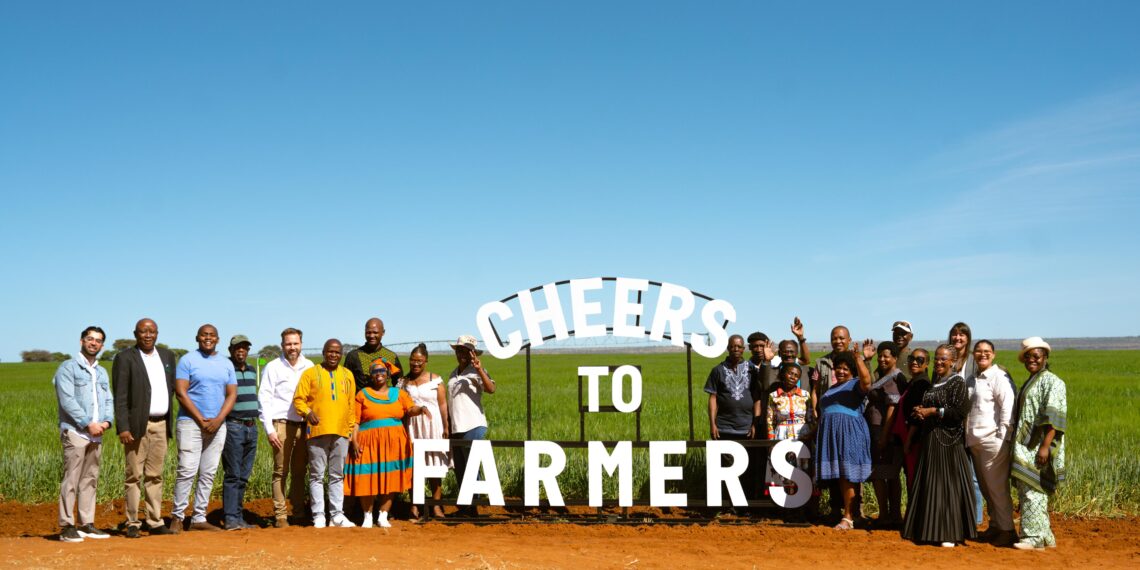
South African Breweries (SAB) and FarmSol shone a spotlight on barley growers, celebrating their dedication, resilience, and the hard work they put into their farming operations.
At the event in Taung, North West, Zoleka Lisa, the vice president with SAB, paid tribute to the country’s barley farmers, noting that their sweat, failed harvests, and bountiful ones have shaped SAB into what it is today.
‘To a future with more cheers’
“This year, we’re celebrating 130 years of being committed to South Africa. In reflecting on what 130 years mean, it’s about the people who walk the journey with us.
“SAB is one of the largest providers of interest-free loans to our farming community. When you start farming, you need to procure all your inputs. Having an upfront interest-free loan that allows you to get what you need, like fertilisers, materials, and other essential equipment, is where we come in,” she said.
She further highlighted the contribution of business partner Kyle Day, vice president of procurement and sustainability for AB InBev’s Africa Zone, who ensures that once the barley is ready for processing, there is always a market for the farming community.

“We have 62 farmers in this community, and this year, we are looking forward to harvesting 4 000 tons of barley to go into Castle Lager, Carling Black Label, Castle Lite, and other SAB beverages”
Zoleka Lisa
Lisa pointed out that SAB contributes about R1.4 billion to South Africa’s economy, supporting 32 000 jobs across four provinces.
“Today is all about cheers to our farmers. We see you; we celebrate you, we thank you for your resilience, we thank you for your harvest, and we thank you for all the impact you are making,” she said.
Related stories
- North West farmers explore blended finance opportunities
- TVET colleges put agriculture at the heart of student development
- IN PICTURES: Joy as FarmSol and SAB go big
- FarmSol hooks farmers up with megabucks machinery
Support that pays off
According to Aron Kole, managing director of FarmSol, the interest-free loans provided by SAB have helped farmers gain mentorship, market access, and expertise.
“Nobody nowadays can give you an interest-free loan, but SAB does that, he said.
“We assist farmers from the basics of an agreement, helping them sign it and prepare a budget. We work out the production inputs they require, how much they need to spend per hectare, and the profits they can realistically expect.”
Aron Kole

Kole explained that once the farmers have planted and the delivery of the barley is completed, they offset their loan on the income that is derived from the proceeds of the sale of the crop.
Barley farmers celebrated
Day said the growth with InBev comes when farmers put in effort, and thanks to all the work they do, the company has seen significant gains.
Farmers were honoured, and the Best Barley Farmer of the Year, achieving the highest yield of 8.6 tons per hectare, was awarded to Gaosirwe Johannes Thejane.
The Best Female Farmer award went to Smous Dorcas Madithole, while the Most Profitable Farmer Co-operative award was presented to Tshidiso Farmer Co-operative.

Day noted that from 2022 to 2023, 50 farmers in Taung participated in the programme and produced an impressive 8 000 tons of malting barley of the highest quality.
“We believe that at SAB, we cannot do this alone. We can collaborate with the department of agriculture, the provincial government, marketing councils, local leaders, as well as partners like FarmSol.”
Kyle Day

Meanwhile, Madoda Sambatha, the Northwest MEC for agriculture and rural development, said that land must be used productively, as it is intended.
“You, [stakeholders], have taken pressure off us. It is in government policy to create space for private sector partnerships.”
Madoda Sambatha
He added that following a recent cabinet visit to the region, it was decided that the department of agriculture must work with the ministry of water and sanitation to explore ways to increase the capacity of irrigation systems to cover areas in North West that were left out when the scheme was initially implemented.


ALSO READ: Umqombothi: Where tradition meets nutrition