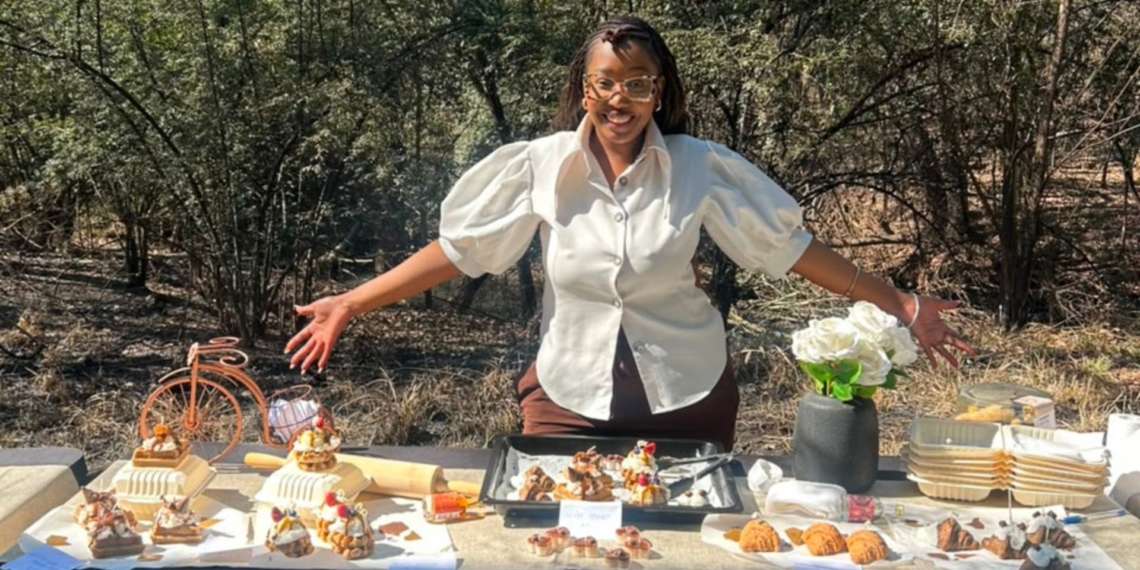
At first glance, Neo Mokhomo’s candles look good enough to eat. But behind the dessert-like designs is an unexpected agricultural ingredient: soya. For Mokhomo from Secunda, Mpumalanga, turning agricultural products into something beautiful is where creativity meets business.
Through her candle brand, Treat Torch, she uses soya wax to create candles that look like desserts and fill spaces with scents designed to welcome guests from a distance.
Her creativity was nurtured from a young age.
Growing up between Lesotho and South Africa, Mokhomo was raised in a home where books and creativity were never far apart. Her mother, Seithati, was a librarian, while her father, Eric, gave her the freedom to explore, read and interact with different people.
That curiosity followed her into science. Mokhomo says studying chemistry shaped not only how she understood the world, but also how she created it.

“I always say that studying chemistry shaped the way I think and create,” she says.
“It taught me to be curious, experiment systematically, and understand why things work the way they do.”
Creating thoughtful gifts sparks business idea
While completing her advanced diploma in analytical chemistry at Vaal University of Technology, she worked as a research assistant under the head of her faculty’s department, focusing mainly on wetlands research.
Her move into hospitality and entrepreneurship, however, was driven by a desire for financial freedom and a willingness to look beyond her qualifications.
The idea for Treat Torch took shape in February 2024, though Mokhomo didn’t start making candles in person until May 2025. The idea grew from her Airbnb business and her desire to leave guests with a gift.
“I wanted to give my guests thoughtful gifts, especially because I live quite far from my properties,” she says.
“Candles made sense because they could say, ‘I thought about you,’ without the risk of perishing or expiring.”
As the idea developed, Mokhomo travelled to Singapore in August 2025 for a candle-decorating and perfume-making class.
Natural ingredients fuel quality products
Today, she uses wax, fragrance oils, dyes, herbs and dried flowers, sourced mainly from a local supplier in Edenvale, Johannesburg.
“The main ingredient in my candles is soy wax, which is made from soybean oil,” she explains.
“I chose soy wax because soybeans are a renewable agricultural resource, and it works exceptionally well for the type of candles I make.”
She adds that the wax also holds fragrance well and gives the candles a longer, slower burn.

Finding the right combinations has taken experimentation. Some scents did not perform as expected, while others became customer favourites. Mokhomo says testing in smaller quantities allowed her to learn what customers wanted without investing heavily in stock.
“It allowed me to experiment without unnecessarily tying up money in stock,” she says.
The challenges behind the growth
Finding the right materials has been another part of the learning curve. Mokhomo says locally available moulds and other specialised materials do not always match what she needs, while affordable soya wax can also be difficult to source.
“Sometimes I’ve had to order things from outside the country, or even try to make them myself. It takes quite a bit of time, especially for something that started out as a small creative business.”
She believes there is an opportunity to strengthen links between agricultural producers, manufacturers and small businesses using agricultural products.
“I think the more accessible these raw materials become, the easier it is for entrepreneurs to experiment, develop products and create additional value from agricultural products,” she says.

Electricity cuts have brought another challenge.“I’ve had to make candles during power cuts and even had to buy a gas plate for one of my workshops,” she says.
For a small business, these unexpected costs and disruptions can have a real impact.
Her candles have since become gifts for anniversaries, birthdays and returning Airbnb guests.
Mokhomo says the business was also influenced by seeing how guests responded to colour, creativity and unique spaces, particularly when she created a retro-themed Airbnb.
Mokhomo’s lessons from building Treat Torch
- Start before you feel completely ready.
- Test your products before you scale.
- Don’t only test with people who love you; seek honest feedback.
- Research your customer as much as you research your product.
- Build a story around what you create.
READ NEXT: Market first: How Tshepiso built Blessed and Beautiful Farms