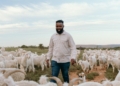
Before planting her crops, Tshepiso Mkandawire engaged with Mabaalstad locals to find out what they actually needed. In this edition of Farmer Mentor, she explains how that market-first mindset helped Blessed and Beautiful Farms grow from a backyard garden into a thriving multi-hectare enterprise.
For Tshepiso Mkandawire, farming is about more than producing food. As the founder and director of Blessed and Beautiful Farms in Mabaalstad in North West, she is building an enterprise to improve access to fresh, affordable food while creating opportunities for her community.
Mkandawire officially started farming in 2025 after a dream inspired her to address food and water challenges in her village. Today, the farm produces crops such as spinach, cabbage and tomatoes, while gradually expanding into poultry, eggs, sheep, goats and pigs.
Hard-learned lessons
Her experience has taught her several lessons that could help farmers looking to establish or expand their own enterprises.
Mkandawire believes farmers should not wait for perfect conditions or large amounts of capital before starting.
The farming operation currently spans several portions of land, including a backyard garden, a 0.2-hectare plot, a four-hectare area under development, and a larger 200-hectare allocated farm. The latter is being planned in two sections, with 100 hectares earmarked for crop production and the remaining 100 hectares intended for livestock and an agro-processing plant.
“If you wait, you’ll wait forever. We started with what we had,” she says.
Rather than waiting for external funding, she bought seeds and seedlings, planted on a small scale and reinvested income back into the business. At the same time, she has been working towards meeting the requirements to access future funding and developing strategic partnerships to support expansion.
Her advice is to start within your means, prove the concept and grow gradually.
Related stories
- No one-size-fits-all: Liane’s lessons on leaving the land better
- Eggsellent growth: How Lebo Mashigo built a poultry empire
- EC women-led co-op turns communal land into retail success
- Rising talent: Gugu grows from two piglets to poultry, spinach
Understand what your market needs
One of the biggest lessons Mkandawire has learnt is the importance of understanding customers before deciding what to produce.
“We need to be with the people to know what they need,” she says.
She engages with community members and local authorities to identify demand. This approach revealed that cabbage was particularly popular because households could use it in different ways.
The farm also trials new crops and introduces them to customers, such as bishop’s crown pepper.
“It’s good to plant, but if you don’t have a receiver for your product, then it’s all in vain.”
As the enterprise expanded, Mkandawire realised that diversification requires additional skills and labour.
Her advice is simple: know when to ask for help. “You can’t eat an elephant alone. You need other hands to help you navigate through it.”
The farm has brought in part-time local workers to assist with planting and land preparation.
Blessed and Beautiful Farms has different sections for crop trials and production, while larger areas are being prepared for future livestock and processing activities.
Mkandawire says farmers should resist the temptation to develop everything at once, particularly when resources such as water and capital are limited.
“You need to understand that there is a process to everything,” she says. “We are taking it bite by bite.”
Water availability has also influenced the farm’s pace of expansion. While working towards completing its water licensing process, the farm has focused on smaller areas where it can maximise available resources.
Be compliant right from the beginning
Mkandawire stresses that farmers should involve the relevant government departments early, particularly when planning major developments.
Agricultural officials have assisted with evaluating the land and soil testing, while the farm is also working through water-related compliance requirements.
“You don’t want to be doing all the work, getting everything together, only to find that you are not compliant or that the soil cannot accommodate what you want to produce,” she cautions.
Starting correctly, she adds, is essential for building an enterprise that can become a long-term legacy.
For Mkandawire, purpose is what keeps a farmer moving through difficult seasons. “Remember why you started, because there will be frustrations along the way.”
Her vision extends beyond selling produce. She wants to equip community members with farming skills that they can apply in their own backyards and pass on to future generations.
“We can’t feed the whole nation, but we can impart skills so people can take them to the next generation,” she says.
For farmers facing setbacks, Mkandawire’s message is to remain focused on the bigger picture.
READ NEXT: Practical water-saving strategies every SA farmer can use now