Tuesday, October 20, 2026
SUBSCRIBE
22 GLOBAL MEDIA AWARDS
Food For Mzansi
  • News
  • Changemakers
  • Lifestyle
  • Farmer’s Inside Track
  • Food for Thought
No Result
View All Result
  • News
  • Changemakers
  • Lifestyle
  • Farmer’s Inside Track
  • Food for Thought
No Result
View All Result
Food For Mzansi
No Result
View All Result
in Entrepreneurs, News

Covid-19 lockdown: ‘Democracy has not been suspended’

by Duncan Masiwa
29th April 2020
women still behind

Prof. Elmien du Plessis is a leading expert in land and expropriation law. Photo: Supplied/Food For Mzansi

Share on FacebookShare on TwitterShare on WhatsApp

North-West University law professor Elmien du Plessis certainly doesn’t shy away from engaging in difficult debates. As an expert in land and expropriation law she is often under scrutiny, but in the last five weeks she had to face her toughest audience ever: her own three children.

Like many South African parents, Du Plessis has had to find constructive ways to talk to her children about the covid-19 pandemic. This time around, though, she could not rely on years of comprehensive research and legal frameworks. Her children needed answers and they needed them fast.

“My older two are 8 and 11. They are great fans of (The Daily Show host) Trevor Noah, so I let him do the talking and we sort of discussed what he said,” Du Plessis tells Food For Mzansi during a recording of the popular Farmer’s Inside Track podcast.

Helping children understand the virus

Of course, Noah’s show is focused on a US audience, and she obviously had to find another way of talking to her four-year-old about the coronavirus lockdown. This was when she discovered a children’s book that helped her youngest child understand the virus.

She says, “There are a lot of nice stories for the younger ones. And the one story that I particularly liked was this story about butterflies. It said sometimes the butterflies go into a cocoon. While they are in a cocoon to become butterflies, it is really messy. It is yucky sometimes and I said, ‘This butterfly is in a cocoon. In our house we are also in a cocoon, but when all of this is over, we are going to emerge as butterflies.’”

Du Plessis certainly was not sugar-coating the sharp, direct and immediate impact of covid-19. “My father is quite old and he’s in a vulnerable group. My children know that I am worried. So, I think I am quite honest about my emotions and we deal with it. We say how we feel, but while this is messy and scary and we are sometimes sad because we can’t see our parents, grandparents or friends, in the end, maybe, we can emerge as butterflies out of it.”

Read more: Free lockdown learning tips for children

While the unprecedented lockdown has given Du Plessis and her husband more time to bond with their children, the family discussions are also worlds apart from the usual discussions on the structural problems of land redistribution in South Africa. As a NWU lecturer and constitutional law expert she has become one of the nation’s top thought leaders.

Previously, she was also invited to address pres. Cyril Ramaphosa’s land reform panel – an experience she won’t easily forget.

“I always ask myself, ‘Did I get my message across in a way that showed that I understood the human need, but also that the law regulates society?’ So, on a very personal level, I would have perhaps tried to do this in a way that was more empathetic, but since I didn’t formally serve on the panel, I did not really have the power to do things differently. I’m happy with the advice that I gave them.”

Agbiz chief economist Wandile Sihlobo and prof. Elmien du Plessis.

Also, she describes the final report of the presidential advisory panel as a “mixed fruit of various ideas which is great, but there wasn’t one definite goal that said: ‘This is what we want to achieve. It is very important to have a goal that you want to work towards to. Why do we want land reform? Why is it important? What do people want when they say they want land reform? Do they want to farm, or do they just want land to ensure that they won’t be removed from the land?”

In the podcast she also delves into new regulations to try and curb the spread of covid-19.

“It is difficult because on the one hand we are making laws by ministerial decree, and we must always be vigilant about that because ministers can abuse power. But it is also a time of quick decision-making so there are going to be many mistakes made. We must navigate our way through this always remembering that we remain a constitutional democracy. There are no rights that have been suspended. Democracy has not been suspended.”

  • Prof. Elmien du Plessis’ full podcast interview with Food For Mzansi’s Dawn Noemdoe and Ivor Price can now be downloaded for free on Spotify and Apple Podcasts. Subscribe to “Farmer’s Inside Track” on these channels for a weekly interview with Mzansi’s agricultural movers-and-shakers.
  • Click here to download the interview on Spotify.
  • Read more: Free lockdown learning tips for children.

Duncan Masiwa

DUNCAN MASIWA is the assistant editor at Food For Mzansi, South Africa’s leading digital agriculture news publication. He cut his teeth in community newspapers, writing columns for Helderberg Gazette, a Media24 publication. Today, he leads a team of journalists who strive to set the agricultural news agenda. Besides being a journalist, he is also a television presenter, podcaster and performance poet who has shared stages with leading gospel artists.

Tags: children and covid-19CoronavirusCovid-19Elmien du PlessisLandLand debateland expropriation without compensationLockdownNorth West University
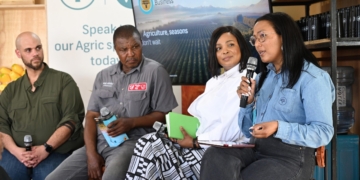
The panellists at FNB Business’s “Farming together” discussion at the Royal Show explored how market access, mentorship, financial discipline and strong commercial relationships can help farmers build sustainable businesses. Featured from the left are Bertram July (FNB’s distribution sales lead), commercial farmer Shakes Shabalala; Sandy Gumede (co-founder of Zulu Girl Wines), and Janis Robson (FNB’s head of development and SME business development). Photo: Food For Mzansi
News

FNB puts relationships at the heart of commercial farming

by Staff Reporter
17th October 2026

From buying a farm with cattle to building a wine brand from scratch, entrepreneurs shared how strong relationships, market access...

Read moreDetails
Agri Skills Transfer students gain hands-on experience at the institution’s Cullinan Farm Training Centre, where agricultural theory meets the realities of commercial production. Photo: Supplied/Food For Mzansi

Build your future in agriculture with Agri Skills Transfer

17th October 2026
Durbanville Hills tastes sweet success at Michelangelo Awards

Promising early conditions predicted for 2027 SA wine harvest

17th October 2026

Reclaiming the kraal: Cultural heritage sparks a farming dream

16th October 2026

How animal welfare and human rights shape food security

16th October 2026

SA and Namibia reevaluate livestock trade after FMD outbreak

FNB puts relationships at the heart of commercial farming

How animal welfare and human rights shape food security

What farmers should know about diarrhoea in lambs and kids

Farmers urged to tap into recycled human waste as fertiliser

Join Food For Mzansi's WhatsApp channel for the latest updates!

JOIN NOW!
Next Post

BREAKING: A big NO for ciggies, YES for wine exports - and MAYBE for online wine sales

THE NEW FACE OF SOUTH AFRICAN AGRICULTURE

With 21 global awards in the first six years of its existence, Food For Mzansi is much more than an agriculture publication. It is a movement, unashamedly saluting the unsung heroes of South African agriculture. We believe in the power of agriculture to promote nation building and social cohesion by telling stories that are often overlooked by broader society.

Fixing SA’s agricultural visa system to protect seasonal harvests

SA and Namibia reevaluate livestock trade after FMD outbreak

Agda conference to tackle finance, market access and agri growth

Reluctant farmer scales EC cabbage enterprise to supply Spar

Reality check: What SA agri interns really experience on the farm

This week’s agri events: 19 – 23 October

  • Awards & Global Impact
  • Our Story
  • Contact Us
  • Cookie Policy
  • Privacy Policy
  • Copyright

Contact us
Office: +27 21 879 1824
News: info@foodformzansi.co.za
Advertising: sales@foodformzansi.co.za

Contact us
Office: +27 21 879 1824
News: info@foodformzansi.co.za
Advertising: sales@foodformzansi.co.za

  • Awards & Global Impact
  • Our Story
  • Contact Us
  • Cookie Policy
  • Privacy Policy
  • Copyright

Chat Options

About this assistant

This feature generates automated answers summarised from Food For Mzansi articles. By using it, you are interacting with an AI system (provided by Google), not a human. AI can make mistakes. Please refer to the source articles for verification and citation purposes.

Our staff do not check or moderate Lerato’s answers in advance, but may review some later. Our journalists continue to write and edit all the articles Lerato uses as sources.

To estimate unique and returning web users, we store a random browser ID in this browser. WhatsApp users are counted by phone number. The same person using both channels may be counted twice.

I'm Lerato, your AI assistant!
No Result
View All Result
  • News
  • Changemakers
  • Lifestyle
  • Farmer’s Inside Track
  • Food for Thought

Copyright © 2026 Food for Mzansi