Coastal foraging is transitioning from wild, seasonal gathering into structured coastal farming, as growers turn to resilient, marine-adjacent greens to diversify local food systems.
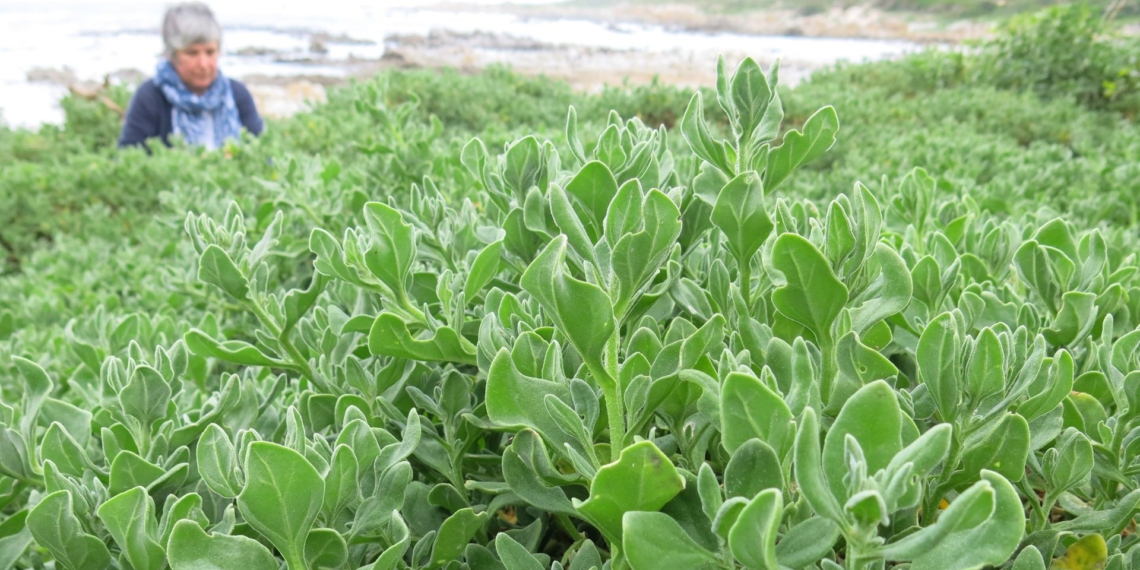
A prime example is dune spinach (Tetragonia decumbens). Historically valued as a beach-stabilising succulent, this nutrient-dense plant is gaining agronomic backing across South Africa.
From wild plants to field trials
Dune spinach’s cultivation journey began in 2016 when Loubie Rusch, food innovator, activist, author and programme coordinator of the Local Wild Food Hub at the Sustainability Institute (SI), established an experimental Cape Wild Food Garden at Khayelitsha’s Moya weKhaya urban farm in the Western Cape. This was supported by the SI and Abalimi Bezekhaya.
“Quite by chance, the SI had some funding available,” Rusch recalls.
“To my knowledge, that’s the first time dune spinach was tested in cultivation, along with six other Cape wild plants. I had been observing them in nature and wanted to see if intentionally growing them would be viable.”

Those early trials led to the establishment of the Local Wild Food Hub at the SI in 2022. Today, the organisation runs Edible Futures field trials with the Royal Botanic Gardens, Kew, at the SI and the Grootbos Foundation. Using soil moisture sensors and weather stations, researchers are gathering data to develop practical growing guidelines, including planting distances, irrigation schedules and expected yields.
Laboratory analysis has confirmed that the selected wild plants are rich in micronutrients that could help address malnutrition, explains Rusch.
Dune spinach is not just confined to the Western Cape; it grows as far as Gqeberha and the Wild Coast in the Eastern Cape.
“One of the Xhosa-speaking women making and selling beadwork outside the local hotel took a piece of dune spinach out of my basket and said, ‘Morogo, imifino’ [wild leafy greens],” she says. “That was such an amazing living confirmation.”
Related stories
- In pictures: Safeguarding indigenous plants for the future
- Spinach queen, butcher and kasi cuisine – she’s all that
- RECIPE: LesDaChef’s Creamed Spinach
- Recipe: Spinach and pap team up in this smashing side
Beyond the dinner plate
Research has also shown that dune spinach helps desalinate soil and can adapt to both hot, dry conditions and wet seasons, making it a promising crop for year-round production with minimal irrigation.
While human nutrition remains the priority, Rusch believes dune spinach could also serve as livestock feed.
“We took several wheelbarrows through to the pigs,” she tells Food For Mzansi. “They were just about fighting each other to get to the dune spinach. It made me think: not only can people enjoy it, maybe it’s even a grazing plant.”

Building a market, however, remains the biggest challenge.
“The supply flow is only as strong as the farmers that cultivate it and the cooks interested in using it,” says Rusch.
To bridge that gap, she authored grower and cooking guides, trained farmers and educators through the Local Wild Food Hub, and helped introduce the crop into school feeding programmes and restaurant kitchens.
The versatility of this coastal plant
For indigenous chef and cultural food systems practitioner Shihaam Domingo, from Retreat, Cape Town, the coastal green is a living ingredient that changes its profile depending on when and where it is harvested.
“Sometimes it’s more juicy and a little salty, and then sometimes more astringent. It depends on the weather and the moon phase, but it grows all year round,” says Domingo, also known as the “Food Witch”.
Domingo says the plant’s versatility makes it a flexible addition to both raw and cooked dishes. The tender tips offer a crisp texture when eaten raw as salad greens or sandwich toppers, while the broader leaves hold up well when stir-fried, baked in the oven, or slow-cooked in traditional stews.
Aside from its culinary appeal, Domingo introduces dune spinach to participants on her cultural “Dream Walks” as a vital historic source of nutrition and shelter-building along the coastline. She highlights a unique, practical relationship with the species that goes beyond simple foraging.

Because the dense foliage covers the sand, Domingo explains that it acts as a natural insulator, keeping the soil cool under the hot sun. Therefore, you can shelter under or burrow into the sand beneath the dense foliage canopy if you need protection on a hot day.
The reverse applies when temperatures drop, as the thick mat of leaves traps heat to protect the roots from cold coastal nights.
“At night, it’s warmer, and you have protection from the wind, with a nourishing snack in arm’s reach just above.”


READ NEXT: The Sustainability Institute: Breaking rural poverty cycles