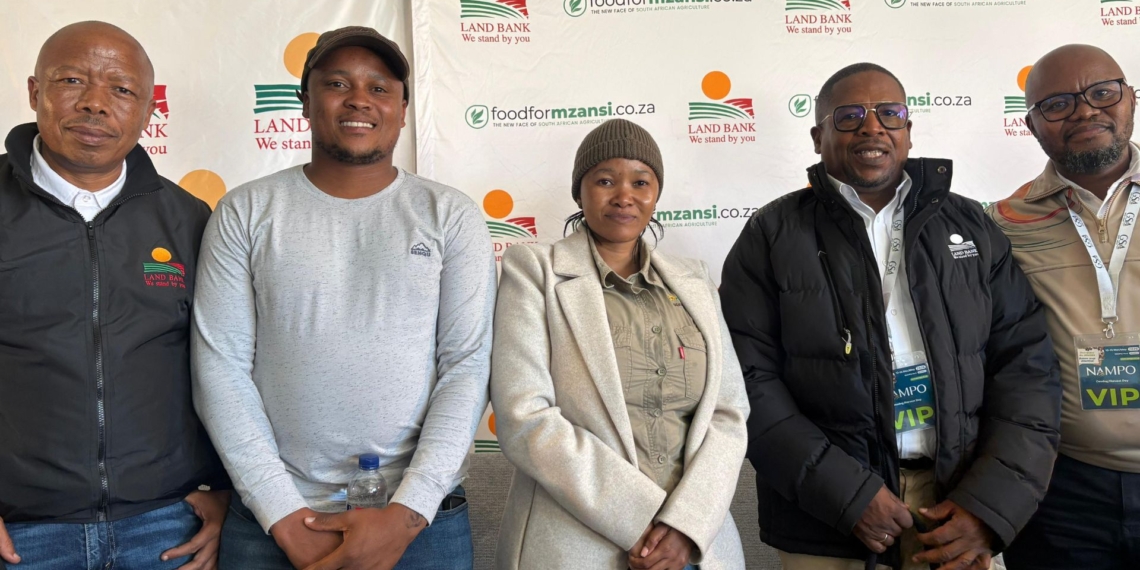
At this year’s Namp Harvest Day in Bothaville, Free State, Land Bank and Food For Mzansi hosted a discussion on blended finance and agro-energy funding. The session highlighted how these funding models are helping farmers expand, improve sustainability and strengthen long-term growth.
Speaking during the session, chief banking officer Vonani Mabunda, said access to finance remains one of the biggest barriers for smaller and developing farmers.
“Land Bank has always been looking at how we can innovate and come up with solutions that enable access to finance, especially for smaller farmers,” Mabunda said.
He noted that the blended finance model, developed with government support, combines grant funding with loan finance to reduce the burden on farmers.
“If a farmer requires R100 in funding, R50 can be approved as a grant and the remaining R50 as a loan. That means the farmer only pays interest on the loan portion,” he explained.
Mabunda said the model helps farmers who previously struggled to qualify for conventional loans. “We have to find a balance between being developmental and doing that mandate in a way that is commercially sustainable for the bank.”
Related stories
- Innovation drives resilience at Nampo Harvest Day 2026
- Land Bank back on track, boosting support for farmers
- Blended finance: Closing the gap for Africa’s smallholder farmers
- Compliance gaps threaten farmers’ access to finance
Helping farmers scale
Nthako Nthaele, provincial head for Free State at Land Bank, said blended finance is not only about transformation but also about strengthening food security and helping farmers reach sustainable scale.
“You can never have enough farmers producing so that there is food security in the country,” he said.
Nthaele noted that many farmers have the technical skills and passion to farm successfully, but cannot expand due to a lack of collateral. “Blended finance is closing that gap where farmers could not expand because they did not have enough collateral.”
He stressed that scale is critical in agriculture. “Farming is about scale. The smaller you remain, the more likely you are to fail.”
Nthaele added that Land Bank’s role extends beyond funding. “We do not just provide funds. We offer pre- and post-support and walk the journey with farmers to help ensure their enterprises succeed.”
Agro-Energy Fund evolves beyond load-shedding relief
Sakhumzi May, chief agricultural economist at Land Bank, said the bank’s Agro-Energy Fund was initially introduced to help farmers manage load shedding, but has since evolved into a broader sustainability solution.
“At the time, we introduced it as a mitigation measure during load shedding to ensure business continuity,” May said. The fund now supports investments in renewable energy systems such as solar, hydro and biomass.
“It is not only about power continuity anymore. It is about operational efficiency, planning, sustainability and cost savings.”
May noted that reliable electricity is critical in industries such as livestock production, where disruptions can affect animal welfare and production systems.
“At some point, farmers break even on the investment and begin to realise long-term cost savings that improve the bottom line of the business,” he added.
Farmers share growth stories
Free State farmer Tumelo Pedi said blended finance helped him move from communal farming to commercial agriculture.
“I started with communal farming, and it was very difficult to make a business sustainable under that model,” he said.
Pedi, who farms cattle, sheep and grain near Bloemfontein, said the funding enabled him to acquire two farms in 2024 and expand to four farming operations.
“Blended finance is by far the best product. It closes the gap and allows black farmers to build sustainable businesses that can support future generations,” he said.
He also praised the guidance offered by Land Bank officials.
“The bank may say no, but they also show you how to turn that no into a yes. Sometimes the rejection protects you from making the wrong decision.”
Tumelo Pedi
Fellow Free State farmer Dikitseng Mahlelelele described the programme as life-changing. “I wanted to turn my farming enterprise into a real business and make it profitable,” she said.
Mahlelelele explained that the process helped formalise her operations and improve business systems, while also supporting expansion into logistics, fresh produce and livestock.
Land Bank officials encouraged farmers to engage with financiers early and ensure their businesses are properly prepared before applying for funding.
“Finance is actually the last thing you need. There is a lot of preparation that must happen first,” Nthaele said.
Mabunda added that the bank continues to support farmers beyond financing approvals by connecting them with technical support, market opportunities and industry partners.
“It is not only about giving finance. It is about helping farmers develop sustainable agricultural businesses,” he said.
If you want to attend Land Bank’s conversations at Nampo, visit Food For Mzansi at stand H9e (outside). Wednesday’s topics are “De-risking agriculture: Financing and scaling the next generation of SA farmers” and “Unlocking the future: Strategic leadership & farmer success”, while Thursday will focus on “Protecting agriculture: Insurance, risk & resilience”.
Click here to RSVP to attend these talks.
READ NEXT: Unlocking the potential of fallow farmland in SA’s former homelands