Friday, May 15, 2026
SUBSCRIBE
21 GLOBAL MEDIA AWARDS
Food For Mzansi
  • News
  • Changemakers
  • Lifestyle
  • Farmer’s Inside Track
  • Food for Thought
No Result
View All Result
  • News
  • Changemakers
  • Lifestyle
  • Farmer’s Inside Track
  • Food for Thought
No Result
View All Result
Food For Mzansi
No Result
View All Result
in News

Citrus farmers count losses as floods drown export hopes 

Heavy rains and a national state of disaster have crippled South Africa’s citrus hubs. From uprooted trees in the Eastern Cape to rising river banks in the Western Cape, growers are tallying the cost of destroyed infrastructure and lost exports.

by Lisakanya Venna
15th May 2026
Local citrus farmers estimate losses of millions as export-grade fruit is rendered unsellable by floodwaters. Photo: Supplied/ Food For Mzansi

Local citrus farmers estimate losses of millions as export-grade fruit is rendered unsellable by floodwaters. Photo: Supplied/ Food For Mzansi

Share on FacebookShare on TwitterShare on WhatsApp

South Africa’s citrus growers entered the 2026 season with high hopes, projecting a record-breaking export of up to 215 million cartons. However, those aspirations were washed away as catastrophic flooding across the Western and Eastern Cape left farmers tallying millions in losses and facing a significant setback.

This follows a week of weather chaos that saw the Kouga Dam in the Eastern Cape skyrocket from 32% to 119% capacity in just 24 hours, unleashing 2.2 million litres of water per second over its spillway. The relentless cut-off low system dumped more than 300mm of rain in parts of the region, triggering a national state of disaster as orchards turned into rivers just as early mandarin harvesting was beginning to hit its stride. 

The CEO of the Citrus Growers Association (CGA), Boitshoko Ntshabele, expressed deep concern over the severe flooding that has crippled key production hubs. “This is a significant setback, particularly as the citrus season was just beginning to ramp up. While it is still too early to determine the full impact on the crop, there has clearly been damage to infrastructure.

“Early indications suggest that orchards have been flooded, with some trees uprooted, and initial estimates indicate that around 10–12% of the local crop may be affected,” he stated.

The sheer force of the floodwater has uprooted mature citrus trees and carved new river courses through established Eastern Cape farms. Photo: Supplied/Food For Mzansi

The CGA has welcomed the declaration of a state of disaster, as the move will enable coordinated government support in response to the crisis. 

FARMER POLL

📢 Which bank is powering your farming journey?

Tell us which bank you use so we can better advocate for the specialised financial tools and accessible capital needed to help South African farmers overcome growth barriers and thrive!

All submissions are kept strictly confidential. 


Related stories
  • State of disaster: Floods and storms push farming into crisis mode
  • Farmers battle floods, snow and damaged infrastructure
  • Good weather & more extension officers top farmers’ 2026 wishlist
  • Shifting seasons ahead: Brace for more extreme weather

Millions lost in the Gamtoos Valley

The Eastern Cape, specifically the Gamtoos Valley around Patensie and Hankey, has emerged as the most severely impacted region. For local producers, the optimistic export projections for 2026 have been replaced by the grim reality of submerged trees and lost income. Food For Mzansi spoke to farmers in the area who are now battling to save their livelihoods.

Khaya Katoo said his 12 hectares of citrus trees intended for the export market were underwater for more than 24 hours. “Unfortunately, this means we won’t be able to export that fruit, resulting in an estimated loss of around R3.5 million already.

“The floodwater has found a new route directly through our farm. We may lose 30–40 hectares of land to the new river course. In addition, some of the trees we planted in January, about one hectare, were swept away. We still don’t know the full extent of that loss yet. At the moment, we also have no water, no electricity, and no signal,” Katoo said.

Citrus trees left with exposed root systems as topsoil washed away, leaving their survival in doubt. Photo: Supplied/ Food For Mzansi

Crewelyn Katoo shared the same heartbreak, noting that some of their fruit was underwater, “and that means we won’t be able to export it, so as it stands now, we already will lose an income of R3.6 million.” 

Eben-louw Bezuidenhout echoed these concerns, noting that the water ran through his entire farm and all the trees. “There is still fruit on the trees, so I do not know if they are going to fall off or rot; it is too early for me to say,” he said. 

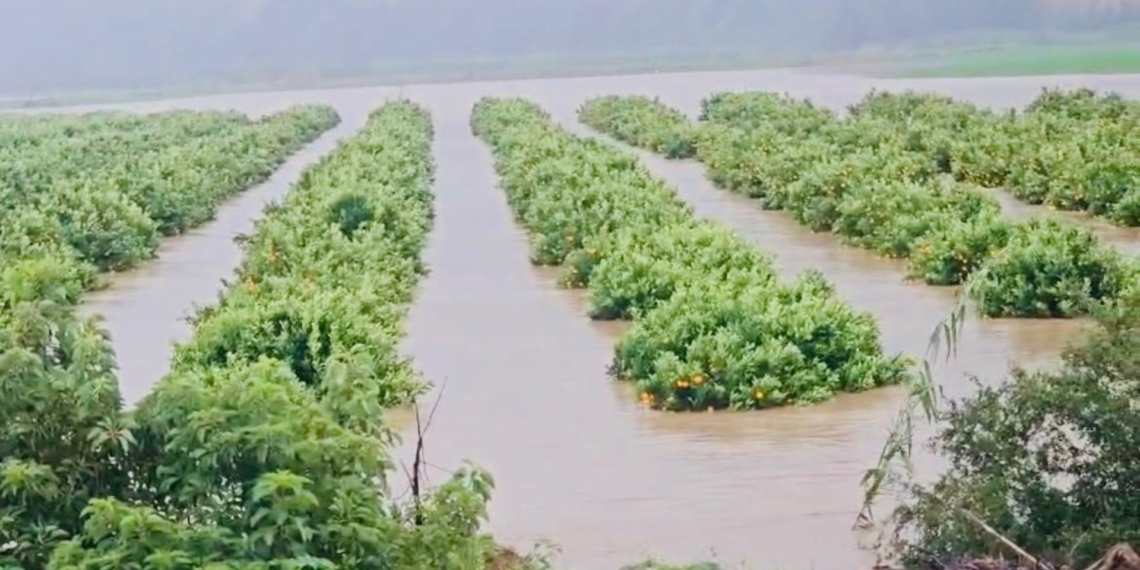
Citrus trees in the Eastern Cape are barely visible as floodwaters swallow the orchards. Photo: Supplied/ Food For Mzansi

Western Cape assessing storm impact

In the Western Cape, while some farmers escaped direct damage to their orchards, they witnessed the struggles of those nearby. Debbie Theunissen, a commercial pomegranate farmer, told Food For Mzansi that her neighbour’s citrus crop was not as fortunate.

“Our neighbour grows citrus, mostly under nets, and some of his trees stood in water,” Theunissen said. Regarding her own farm, she noted, “The farm itself received only about 32mm of rain over two days, but borders the Berg River, and it pushed past the banks onto the farm, but fortunately not into the orchards.”

According to Ntshabele, the province also experienced heavy rainfall; however, the extent of damage in regions like Citrusdal and the Boland appears to be less severe than in the Eastern Cape. He noted that key infrastructure, including main access routes, has largely remained operational. He attributed this mitigation to the preventative river work undertaken in recent years by the Western Cape government.

The disruption caused by the floods is expected to be felt most acutely in the soft citrus category, Ntsabele added, as early mandarin harvesting was ramping up when the rains arrived. The extent of this impact is still being assessed.

“What had been shaping up as a strong season now requires high levels of adaptability and responsiveness,” he said.

READ NEXT: Nampo panel unpacks what makes farmers bankable

Sign-up for the latest agricultural news delivered straight to your inbox every day with Mzansi Today!

Lisakanya Venna

Lisakanya Venna is a junior journalist and content coordinator with varied multimedia experience. As a CPUT journalism alumni, she finds fulfilment in sharing impactful stories and serving as a reliable source of information.

Tags: Citrus Growers Association (CGA)Citrus industryEastern CapeFloodsWestern Cape
State of disaster: Floods and storms push farming into crisis mode
News

State of disaster: Floods and storms push farming into crisis mode

by Lisakanya Venna
13th May 2026

Heavy rains, mudslides and destructive winds have left many South African farmers counting losses and prioritising safety over production. Small-scale...

Read moreDetails
Eggsellent growth: How Lebo Mashigo built a poultry empire

Eggsellent growth: How Lebo Mashigo built a poultry empire

13th May 2026
Potatoes SA and DBE partner to power up school nutrition

Weather shocks keep vegetable markets volatile

13th May 2026
Land Bank unlocks growth, tackles financing gaps at Nampo

Land Bank unlocks growth, tackles financing gaps at Nampo

13th May 2026
African farmers face fertiliser fallout from Gulf conflict

African farmers face fertiliser fallout from Gulf conflict

13th May 2026

Below-normal rainfall forecast threatens winter crops and dams

Farmers embrace smarter strategies for sustainable growth

Mothers of the land: Celebrate women who feed and teach Mzansi

Finance to flora: Zizipho Zungu’s farm cultivates beauty & business

Eggsellent growth: How Lebo Mashigo built a poultry empire

Join Food For Mzansi's WhatsApp channel for the latest updates!

JOIN NOW!
Next Post
Kagiso Mashiane, events manager for Engen South Africa, at the Engen Tractor Museum during Nampo Harvest Day in Bothaville, where heritage farming machinery and modern agricultural innovation meet. Photo: Supplied/Engen

Engen keeps tractors and farming dreams moving at Nampo

THE NEW FACE OF SOUTH AFRICAN AGRICULTURE

With 21 global awards in the first six years of its existence, Food For Mzansi is much more than an agriculture publication. It is a movement, unashamedly saluting the unsung heroes of South African agriculture. We believe in the power of agriculture to promote nation building and social cohesion by telling stories that are often overlooked by broader society.

Engen keeps tractors and farming dreams moving at Nampo

Citrus farmers count losses as floods drown export hopes 

Quality and export markets drive SA table grape industry growth

Land Bank pushes back on ‘bailout’ claims amid funding talks

Mpho Majeng honours heritage through hops-infused drinks

Livestock health: Why biosecurity starts at the farm gate

  • Awards & Global Impact
  • Our Story
  • Contact Us
  • Cookie Policy
  • Privacy Policy
  • Copyright

Contact us
Office: +27 21 879 1824
News: info@foodformzansi.co.za
Advertising: sales@foodformzansi.co.za

Contact us
Office: +27 21 879 1824
News: info@foodformzansi.co.za
Advertising: sales@foodformzansi.co.za

  • Awards & Global Impact
  • Our Story
  • Contact Us
  • Cookie Policy
  • Privacy Policy
  • Copyright
No Result
View All Result
  • News
  • Changemakers
  • Lifestyle
  • Farmer’s Inside Track
  • Food for Thought

Copyright © 2024 Food for Mzansi

This website uses cookies. By continuing to use this website you are giving consent to cookies being used. Visit our Privacy and Cookie Policy.