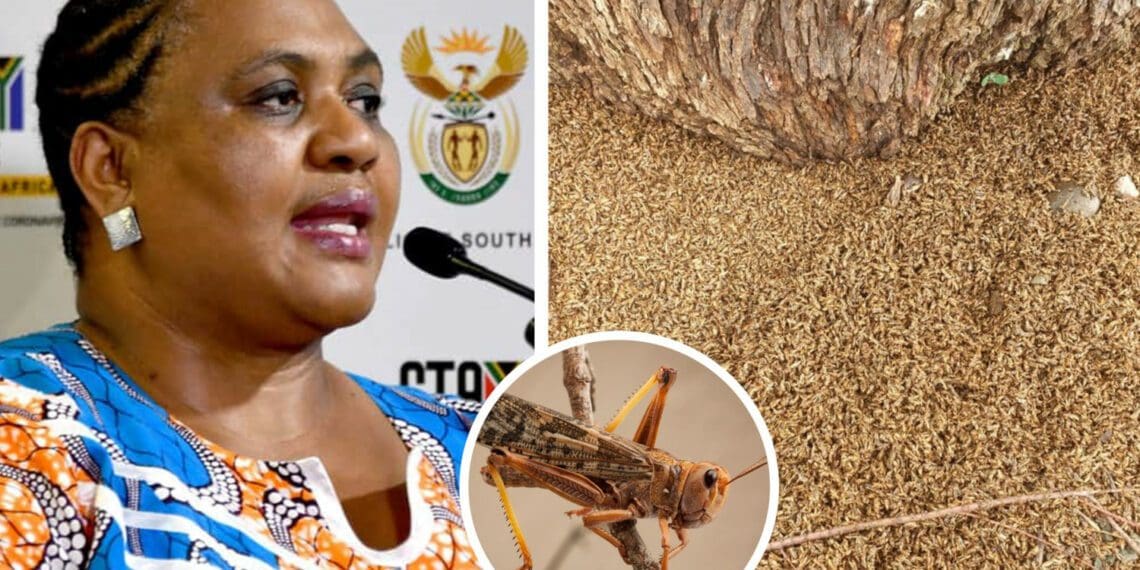
With more than R80 million already spent on insecticides and equipment for ground and aerial spraying, the minister of agriculture has confirmed that the current brown locust outbreak is the worst in decades. The outbreaks in three provinces are made worse by continuous rainfall in many areas, causing new generations of locusts to emerge with no end in sight to the reproductive cycle.
According to the minister of agriculture, land reform and rural development, Thoko Didiza, the outbreak is unprecedented in recent decades, with the insects currently in a variety of life stages.
In a statement released by her department, Didiza said that continuous rain is falling in the Karoo and nearby areas, complicating efforts to contain the outbreak and break the cycle continuously producing new swarms.
“South Africa is experiencing a brown locust outbreak since September 2021. The outbreak is in three provinces of the country (Eastern Cape, Northern Cape and Western Cape). Due to the amount of rainfall received, the outbreak tends to escalate and this resulted in the development of a new generation after the other,” the agricultural minister said.
ALSO READ: R5-million locust fight pays off for Western Cape
Why are there so many outbreaks?
The severity of the outbreak has led to an all-hands-on-deck approach by the department with aerial and ground spraying teams fighting back against locusts swarms. Currently in the Northern Cape 33 districts have been affected, 13 districts in the Eastern Cape while six districts in the Western Cape are suffering outbreaks.
Veld, grazing lands, crops, roads, railway lines, towns and residential areas have all seen swarms of ravaging locusts.
According to the department, continuous rainfall in the Karoo and nearby areas is making the situation worse.
The wind is also playing a huge role in migrating the swarms into areas where locust infestations have been unknown, such as the Garden Route area in the Western Cape and on the citrus farms of Kirkwood and Patensie in the Eastern Cape.
“There are ground teams appointed to control the locusts in the three provinces. 1200 controllers have been appointed and two helicopters are currently doing the aerial spraying, mostly on inaccessible areas and where there are huge locust outbreaks,” the department said.
What’s being done about it
To date the department said it has spent more than R80 million on the locust control program and most of the funds have been spent on the procurement of insecticide. This included the spraying pumps, protective clothing, payments to controllers and aerial spraying.

Meanwhile the Western Cape Province has contributed R5 million to assist in the locust control programme. The province has procured insecticide, protective clothing and spray pumps.
Minister Didiza said that her department has established a joint operations committee who meets once a week to discuss locust control issues. The committee consists of members of the department, the Agricultural Research Council, Northern Cape, Free State, Eastern and Western Cape provinces and organised agriculture.
“To date the Registrar has assisted by registering new insecticide to be produced for the control of brown locust as well as the registration of Bayer’s Decis to be used for aerial spraying, as it was originally used for ground control to alleviate the insecticide shortage for both ground and aerial control,” Didiza pointed out.
Locust control contractors, the department said, have also been furnished with insecticides, spray pumps and protective clothing.
ALSO READ: Locust spraying halted to find ‘missing’ insecticides
Progress to date
The huge swarms of flyers are currently in eastern districts, bordering the Eastern Cape, Northern Cape and Western Cape. The department said that aerial spraying teams were currently in those areas.
Meanwhile in the Northern Cape, 15 000 hectares have been sprayed from the air in Britstown, Loxton, Kenhardt, Groblershoop, Upington, and Kakamas.
In the Eastern Cape, 11 581 hectres have been aerially sprayed in Middleburg, Aberdeen, Steytlerville, Jansenville, Patensie and Wolwefontein. In the Western Cape 8000 hectares have been sprayed in Murraysburg, Prince Albert and Merweville. Over the borders of three provinces 6 000 hectres have been sprayed.
In terms of ground spraying, teams are continuing with their control in all areas of the three provinces as locusts in mixed life stages are being observed, including hoppers and swarms of flyers, Didiza said.
In the Northern Cape, 375 290 hectares have been sprayed on the ground, 16 000 in the Western Cape and hectares 22000 hectares in the Eastern Cape.
The Minister has called on members of the public to assist by notifying the department’s nearest district offices if they spot these locusts.
Members of the public can also report to the following officials of the department: Vuyokazi Jongwana: 0847608176 and Mulalo Matodzi: 0833267773.
Sign up for Mzansi Today: Your daily take on the news and happenings from the agriculture value chain.