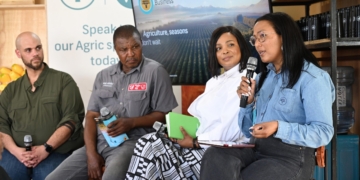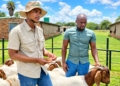
 Climate change is directly proportional to how many things we humans consume, says Dr Naudé Malan. Right now, every manufactured thing you’ve ever owned in your lifetime probably still exists somewhere on earth, and it will keep taking up space for decades to come. Malan, a lecturer and founder of iZindaba Zokudla, a Soweto-based farmers’ lab, argues for replacing human-made objects with climate-enhancing biomass.
 The weight of human-made things exceed the weight of all living things – biomass – on the planet. This has direct bearing on climate change.
We need to understand how climate change comes about and how we affect it. Thinking about the things we make allows us to see how to respond to this challenge.

The climate of the earth is created and regulated by all the living things on the planet. The processes in the ecosystem constitute a physiological process that circulates all resources on the planet and the collective interaction of all creatures creates a healthy climate.
Cockroaches chewing on food scraps are processing waste into biologically fertile habitat for other organisms.
Living things regulate the planet to a highly refined degree. For instance, if oxygen in the atmosphere increases by only 2% to 3% we would all catch fire! The Earth’s atmosphere is however in disequilibrium. Without living things, the atmosphere will change and all oxygen will react.
Living things eating and growing and dying keeps the climate stable. The “Gaia hypothesis” (which underlies the science of climate change) postulated that the earth is regulated by the activities of living things, and the more living things on earth, the more stable and better regulated is the climate. Global warming is due to the absence of enough living things to regulate the climate.
The protection and enhancement of living things are more important than driving electric cars and installing solar geysers.
The causes of global warming is thus not directly emissions and pollution, but rather comes from impacts on and losses to biodiversity (more diverse living things will regulate the climate better) and from the sheer numbers of living things that are dying or becoming extinct. To remedy it, we need more biomass. There are not enough living things left on earth to keep the climate at this very special point of disequilibrium where we can comfortably live.

The protection and enhancement of living things are more important than driving electric cars and installing solar geysers. Pollution detracts from the ability of living things to live and regulate the climate.
An increase in living things will build the capacity of the ecosystem to regulate the climate. Manufactured things are losses to regulating capacity. These losses in capacity causes natural disasters.
The way to combat global warming is thus to increase the numbers and diversity of living things on earth, and to capture the carbon in their bodies underground. All biological waste is simply too valuable as habitat for living things to discard. Because agriculture deals mostly with living things, it is peculiarly able to use these wastes productively. But what then do we do with the things we make?
Paving, concrete, roads, floors and roofs are all devoid of living things. Paving is a particularly pernicious form of habitat loss and should be avoided at all costs. Leave soil open and mulched and stop sweeping leaves away in the garden. Only pave with open blocks so water can seep into the ground.
Buy a bicycle and only use clean, efficient, extensive and above all public transportation systems.
Concrete production accounts for a significant percentage of all energy use and directly contributes to global warming. “Heat islands” emerge in our cities around bare concrete, paving and buildings. Pollution and temperatures in local areas become more severe. We lose regulative capacity and gain heat! All cities should be liberally gardened with street and food trees and agriculture integrated with planning.
Transportation pollutes, and roads occupy space like paving does. Fossil fuels need to be eliminated completely, and transport is really a dead loss in the regulating capacity of the earth. Sustainable transport only minimises losses and do not contribute to the regulative capacity of the earth. We would have to make up for it elsewhere by creating space for more plants and animals. Buy a bicycle and only use clean, efficient, extensive and above all public transportation systems.
Saving natural resources

Energy systems should not only become diverse and renewable (and should include new generation small scale safe nuclear) but should be under the control of its users.
Production and governance of energy generation should be decentralised. Smaller regenerative systems are cleaner, can be better managed and benefits can flow to people instead of bulky corporations.
Water is a key challenge. Water stimulates life which contributes greatly to more biomass and greater regulating capacity of the earth. Water channelled to urban storm water drains is immediately lost to the soil and the creatures in it. These need to be designed as urban mini-wetlands on street corners that capture water in the soil.
In South Africa we capture almost 50% of all our rain in dams. Irrigation uses most of this but arguably contributes to greater biomass as water is available widely and for longer. Irrigation agriculture unfortunately does not often use regenerative methods that store carbon and thus water in the soil. Carbon rich soils and regenerative agriculture stores more and uses less water.
Climate change is directly proportional to how many things we consume.
Water used for industry simply has to be recycled. Innovations are bound to happen and even acid mine water can now be rehabilitated at no cost! This should be the norm for all industrial processes.
Industry and agriculture will adopt such technology as it increases control over production processes. Circular enterprises and circular economic systems make this possible and will become the norm as they are more profitable. For instance, potassium nitrate and ammonium sulphate can be recovered from acid mine water with immediate agricultural applications. The water and the residue minerals can be sold. Profitability lies in multiple products derived from what we previously regarded as waste!
Water used for flushing loos is often also lost to the ecosystem and can be treated and re-processed by the ecosystem. The carbon simply has to be captured and agriculture can do so. Sewerage is full of nutrients. Used as fertiliser for agriculture it will capture carbon and help regulate climate by using existing carbon with high net gains.
Changing human behaviour
The only way to stop climate change is to capture carbon in the ground. Agricultural approaches like deep trench gardens and the use of good old fashioned compost and building organic carbon in soils should be the basis of production. We need to create agricultural systems that feed off cities and the waste generated there.

On the farm, biomass should be the first port of call for fertility and it is possible that large composting systems could lead to acceptable yields without the financial burden of synthetic inputs.
Intensive internal processes on a regenerative farm will re-make all things on the farm from previous biomass.
Climate change is directly proportional to how many things we consume. Every single manufactured item we have ever owned possibly still exists in some form on the planet. We need to eschew plastics and synthetic packaging mainly because it cannot be re-used.
Organic packaging will become topsoil if we compost it, reducing carbon in the atmosphere. Our food waste needs to be composted or processed to biochar or fertiliser or feed. Our consumption is part of the overall planetary physiology. What we consume must be recirculated to feed the ecosystem.
Humanity today is bio-phobic. Current habits are deeply entrenched but are also changeable. We as humans resist change. However, a biologically-based society is the only solution that will create enough additional interaction amongst living things to stop climate change.
Climate is sustained by biological processes, and our phobia of the natural world and our deeply cultural ways of living in built environments are undermining the climate that keep us alive. Many will be astonished how comfortable it would be with greater numbers of living things sharing our world with us. We should not be afraid of a deep dive into nature, and this is exactly what we need to do.
- Dr Naudé Malan is a senior lecturer at the University of Johannesburg and founder of iZindaba Zokudla, a Soweto-based farmers’ lab.