Lives depend on keeping Africa’s old-growth grasslands healthy. But a grim form of pollution in the Eastern Cape – soiled nappies – is undermining communal farmers’ ability to be good stewards of shared grazing. A simple solution shows how local action, if done at scale, will have regional and global implications as the climate becomes more volatile.
The call to action to deal with the nappy problem in rural Matatiele came from the indigenous stockmen, not their wives. This might come as a surprise, given that child care and the grim job of diaper changing are still the domain of womenfolk everywhere.
But a man still holds the purse strings here, and through the course of his baby’s nappy-wearing days, he might have to fork out as much as R15,000 on single-use nappies. That could buy his family three cows, give or take. However, it wasn’t the cost of the nappies that had the men worried. It was the impact on their cattle’s health.
These farmers in the Madlangala district of the Eastern Cape highlands are descendants of cattle herders who, for generations, have relied on small herds as a way to bank the family savings. They know that their nest eggs are whittled away if their animals lose condition. A lean, bony cow is going to fetch less on auction than a plump one.
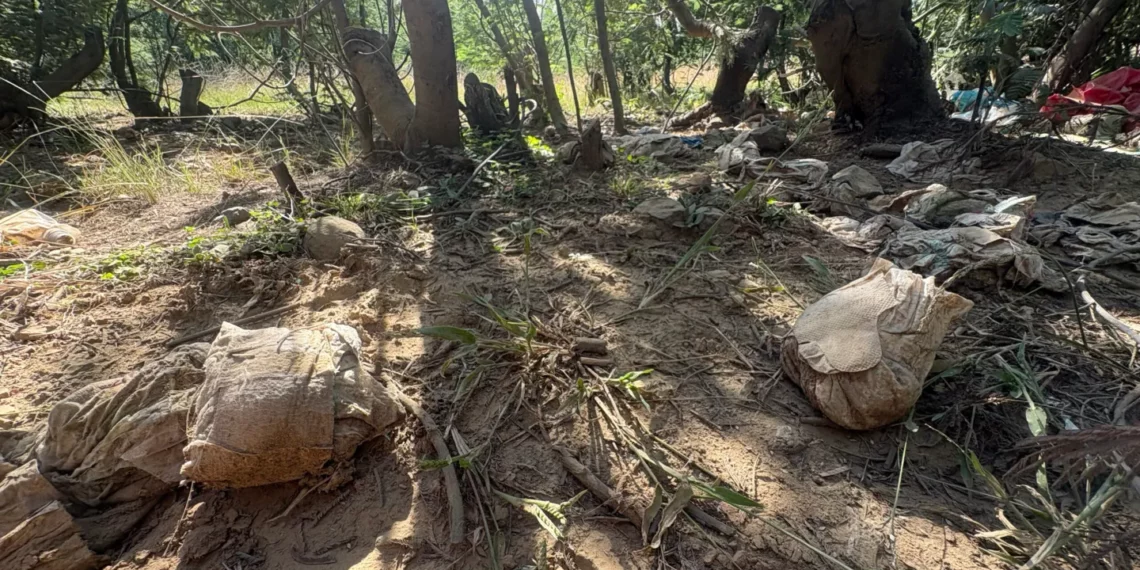
Soiled nappies, tossed into the veld and streams, were part of why farmers were battling to get their animals to market.
A healthy, bankable herd isn’t just important for a family’s livelihood in a remote countryside like this, where jobs are few, though. It has regional and planet-scale implications.

The role of grasslands
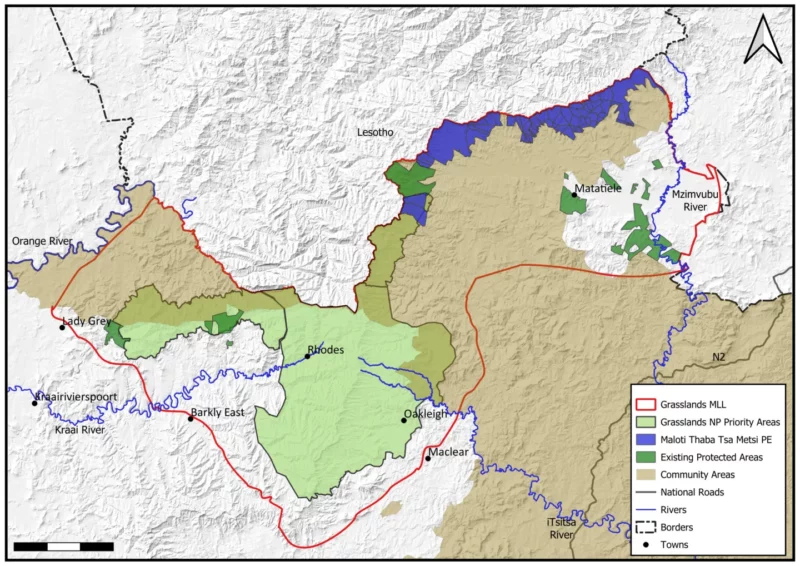
Farmers who lose money because their cows are skinny will run bigger herds to make up the loss, which hammers the veld. Animals go hungry, but overgrazing also breaks down the veld’s water-catchment function. Madlangala falls in one of the country’s strategic water source areas, a region that covers only 10% of the country but collects 50% of South Africa’s water.
Grasslands are also powerful carbon mop-up machines, taking excess planet-heating carbon from the atmosphere and locking it away in the soil, which regulates the climate across the planet.
About a third of South Africa is covered with grasslands. Plants are a tried-and-tested technology for mopping excess carbon from the atmosphere.
Trees and forest ecosystems are often seen as the heavyweights in this work. But in a country like South Africa, which doesn’t have much natural forest, grasslands are the most important ecosystem for carbon sequestration, locking away 28% of the country’s land-based carbon, according to the 2020 National Terrestrial Carbon Sink Assessment. Savannahs follow at 25%. At scale, this ecosystem service adds up to a significant contribution to global carbon clean-up.
But around 60% of South Africa’s grasslands are so badly damaged they may be irreparable, according to the Endangered Wildlife Trust.
If families’ efforts to tackle the nappy pollution in Madlangala can improve herd health and keep the veld healthy, and if similar veld restoration can be done at scale across this critical ecosystem, these citizens, and South Africa as a whole, will be adding their weight to the collective global efforts needed to address the climate emergency.
Related stories
- Water woes leave EC farmers high and dry
- Drought, rain, disease: Sheep farmers battle climate extremes
- Goat and sheep farmers breed smarter to beat climate stress
Tummy problems and tapeworms
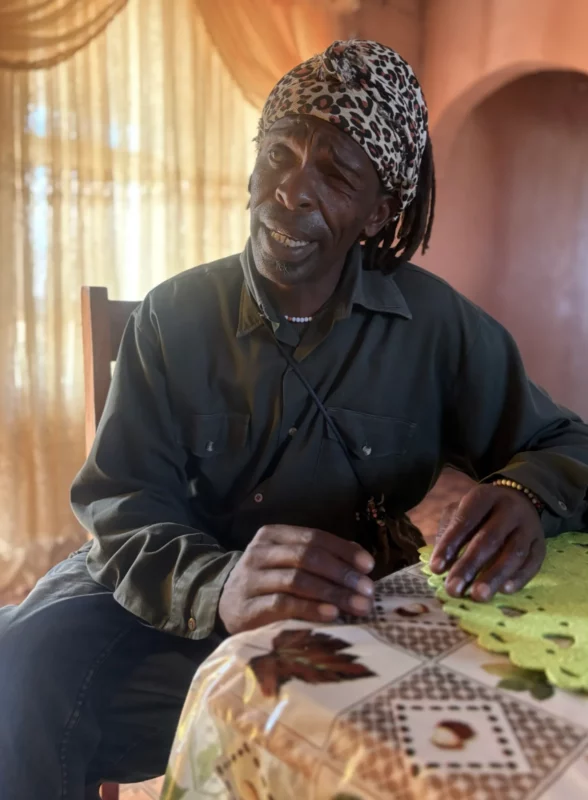
Traditional healer Xolo Mandubu has seen first-hand what happens when cows eat plastic litter lying in the veld.
“They lose their appetite. They become weak, the (digestion) is not effective,” Mandubu says. After 10 years of practising in his community, he’s found animals he’s slaughtered for ceremonies have had stomachs or intestines clogged with plastic. At best, it causes bloating and disrupts digestion. At worst, it can lead to a fatal gastric blockage.
Mandubu often treats people for diarrhoea that he attributes to drinking E.coli-tainted water, and has treated skin irritations he links with the chemicals in single-use nappies.
But there’s another reason why abattoirs steer clear of animals from communal farm areas. If the telltale sign of tapeworm infection turns up after slaughter – a noxious-looking eruption of white pimples that’s found between the muscle and hide – and if it covers more than half the animal, by law the carcass must be condemned.
“It was too risky (for abattoirs) to buy from communal areas,” says Sarah Frazee, chief executive officer of Meat Naturally, a social enterprise initiative that’s working with farmers and civil society organisations here to improve herd health and grazing.
“Sanitation has improved in the communal areas, but the diapers are a big issue, which is the combination of (eaten) plastic and the tapeworm cycle,” she says, explaining the historic reason why communal herders have battled to get into the formal meat market.
Human faeces in water courses or the veld keep this parasite cycle ticking over, with cattle picking up the eggs on grass shoots as they feed.
Mountains of waste
Like most people living in the remote countryside, families in the Madlangala area were in a bind. What to do about the mountain of nappy waste?
A household survey among a little more than 500 people in the area found that babies needed an average of four nappies in a 24-hour period. That’s 1 785 nappies a day across all the families, and roughly 100 000 nappies daily across the entire municipal district. In the course of a year, 3.1 million nappies made of virtually indestructible plastic will be thrown out in the household waste.
Families are buying cheap and convenient throw-away nappies mostly because they don’t have an alternative, even if they want washable nappies, according to Amanda Kalaku, the rangeland and waste management lead for the non-governmental development agency Environmental and Rural Solutions (ERS) that did the survey.
From the corner tuck shop selling single no-name nappies for about R2 each, to the supermarket chains in nearby towns where big brands sell bulk packs of 30 or more on special, it’s shelf-to-shelf disposables.
“That’s R2 (per nappy), it’s very cheap. But it’s not biodegradable, even for thousands of years,” she says.
Even if the plastic nappy components eventually break apart, they won’t decompose to become a useful part of the nutrient cycle, the way paper or wood do. They stay in their industrial formation, but just become too small to see with the naked eye, so they seem to have disappeared.
Municipal waste trucks don’t travel this far out, either. People can’t burn the nappies, what with all that soiled, moisture-absorbent gel. Soiled nappies can’t go in the pit latrine, because they will quickly fill it up. Bury them in the ground, and the family will soon find they lose healthy crop-growing plots to the spreading filth.
The people of Madlangala put their heads together with ERS and Meat Naturally to come up with a fix. If retailers weren’t going to stock washable options, they’d find their own supply of reusables.
What they don’t know is that their actions unwittingly align with the vast majority of citizens around the world. A recent global study found that as many as 89% of people around the world want action on climate change, and most expect this to come from their governments. For this community in rural Matatiele, they’re taking matters into their own hands, possibly without realising they’re contributing to helping the global climate effort.
The poo problem
When Kalaku and her team canvassed the locals about their attitudes towards nappies and how this informs their choices, the findings were unsurprising. The matter of stigma came up – cloth nappies are sometimes seen as old-fashioned; branded disposables are the rich mum’s choice.
“But the old cloth nappies are no longer available in the shops,” Kalaku recalls them telling her.
If people had the option, would they be willing to shift?
“I think 40% said yes, the rest said no. When we asked why not, they said ‘we don’t want to wash the poo’.”
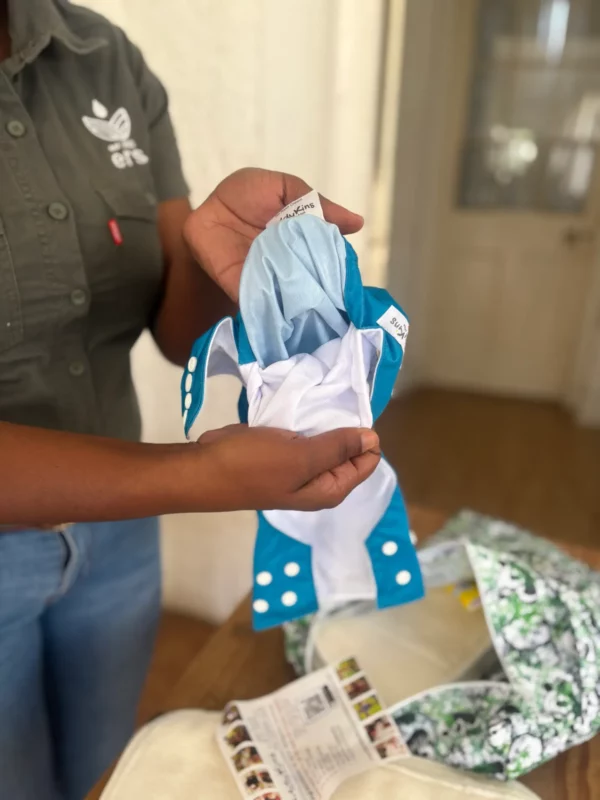
With this information in hand, ERS found a solution: a cloth nappy made by a small operator, Biddykins, in Durban, about a five-hour drive away. The nappy is shaped, unlike the old square towelling nappies, with a patchwork of press studs that allow it to expand as the baby grows. It has a waterproof insert. Most importantly, it comes with a compostable liner that catches the solids.
“They can throw the liner in the pit latrine. It’s biodegradable, like toilet paper.”
The cloth nappy then goes into the laundry basket with all the other clothes.
There was one problem, though.
“(Biddykins is) an online store. There’s no signal (out here),” says Kalaku. A rural community like this is so far off the e-commerce grid as to be invisible to it. A courier service certainly won’t deliver here.
The solution: ERS had stock delivered to their Matatiele office and worked with aspirant entrepreneurs in Madlangala who wanted to become middlemen, buying the nappies at cost and reselling them for a small profit.
It’s early days, but since the first families began using the cloth nappies in 2022, parents have remarked on how little water or elbow grease goes into laundering them.
Mostly, though, it’s the savings that they commented on. When ERS did the initial survey, 93% of people were on a child income grant, which today amounts to R560 per month. Now, instead of having to pay most of that towards disposable nappies, a once-off payment of R290 will get them a pack of two Biddykins nappies. A pack of five will set someone back by R525, and that will last for the full nappy-wearing life of the baby.
“Out of the volume of disposable nappies that was going into the landscape, if it’s reduced by 50 people, that’s four or five nappies per day. So imagine. That’s radical!’
Even some men are promoting the “smart” nappies – a deliberate renaming to remove some of the stigma that might still stick to cloth nappies. Men like Xolo Mandubu.
“A man who says he has got nothing to do with nappies, to me, such a man is more or less confused,” he chuckles, his hands rummaging in an animal skin bag to find a tub of powder from dried plants that he recommends for treating various skin conditions.
“I say (to fathers), as a man, you are the one impregnating the woman. What did you expect after that? What role do you have to play?”
Eyes twinkling with humour as he recalls his exchanges with others in the community, Mandubu rubs a pinch of the powder between his palms and wipes it over his brow and cheeks.
“How did that young boy (that you fathered) grow?” he asks men. “He didn’t come out of nowhere.”
- This article was first published by Daily Maverick.
READ NEXT: The farmer’s guide to supplying fresh produce to markets