When the taps run dry, it’s more than just water that’s lost. Food For Mzansi journalist Vateka Halile travelled to Buffalo City Municipality, where small-scale farmers spoke openly about the daily struggle of trying to grow crops without a reliable water source. Even when it rains, the water disappears again because of failing infrastructure.

For new-era crop farmers in the Eastern Cape, every missed drop means stunted plants, lost income, and sleepless nights.
From Mdantsane to Berlin and Msintsini Village, their stories share the same pain: years of water challenges, no real solutions, and dreams slowly fading under the sun.
When farmers can’t grow food locally, it’s not just them who suffer. Food security in the region is affected too.
According to the Eastern Cape department of agriculture, the crisis in Buffalo City Municipality is a combination of drought, logistical issues, and infrastructure.
However, farmers do not agree.
When farming becomes a burden
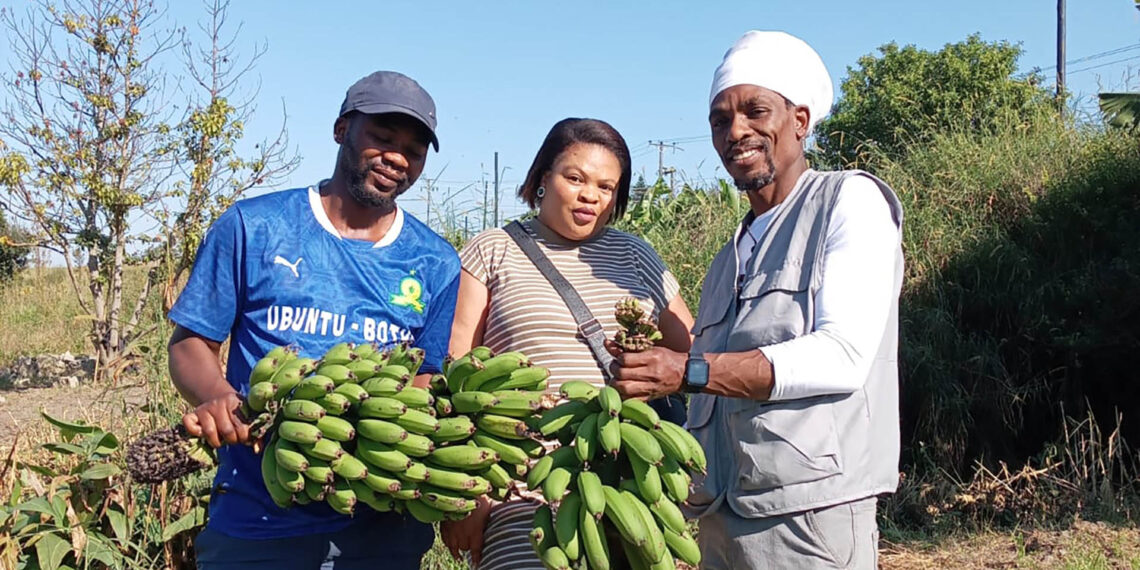
For Sihle Ntozini from Nu-1 Mdantsane, farming has become a struggle. He farms on a 1.2-hectare plot, growing crops like spinach, cabbage, potatoes, broccoli, and bananas. But now, only the bananas survive. The rest are dry, weak, and not bringing in any income.
“It started in 2020. When it rains, it pours – and floods all the crops I had,” he said.
Sihle also has water running through his land from a nearby stream, but it’s dirty. He doesn’t trust it enough to use it for watering his plants.
What once was a thriving food plot in Mdantsane feels forgotten now, he noted, with tears in his eyes.
Mangaliso Balelo from Emsintsini Village was known for growing healthy produce and supporting the local community with fresh fruit, herbs, and vegetables. That was before the water crisis became a heavy burden for him.
He said the struggle started to show in 2020, when the water shortages hit.
“Even though we were helping the village by providing fresh produce locally, so people didn’t have to spend money going to town, we had to close down.”
He added, “I thought about using the community tanks to water my crops, but that water is meant for drinking – it’s more important than my business,” said Balelo.
READ NEXT: Drought, rain, disease: Sheep farmers battle climate extremes
Reliance on different water sources
Of all the provinces, the Eastern Cape is the least reliant on municipal water, with only 30% of farmers identifying it as their primary water source. Eastern Cape farmers rely on rainwater tanks and rivers more than any other province.

Only 30.77% of Eastern Cape farmers rely on municipal water. The lowest in the country. Nationally, about 55% of farmers rely mostly on municipal water.
The publicly available data does not clearly show when these farmers opted for alternative water sources. In a 2022 census question on municipal supply reliability, a staggering 69% of Eastern Cape farmers replied that it does not apply to them.
Even back in 2016, water was already a problem for Phiwokuhle Myoyo, a crop farmer and advocate from Berlin Village. Taps would open for a few hours, then shut again. But she managed, until things got worse.
As someone who’s been pushing for better support in Buffalo City Municipality, Myoyo says she’s tried everything. “I’ve knocked on every door – from the extension office to Amatola Water, even the premier, Oscar Mabuyane. Nothing has changed.
“Last year February, I felt like I was gambling with my soul. Relying only on water tanks, and when they run dry, there’s no backup.”
She believes things could’ve been different. “If we were supported properly with boreholes, we wouldn’t be here.”

Now, Myoyo is considering walking away from farming. “It’s hard to believe that after all these years of asking for help, we’re still singing the same song. It’s too much.”
Myoyo said the worst part was around Easter. It rained for two weeks straight, but just a few days later, the taps were dry again.
READ NEXT: Goat and sheep farmers breed smarter to beat climate stress
The impact of climate change
After a conversation with Buffalo City Municipality authorities, who declined an interview, we reached out to the office of Eastern Cape Premier Oscar Mabuyane. He then tasked the department of agriculture in the Eastern Cape to respond.
Atule Joka, the media liaison officer with the department of agriculture in the Eastern Cape, confirmed that Buffalo City is currently experiencing a degree of water stress, in line with broader drought-related challenges across the Amathole District.
He said the primary causes include prolonged drought conditions experienced since 2019 and the growing impact of climate change. High temperatures, unpredictable rainfall, and reduced recharge of groundwater resources have all contributed to the strain.
“The drought in the province was officially declared in 2019, but farmers and communities began to feel its effects as far back as 2016 in certain areas.”

Warming Stripes for Port Elizabeth, South Africa from 1857 to 2024. Each stripe represents the average temperature for a single year. Darker blues indicate cooler years, while darker reds show warmer years. The persistent red shading from 2000 onwards reflects a period of sustained higher temperatures.
Joka further noted that the situation has become cyclical, with periods of brief relief followed by prolonged dryness. “This is consistent with the effects of long-term climate variability.”
Rainfall may seem adequate, but the intense heat that often follows results in high evaporation rates.
“The department of water and sanitation (DWS), together with the municipality as the water services authority, manages bulk water infrastructure. However, changing weather patterns, high runoff from hardened ground, and limited storage capacity all contribute to water not lasting as expected.”
Joka stated that the crisis in Buffalo City Municipality is a combination of all three things: drought, logistical issues, and infrastructure.
“The drought has certainly worsened the situation, but ageing infrastructure and population growth have also placed additional pressure on supply systems.”
EC department of agriculture
“Where infrastructure is in place but poorly maintained, water losses are inevitable.”
The DWS Water Supply Reliability dashboard’s data suggests that even when farmers choose municipal water, the supply is only guaranteed about half of the time.

Municipal water supply is not reliable in the Eastern Cape. Interestingly, Limpopo has similar water reliability, but has seen a significant increase in agricultural households.
How many farmers are left?
The testimonies of Ntozini, Myoyo and Balelo are compelling and echo the experience of many farmers in the Eastern Cape, but what has the overall impact of drought and unreliable water infrastructure been on farmers? And how does the Eastern Cape compare with other provinces?
The reality is, many farmers have simply given up.
The animation below shows a time-lapse of crop cover (yellow) in the Eastern Cape between 2015 and 2025. The data is from Dynamic World’s land cover maps that classify and track land cover change. While the classification is accurate to 10m, crops can sometimes be confused with grassland and shrubs. The impact of drought on crop cover is, however, clear.

According to the last national census, between 2011 and 2022, South Africa gained an additional 4 million households, bringing the last count to 17.8 million. This is a significant increase of 23%.
In the same period, the share of households engaged in agricultural activity has, however, decreased. The number of agricultural households fell from 2.88 million in 2011 to 2.46 million in 2022 – a decrease of over 400 000 households, or about 14%.

A change in the number of agricultural and non-agricultural households as recorded in the 2011 Census and 2022 Census.

In 2022, most farmers were in KwaZulu-Natal and the Eastern Cape. Only Limpopo has seen an increase in agricultural households between 2011 and 2022.
Only Limpopo has seen a relative increase in farming households, and the Northern Cape has relatively lost the most farmers. But, in absolute terms, KwaZulu-Natal and the Eastern Cape have had the biggest loss of agricultural capacity.
The Eastern Cape has lost almost 115 000 farmers in the last decade.

The Eastern Cape and KwaZulu-Natal have seen the biggest absolute loss of agricultural households.
Most farmers in South Africa are black, so it would follow that any change in the size of the sector would affect this demographic the most, but it is notable that in the Eastern Cape, it is the only group that has seen a reduction in farming.

What next?
Farming has become increasingly precarious throughout the country. While a province like Limpopo has seen an increase in farming activity, most have seen a decline, and in the Eastern Cape, it could hardly get worse.
Joka told Food For Mzansi that it is finalising the Irrigation Scheme Production Strategy (ISPS), which will provide a regulatory framework for the governance of irrigation infrastructure and ensure sustainable land and water use.
He explained they are also:
• Revitalising underperforming irrigation schemes.
• Rehabilitating dams and windmills.
• Supporting community-based water storage solutions.
Joka said public consultations on the ISPS will take place, and the document will be published for comment in the Provincial Gazette.
The water crisis in Buffalo City has pushed many small-scale farmers to the brink. While climate change plays a part, failing infrastructure and limited government response have deepened the struggle. As food security falters and farming households vanish, urgent, lasting solutions are needed.
The province has a critical chance to turn the tide. Without real action, more farmers will be forced to walk away from the land they love.
This article is a collaboration between Food For Mzansi and OpenUp, supported by Africa Data Hub.
ALSO READ: ‘We’re just surviving’: Water woes & land limits cripple NC farmers
Sign up for Mzansi Today: Your daily take on the news and happenings from the agriculture value chain.