Farming is a business, and to be profitable, you need a reliable way to sell your produce. Supplying a large-scale fresh produce market provides farmers with a crucial commercial outlet, offering direct access to a wide network of buyers from retailers to informal traders. This ensures consistent demand for your crops.
However, supplying a market comes with strict regulations for quality, food safety, and fair trade. To enter the market, producers must understand the rules around compliance, packaging, transport, and quality standards. Charles Park, chief operations officer at Joburg Market, explains the requirements for supplying fresh produce markets.
Understanding the benefits of a market system
According to Park, selling through a major market hub can be very beneficial for farmers. Fresh produce markets offer access to thousands of buyers each day.
Additionally, some markets also provide robust infrastructure, which reduces the need for farmers to invest in their own facilities. This can include cold storage, banana ripening rooms, advanced IT systems for sales processing, and strong security.
Park notes that the Joburg market has an on-site laboratory for product testing to ensure compliance and food safety.
“Market agents take care of marketing and sales aspects, freeing farmers to concentrate on production. Another advantage is more secure payment arrangements compared to individual transactions, with payments made to farmers within 24 hours, ensuring a positive cash flow,” he says.
Related stories
- Farmers demand fairer fresh produce markets
- Smart crop protection for greenhouse farming
- Export ready? Here’s what to know about Sacu
- How to compile a winning agribusiness plan
The role of a market agent
Market agents are central to the trading system. Park says, “Agents represent the farmer, and the produce remains the property of the farmer until it is sold. Their role is to secure the best possible price while ensuring that all transactions are fair and transparent.”
Agents also help farmers focus on production by handling the complexities of sales, logistics, and administration. According to Parks, since their earnings are tied to the value of the produce sold, agents are motivated to negotiate the best possible price. Their established networks and knowledge of demand trends also give farmers an advantage in reaching a wider pool of buyers.
Parks explains that markets typically operate on a commission-based model. “Our market agents receive a 7.5% commission on the gross value of produce sold, while the market management receives 5%.”
This structure is often legally regulated under acts like the Agricultural Produce Agents Act No. 12 of 1992, which requires the use of trust accounts and monthly reconciliations to protect farmers’ earnings and ensure transparency.

Essential requirements for supplying markets
Before you begin supplying, producers must understand the key requirements for their produce. According to the Joburg Market farmers’ guide, fresh produce must meet good agricultural practices (GAP) and good manufacturing practices (GMP).
Every container delivered must be properly packed and clearly marked with the following information:
- Producer details: Your name or trademark, and your physical or postal address.
- Product classification: Indicate if it’s Class 1, Class 2, or Class 3.
- Product count: The number of items per container, if not visible.
- Net mass: For vegetables, grapes, potatoes, onions, and bananas.
- Product name and type: If not visible from the outside.
- Packing date: A date or date code is highly recommended for stock management.
Producers can also include an optional production unit code (PUC) or pack house code (PHC), issued by the department of agriculture. That can be requested through the food safety & quality assurance (FSQA) directorate at the department.
Transport requirements
The guide also emphasises that protecting produce during transport is essential to maintaining freshness and preventing contamination.
- Cleanliness: The vehicle must be clean, dry, and in good repair.
- No contamination: Do not transport fresh produce with fertilisers, pesticides, meat, or chemicals.
- Protection: The produce must be protected from the sun, wind, rain, dust, and pollution. Trucks should be closed or covered with a waterproof tarpaulin.
- Cold chain: For produce that needs to be kept cold, like strawberries, grapes, and stone fruit, you must use refrigerated or insulated trucks.
Quality and safety standards
Fresh produce should also comply with the Agricultural Product Standards (APS) Act, Act 119 of 1990. All produce is inspected upon arrival and must be:
- Clean and free from soil.
- Free from blemishes, cracks, and bruises.
- Strong enough to withstand handling.
- In compliance with the declared weight or count.
“It’s your responsibility to ensure all produce is fit for human consumption, meaning it’s free from decay, mould and pesticide residues. The market reserves the right to refuse, downgrade, or reject any produce that does not meet these standards,” the guide states.

Packaging guidelines
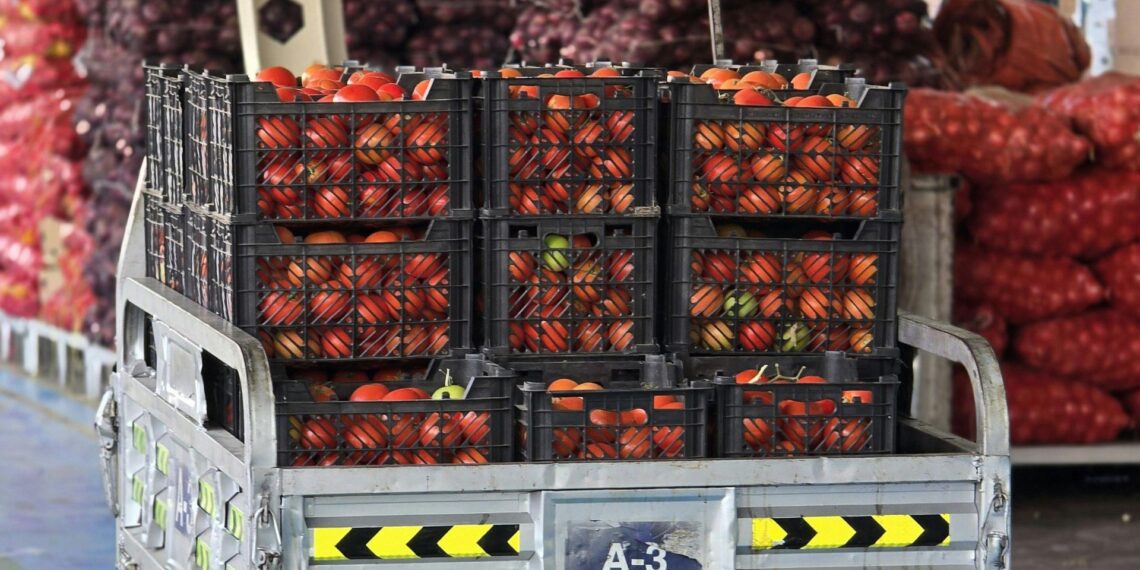
Proper packaging is critical for protecting your produce. Use clean, strong containers and stack them on pallets. Reusable plastic crates must be disinfected and have old labels removed.
Containers should be filled to capacity, and fruit boxes should never be stacked upside down.
The supply process
The determination of produce prices at the Joburg Market follows a discovery mechanism based on the principle of supply and demand. Parks explains that prices fluctuate daily, influenced by factors such as availability, buyer interest, weather conditions, transport logistics, and production challenges.
“There is no fixed or predetermined price; transactions are negotiated in real time between willing buyers and sellers. This creates a dynamic environment where market agents leverage their knowledge and negotiation skills to ensure farmers achieve the most competitive returns,” he says.
To supply a market, producers will need to complete a delivery note with the product, farmer, and market agent details. When the produce arrives, market staff will use the note to create a producer code and gate number, which will be used to proceed to the market agent. The guide states that the produce remains the property of the producer until it is sold. This is logged on the sales processing system (SPS) for transparency.
If a return is requested, a signed letter must be submitted to the particular market agent. If produce is unsaleable, a market floor inspector must approve its destruction, and the producer will be informed and can request photos.
“Selling through the market allows farmers to benefit from competitive market pricing based on real-time supply and demand, potentially leading to better returns than direct selling,” Parks says.
READ NEXT: Farming smarter: Digging into GIS data