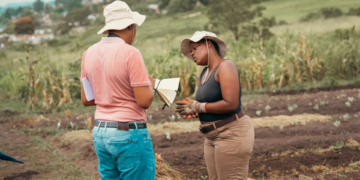
South Africa’s smallholder farmers are producing more, but many are still struggling to earn a sustainable income. Agricultural economist Glen Mendi argues that extension services must move beyond teaching production techniques and include market access, pricing, value chains and profitability if farmers are to truly improve their livelihoods.
Farmers not only need to know how to grow crops, but they also need to know whether those crops can improve livelihoods. For decades, agricultural development in South Africa has followed a familiar script: teach farmers how to produce more.
Extension officers travel to rural communities, demonstrating planting techniques, advising on pest control, and promoting improved seed varieties. In many cases, this support has worked, yields have improved, knowledge has expanded, and farming practices have become more efficient. But there is a persistent problem that continues to undermine these gains: farmers are producing, yet many are not profiting.
Across rural areas, smallholder farmers often find themselves in a frustrating cycle. They harvest crops successfully, only to face low prices, unreliable buyers, and limited access to markets.
Without the ability to sell at fair value, increased production does not translate into improved livelihoods. Instead, it can lead to oversupply, waste, or distressed sales. This raises an uncomfortable but necessary question: what is the value of production without markets?
Traditional agricultural extension systems have focused heavily on the “how” of farming: how to plant, how to irrigate, how to manage soil. While this technical support is essential, it addresses only one side of the farming equation.
Related stories
- Extension officers: Farmers’ lifeline, but they need support too
- Agricultural extension services must evolve or be left behind
- More resources, empowerment needed for extension officers
- Farm extension services key to inclusive agricultural success
The role of extension services
Farming is not just a biological process; it is also an economic activity. When extension services overlook markets, pricing, and profitability, they leave farmers only half-equipped. A farmer may know how to grow tomatoes, for example, but without understanding market demand, price fluctuations, or distribution channels, that knowledge has limited economic value.
This gap helps explain why many smallholders remain trapped in low-income agriculture despite improved productivity. This is where agricultural economics becomes critical. Agricultural economists shift the focus from “how much can be produced” to “what should be produced, for whom, and at what return.” They analyse markets, identify opportunities, and help farmers make informed decisions about what crops are worth investing in.
Their role includes:
- Understanding supply and demand dynamics
- Providing price information and forecasts
- Identifying profitable value chains
- Assessing risks and returns
- Supporting business planning and commercialisation
In essence, agricultural economists help farmers think like entrepreneurs rather than just producers. Without this perspective, farmers may continue to grow crops that are easy to produce but difficult to sell, or they may miss opportunities in emerging markets.
The growing interest in underutilised indigenous crops presents a perfect example of why economics must complement extension. Crops such as sorghum, millet, cowpeas, and amaranth are increasingly recognised for their climate resilience, nutritional value, and cultural importance.
They offer a promising pathway for diversifying South Africa’s food system, especially in the face of climate change. However, promoting these crops without developing markets would be a mistake.
Farmers are unlikely to adopt new crops at scale unless they are confident that there is demand and that they can earn an income from them. This requires:
- Market development
- Consumer awareness
- Processing and value addition
- Supply chain coordination
Agricultural economists play a key role in identifying these opportunities and ensuring that indigenous crops move beyond subsistence production into viable commercial enterprises.
Bridging the gap
One of the biggest challenges facing smallholder farmers is the disconnect between production and markets. Many farmers operate in areas with limited infrastructure, weak transport systems, and poor access to information. As a result, they are often excluded from formal markets and forced to rely on informal or local sales. Bridging this gap requires a more integrated approach to agricultural support.
Extension officers and agricultural economists must work together to:
- Link farmers to buyers and aggregators
- Provide real-time market information
- Support collective marketing through cooperatives
- Develop local and regional value chains
- Strengthen agro-processing opportunities
This collaboration ensures that farmers are not only producing efficiently but also participating meaningfully in the economy. If South Africa is serious about transforming its rural economy, extension services must evolve.
The future of extension is not just about transferring technical knowledge; it is about enabling farmers to succeed in markets. This means integrating economic thinking into extension systems, equipping officers with basic market knowledge, and fostering partnerships with agricultural economists and other value chain actors. It also means recognising farmers as businesspeople.
Farmers make decisions every day about what to plant, how much to invest, and when to sell. These are economic decisions, and they require access to information and support that goes beyond agronomy.
- The views and opinions expressed in this article are those of the author and do not necessarily reflect the views or positions of Food For Mzansi.
READ NEXT: Labour crackdown: Farmers face rising risks over illegal workers