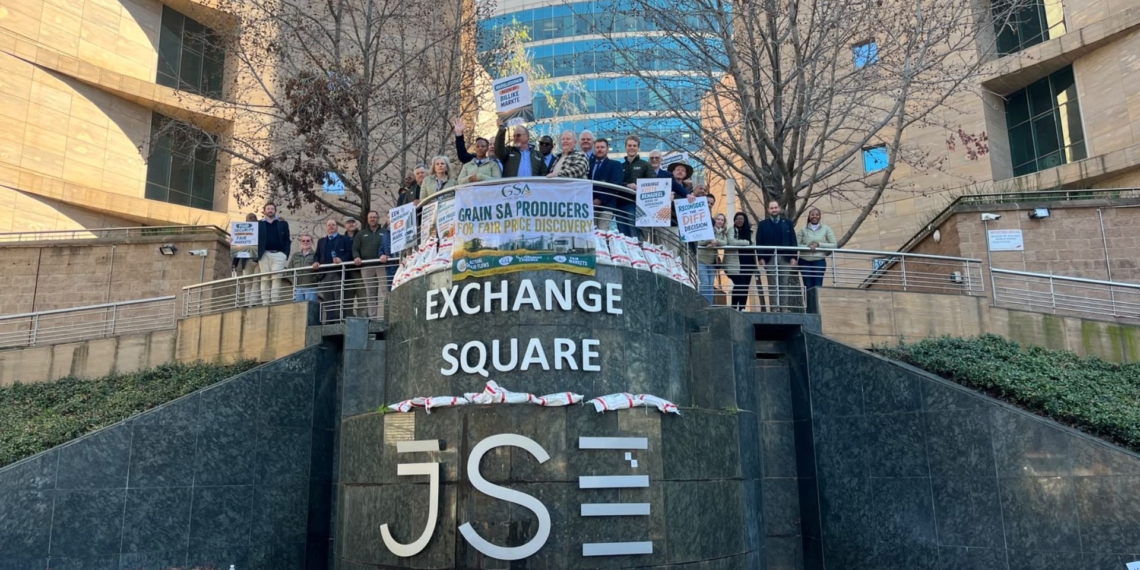
This week, South African grain producers took their call for fair and transparent soybean price discovery directly to the Johannesburg Stock Exchange (JSE), as Grain SA formally handed over its petition and memorandum opposing the decision to return to a single soybean reference point.
Grain SA leadership, board members, and producers participated in a peaceful march through Sandton before handing over the documents to representatives at the JSE’s offices in Gwen Lane.
The petition, supported by 965 signatures and 511 supporting comments, calls on the JSE to reconsider its decision, conduct a transparent and evidence-based review, and adopt a price-discovery system that better reflects actual grain movements and physical market realities.
Grain SA not backing down
Richard Krige, chairperson of Grain SA, said producers made their position clear in a peaceful but firm manner.
“This is not simply about one reference point. It is about whether the system reflects the realities of the physical market and whether producers can have confidence that decisions affecting their businesses are based on transparent evidence,” he said.
Grain SA said in a statement that it is concerned that the decision to reject the Multiple Reference Point model was not supported by sufficient quantitative evidence and that the agreed evaluation criteria were not adequately addressed.
A return to a single reference point could lead to transport-related deductions based primarily on distance from that point instead of taking adequate account of regional supply, demand and the actual movement of soybeans.
Related stories
- Grain SA defends farmers against blame for rising food prices
- Grain SA CEO calls for overhaul in agricultural education
- SA food inflation slows, but rising costs squeeze farmers
- Squeeze or survival? SA farmers ditch retailers for local direct trade
Grain SA chief executive officer Dr Tobias Doyer said efficient markets require credible price discovery.
“Our position remains that the methodology should reflect where grain is produced, where demand exists and how grain actually moves through the market. Unnecessary inefficiency ultimately creates costs somewhere in the value chain.”
The organisation is continuing with its technical submissions, engagement and proceeding with legal action, including an urgent application to prevent implementation of the decision while the matter is challenged through appropriate processes aimed at protecting producer interests and securing a more efficient and transparent outcome.
Participants also carried bags of maize meal as a symbolic reminder that sustainable primary production ultimately underpins food security. The maize meal was donated to charitable organisations following the event.
READ NEXT: Floods, global conflict force lower SA citrus export estimates