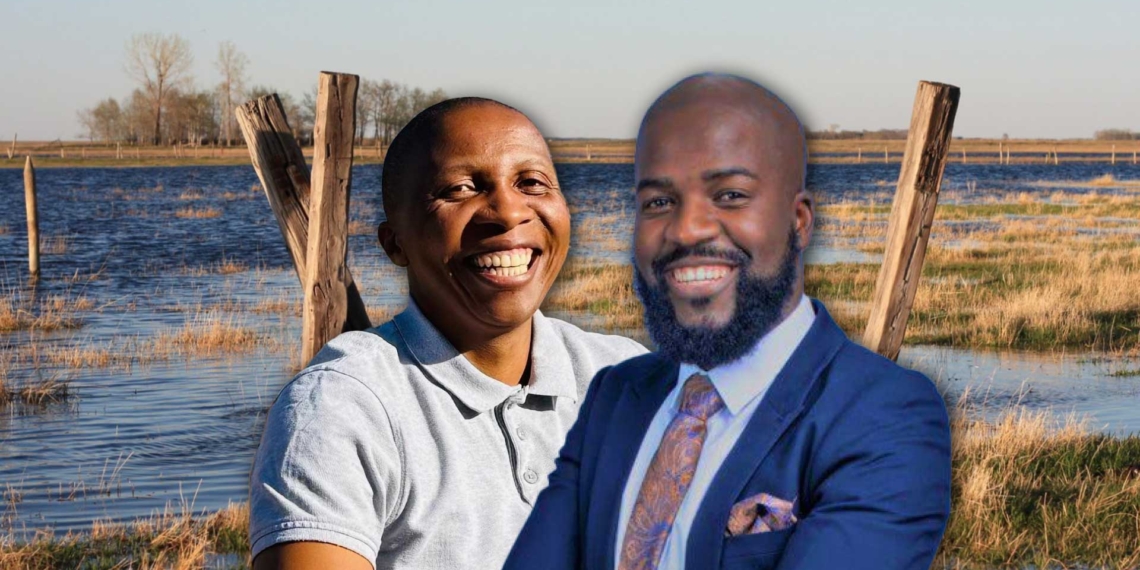
Climate change is escalating risks for farmers, yet most small-scale farmers remain uninsured. Dr Siphe Zantsi, an agricultural economist at the Agricultural Research Council (ARC), and Lunga Njara, manager of strategic partnerships at Land Bank Insurance, delve into the causes of low insurance uptake, key challenges, and practical solutions.
Climate change is one of the global threats to sustainable food systems. All the projections suggest that climate variability will intensify in the future, and the poor are likely to bear the brunt more than anyone else. Our only inevitable option is to get our act together, reduce greenhouse gas emissions, and find sustainable adaptation measures.
Agriculture is one of the sectors that depend on climatic conditions. As such, climate change hits hard on the sector regardless of the size, intensity, and scale of farming.
Crop and livestock insurance exist to cushion farmers against such worst-case scenarios. The recent heavy fall of snow is a typical case in point and a wake-up call.
It is said that many farmers have lost livestock and crop fields, although the exact damage and cost have not yet been fully quantified. Just before the snowfall in some parts of the country, farmers had lost livestock due to veld fires.
However, a vast majority of our small-scale farmers have not insured their farming operations. Anecdotal evidence suggests that only one in ten small-scale farmers have insured their farms.
Eastern Cape MEC for rural development and agrarian reform, Nonceba Kontsiwe, has encouraged communal farmers and smallholder farmers to formalise their businesses and take out insurance policies for their agricultural assets so that they are covered against such occurrences. Currently, guesstimates suggest that only one in ten smallholders have crop insurance.
What could be the causes for the poor insurance uptake?
The challenges contributing to low insurance uptake are two-fold. Some factors challenge the demand-side growth, and some challenges affect the supply-side growth in agricultural insurance.
A view from the former is that factors such as farmers’ awareness of insurance solutions, the affordability of premiums due to a lack of subsidies, limited understanding of insurance solutions as a result of inadequate capacity-building initiatives, and a lack of suitable solutions due to a lack of innovation and flexibility in product design affect the demand for insurance, resulting in low uptake of insurance cover.
The supply-side growth challenges include the high cost of agricultural insurance due to a lack of subsidies or insurance support, unreliable data which results in inadequate modelling, a lack of innovation in the sector, regulatory barriers, and an absence of adequate distribution channels. All these factors have dire consequences on the supply of insurance solutions.
What can be done to encourage farmers to insure their farm operations?
South Africa needs an enabling environment and an effective regulatory framework for the sustainable development of agricultural insurance. This environment needs to foster growth and innovation in the sector by addressing both the demand- and supply-side growth challenges.
The focus should be on flexibility in product design by insurers, capacity building, and public awareness of agricultural insurance products, their benefits, and risks.
Data is king in insurance; therefore, efforts should be made to partner with relevant stakeholders and obtain reliable data to enable risk-based pricing. In addition, clarity and consistency in regulations around insurance products are elements that need great attention.
Lastly, collaboration among stakeholders for public-private partnerships that seek to minimise costs, improve efficiency, and have a massive impact is needed.
Who offers farm insurance, and what do they need to insure you?
Currently, there are a few companies that offer agricultural insurance coverage. The cover offered is on an indemnity basis, with hail being the primary peril covered under crop insurance.
Index insurance as a form of innovation is still in its infancy and pilot stage.
Related stories
- Potato farming: Tips from a pro to beat climate challenges
- G20 Summit sparks optimism for Mzansi agriculture in 2025
- Crop insurance: Why are small-scale farmers so hesitant?
What are some of the current offerings from the state-owned insurance companies?
Land Bank Insurance currently offers crop insurance solutions, and asset and livestock cover, and is piloting index insurance for both crop and livestock farmers.
Some of the perils covered under crop insurance include damage to crops as a result of hail, fire, frost, wind, locusts, and chemical spray. The offering differs from one district to another.
For livestock, the perils covered include risks arising from fire and lightning, snake bites, plant poisoning, and transit risks.
What do agricultural insurers consider before issuing cover?
Insurers go through a process called insurance underwriting, which is guided by a set of principles and proven assumptions.
Underwriting is the process of risk profiling, taking into account the insurance needs of the farmer, profiling the risk, and proposing suitable insurance cover.
Different insurers have different underwriting guidelines.
For livestock
However, some universally accepted rating considerations for livestock include:
- Type of animal
- Susceptibility of the animal to the insured peril
- The location of the animals
- Their age and growth cycle
- The geographic spread of farmers needing similar cover
- The individual loss history
- The overall management and production system
For crops
For crop insurance, the rating considerations differ because it is quite a specialised field.
Some of the considerations are very specific and include understanding variables such as:
- The crop type history
- The area’s exposure history
- The farmer’s individual loss history
- The susceptibility of the crop to the insured peril
- The perils being insured
Location, geographic spread for distribution, and higher producer participation are also considered.
- Dr Siphe Zantsi is an agricultural economist at the Agricultural Research Council, and Lunga Njara is the manager of strategic partnerships at Land Bank Insurance. The views and opinions expressed in this article are those of the author and do not necessarily reflect the views or positions of Food For Mzansi.
READ NEXT: Farmers face rainfall uncertainty this summer
Sign up for Mzansi Today: Your daily take on the news and happenings from the agriculture value chain