With just 65 hectares of land at her disposal, Makhosazane Sambo, together with a group of green-fingered women are slowly but surely growing Sikhwahlane, in the Nkomazi area of Mpumalanga, into a farming heaven.
These women co-exist as the Ikhwezi Vegetable and Poultry Cooperative, a privately-owned business founded by a group of five farmers who were initially only planning to provide for their immediate families.
Today, they are supplying fresh vegetables to local supermarkets, including Shoprite, and the fresh produce markets in Johannesburg and Durban. Although the co-op was only formally registered in 2010, it formed by Sambo way back in 2002. Formal registration as a business helped them to access government funding.
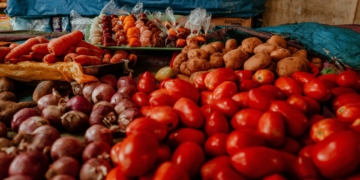
Today they produce green beans, butternuts, tomatoes, onions, beetroot, spinach, chickpeas, bitter melon, sugar beans, watermelon and much, much more. Ikhwezi also provides mechanisation services and farming support (like coaching and mentorship) to local up-and-coming farmers.
Sambo, the founder, was born into a family of vegetable growers. As the fourth-born, her job was to wander the streets of her community to sell their vegetables. “I would go from door to door selling veggies which I carried in a bath basin on top of my head. I was 11 years old then.”
At one point, the little Sambo even convinced her mother to open a market on the side of the road, close to a taxi rank. They sold their veggies there until Sambo went to high school and didn’t want anything to do with agriculture.
“I didn’t want to learn about agriculture. I told myself that this thing was for grannies and old people. I even told my mother that I did not like agriculture,” she says.
After matric she could not afford to go study further. “My family was poor, and they did not have money to send me to tertiary level. It was a very difficult time in the 1990s.” She had very little choice but to return back to the land after completing matric. “I worked for three months after matric, but I said to myself, ‘Why should I go and work for other people while I have a farm?’”
Today, what started out as a family farm on five hectares of land given to them by the local chief, has increased to 65 hectares. “I love farming here and I love agriculture. It feeds my family and community, which means that people around me are no longer struggling to access vegetables like before.”
Despite the co-op’s super success, there have been many challenges that threatened their survival, including pests. They also did not have a packhouse and as a result endured many crop thefts.

Sambo says it was tough because they would store their harvested crops under trees. “It was tough because we did not have a packhouse. We were using a tree to store our produce and people entered the fields and they would take everything we saved. There was nothing to protect the crops. We would just take grass and throw it over the crops to (try and) cover it. It was difficult, but we pushed through.”
They had many other challenges too, she says. “We are located near a river where there’s a lot of snakes slithering around. Sometimes we would find a snake amongst our veggies, even rats occasionally chowed our crops.”
And then there were the daily difficulties like pumping water from the river. “We used a diesel engine which required manual labour to start it. As women, it was very tough for us. The women combined would start the engine with much difficulty.”
“It was tough and there were times when I just wanted to give up because of the challenges. I thought, let me leave this thing called agriculture and go back to school to study something. But because of that passion and living in a place where people are struggling to survive, I simply could not.”
Sambo says, however, their prayers were answered in 2011 when they received funding from the National Development Agency to build a pack house. The Shoprite group has also been a big saviour and the budding farmers now benefit from business training as well as the latest techniques and workshops on permaculture farming. Shoprite also provided them with seedlings and starter kits to establish an additional ten vegetable gardens in Sikhwahlane.
“The assistance from Shoprite is a real game-changer for us. The seedlings could not have come at a better time as they are hard to come by as a result of the ongoing covid-19 pandemic. The training has taught us to be less dependent on chemical fertilisers and we now use compost to fertilise our plants, which will make our produce more attractive to the big retailers.”
The founder adds that while Ikhwezi Vegetable and Poultry Cooperative would love to obtain global certification for their produce, it is rather costly, and they would have to implement many changes that they currently simply cannot afford.
But the future looks bright, though, and in the near future Ikhwezi will be further expanding its business to include a nursery and fisheries. And Sambo would also like to start producing under nets or greenhouses going forward.