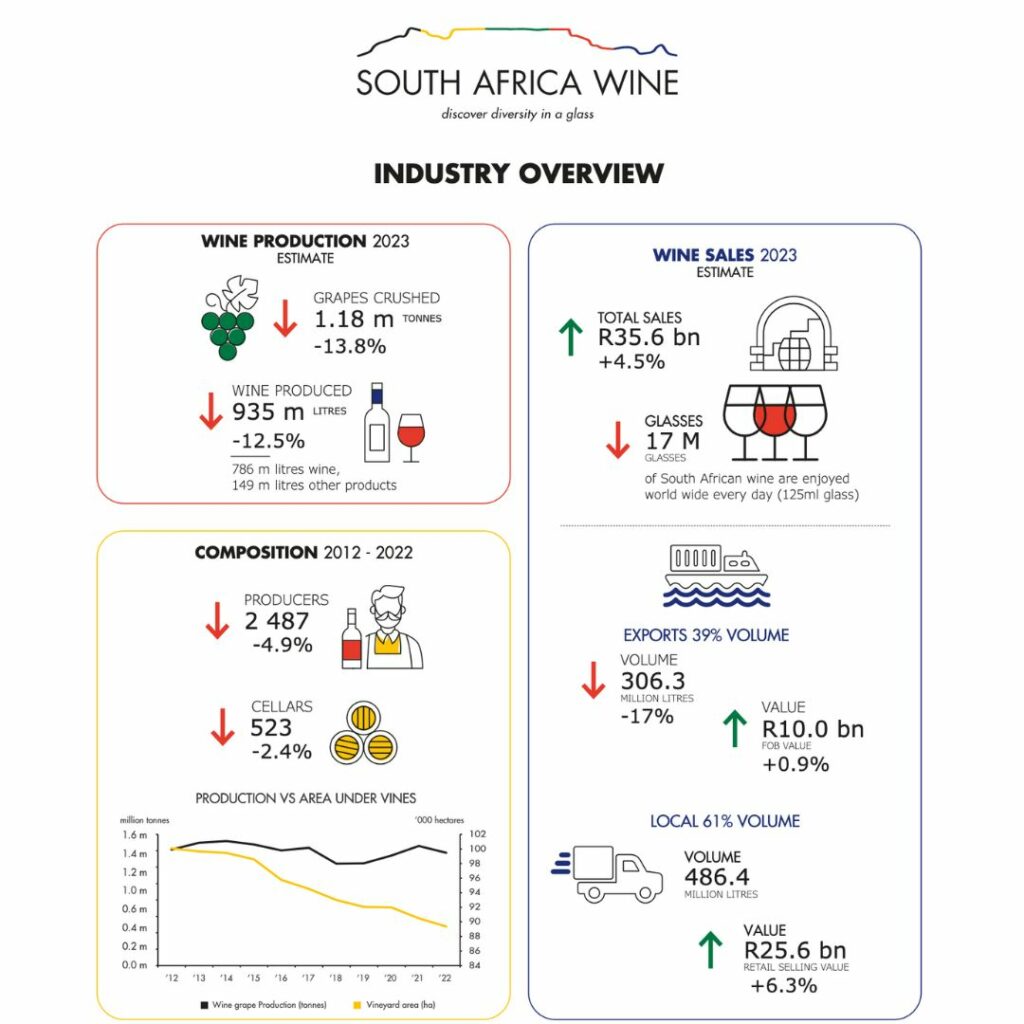
For the first time in five years, the domestic wine industry, under the leadership of South Africa Wine, commissioned a macro impact study to gain a true insight into the health of the industry in the wake of Covid-19. They have a lot to contend with – new government policies, increased tax burden, climate change, and overall rising costs.
In 2022, wine production costs spiked by 15.3%, more than double the 7.3% compound annual growth rate (CAGR) from 2013 to 2022.
The farm net income (NFI) has fluctuated markedly in the past few years, but from 2020 there has been a steady decline. Nearly 40% of farmers in the industry made a loss, and only 12% were profitable in 2022.
Good and bad news
The wine industry has a famous value chain; it is an intensive industry providing jobs to 270 364 people (1.8% of national employment).
South African consumers’ disposable income has been shrinking year-on-year, and this, together with the price increases, has led to a growth of sales in the R60 per litre category, making up 83% of the total domestic sales.
There has also been strong growth in larger container wines and canned wines. The wine industry, inclusive of brandy, significantly contributes to government revenue through excise taxes, which have recently escalated.
In 2022, these taxes and VAT payments totalled R9.01 billion, equivalent to 0.6% of overall government tax revenue. Since 2021, wine sales have contributed increasingly to excise tax and VAT revenues, rising to 59% in 2022 from 54% in 2020, driven by post-Covid sales rebound.
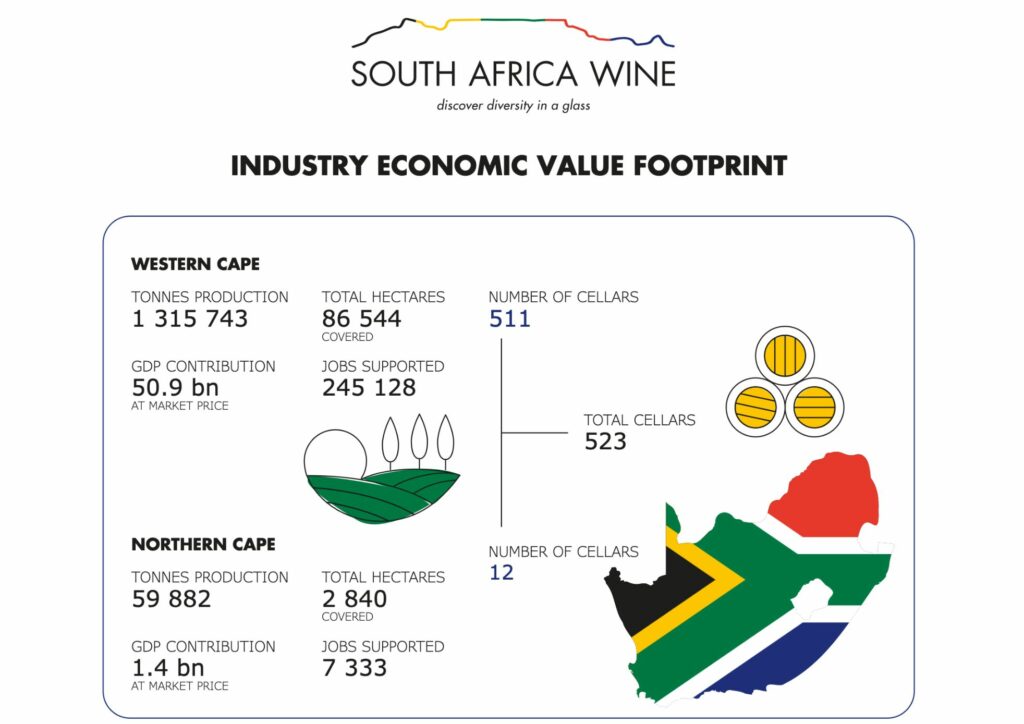
It’s not all good news, but the wine industry is a resilient one, and in the areas in South Africa where it is located, it contributes towards a steady economic environment.
Adapting to the issues of climate change, finding more creative ways to use resources optimally, and growing exports, there is a lot to be optimistic about. Besides the production side, wine tourism has outperformed even the most positive wine enthusiasts’ estimates.
With tourism in the Western Cape not only recovering but surpassing pre-Covid levels and outperforming the rest of the world in the speed of recovery.
Related stories
- In pictures: Father-son duo launch unique wine boutique at CT airport
- Beekeeping and wine: Moedi Wines’ blend heads to Germany
- Elsenburg marks 125 years of shaping SA wine leadership
Looking at the 2024 harvest
According to some wine producers, a good winter, cold and wet, with all the dams filled was a good start to the season. From spring, it started to become drier with no rain, and the first Wellington heat came in December, said Denise Stubbs, managing director of Thokozani Wines.
“Initially, it looked like we would start earlier but turned out like normal with the start of harvest on the 22nd of January,” she said.
Meanwhile, Diemersfontein winemaker Francois Roode said warm conditions and wind during flowering affected the set of the fruit, and on average, there was a 30% decline on production with disease pressure in September.
“Not being able to spray vineyards made things tough. Quality is looking good at the moment,” he said.
Christiaan Loots, farm manager at Waterkloof Wine Estate, said they had a fantastic winter. It was cold and lots of rain. Unfortunately, from spring to harvest, the Western Cape was extremely dry with no rain from late October to January.
“This resulted in very low yields for most wine growers. Some were down 50% on their harvest. Harvest was at least two weeks earlier than normal. Quality looks good, especially on the reds. Reds have small berries, with nice, concentrated juice and even ripening. The whites have nice acidity and are healthy with little rot.
“We are receiving some nice rain now which will help retain leaves after harvest so the vines can build reserves for next year,” said Loots.
Sign up for Mzansi Today: Your daily take on the news and happenings from the agriculture value chain.