Tuesday, October 20, 2026
SUBSCRIBE
22 GLOBAL MEDIA AWARDS
Food For Mzansi
  • News
  • Changemakers
  • Lifestyle
  • Farmer’s Inside Track
  • Food for Thought
No Result
View All Result
  • News
  • Changemakers
  • Lifestyle
  • Farmer’s Inside Track
  • Food for Thought
No Result
View All Result
Food For Mzansi
No Result
View All Result
in Advertorial, Food For Mzansi TV

Grow your agribusiness: Diversify to cut down on risk

by Staff Reporter
31st August 2020
Share on FacebookShare on TwitterShare on WhatsApp

Ultimately, we all want our business portfolio to have as little risk as possible. But can diversification be used to cut down on variability in a portfolio, and how does it work exactly? On today’s episode of Food For Mzansi TV we chat to MC Loock, the senior manager of agribusiness at Standard Bank, about the idea of using diversification as a risk management strategy.

Return on assets

Let’s start at the beginning: return on assets (ROA). Your ROA will give you some indication of how profitable your farm or agribusiness is when compared to its resources. It’s calculated by dividing your business’s net income by the value of total assets used to generate that income and giving you a percentage. If you want to determine your farm’s risk factor, you will start with your ROA.

But does risk increase or decrease from season to season?

MC Loock, senior manager of agribusiness at Standard Bank. Photo: Supplied.
MC Loock, senior manager of agribusiness at Standard Bank. Photo: Supplied

Ideally, you either want the ROA to grow over time while the risk remains constant, or to reduce the risk over time without a decline in the ROA. By diversifying, you can have more than one revenue stream, protecting you from a decline in any one stream.

But why should you care? That’s simple: having more than one stream of income means that the risk on the ROA of your total portfolio will be lower than the ROA of any individual income stream that makes up your portfolio. (Tune into this episode of Food For Mzansi TV for Loock’s explanation of what you can do to achieve this).

Can diversification be taken too far?

Although a diversification strategy is an important tool to manage risk in your business, it can have drawbacks if improperly implemented:

  • A limitation in management: Agribusiness is highly seasonal, and the management intense periods of enterprises frequently overlap. Running income streams with overlapping seasonal peaks can put strain on your management capacity
  • Geographical diversification: When various businesses are situated too far apart from one another it means that tractors and equipment cannot be shared, and cost structures are often duplicated.
  • Complexity of the business model: This can result in a conflicting strategy direction that becomes too difficult to manage effectively. For example, how do you allocate cost and revenues when you own adjacent links in the value chain, like the vineyard, the cellar as well as the bottling plant?

[adsanity id=”18569″ align=”alignnone”/]
Staff Reporter

Researched and written by our team of writers and editors.

Tags: AgribusinessBusiness managementdiversificationStandard Bank
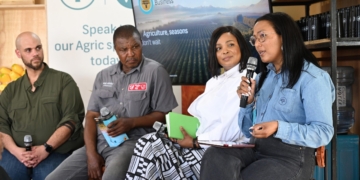
The panellists at FNB Business’s “Farming together” discussion at the Royal Show explored how market access, mentorship, financial discipline and strong commercial relationships can help farmers build sustainable businesses. Featured from the left are Bertram July (FNB’s distribution sales lead), commercial farmer Shakes Shabalala; Sandy Gumede (co-founder of Zulu Girl Wines), and Janis Robson (FNB’s head of development and SME business development). Photo: Food For Mzansi
News

FNB puts relationships at the heart of commercial farming

by Staff Reporter
17th October 2026

From buying a farm with cattle to building a wine brand from scratch, entrepreneurs shared how strong relationships, market access...

Read moreDetails
Agri Skills Transfer students gain hands-on experience at the institution’s Cullinan Farm Training Centre, where agricultural theory meets the realities of commercial production. Photo: Supplied/Food For Mzansi

Build your future in agriculture with Agri Skills Transfer

17th October 2026
Durbanville Hills tastes sweet success at Michelangelo Awards

Promising early conditions predicted for 2027 SA wine harvest

17th October 2026

Reclaiming the kraal: Cultural heritage sparks a farming dream

16th October 2026

How animal welfare and human rights shape food security

16th October 2026

Reality check: What SA agri interns really experience on the farm

SA and Namibia reevaluate livestock trade after FMD outbreak

Farmers urged to tap into recycled human waste as fertiliser

How animal welfare and human rights shape food security

Cutting-edge crop solutions take centre stage at the SADC Plant Nutrition Symposium

Join Food For Mzansi's WhatsApp channel for the latest updates!

JOIN NOW!
Next Post
Andries Bezuidenhout, feed mill manager at Rosgrow Feeds a specialized animal feed company.

AgriSETA Learner Connect: Meet a feed mill manager

THE NEW FACE OF SOUTH AFRICAN AGRICULTURE

With 21 global awards in the first six years of its existence, Food For Mzansi is much more than an agriculture publication. It is a movement, unashamedly saluting the unsung heroes of South African agriculture. We believe in the power of agriculture to promote nation building and social cohesion by telling stories that are often overlooked by broader society.

Fixing SA’s agricultural visa system to protect seasonal harvests

SA and Namibia reevaluate livestock trade after FMD outbreak

Agda conference to tackle finance, market access and agri growth

Reluctant farmer scales EC cabbage enterprise to supply Spar

Reality check: What SA agri interns really experience on the farm

This week’s agri events: 19 – 23 October

  • Awards & Global Impact
  • Our Story
  • Contact Us
  • Cookie Policy
  • Privacy Policy
  • Copyright

Contact us
Office: +27 21 879 1824
News: info@foodformzansi.co.za
Advertising: sales@foodformzansi.co.za

Contact us
Office: +27 21 879 1824
News: info@foodformzansi.co.za
Advertising: sales@foodformzansi.co.za

  • Awards & Global Impact
  • Our Story
  • Contact Us
  • Cookie Policy
  • Privacy Policy
  • Copyright

Chat Options

About this assistant

This feature generates automated answers summarised from Food For Mzansi articles. By using it, you are interacting with an AI system (provided by Google), not a human. AI can make mistakes. Please refer to the source articles for verification and citation purposes.

Our staff do not check or moderate Lerato’s answers in advance, but may review some later. Our journalists continue to write and edit all the articles Lerato uses as sources.

To estimate unique and returning web users, we store a random browser ID in this browser. WhatsApp users are counted by phone number. The same person using both channels may be counted twice.

I'm Lerato, your AI assistant!
No Result
View All Result
  • News
  • Changemakers
  • Lifestyle
  • Farmer’s Inside Track
  • Food for Thought

Copyright © 2026 Food for Mzansi