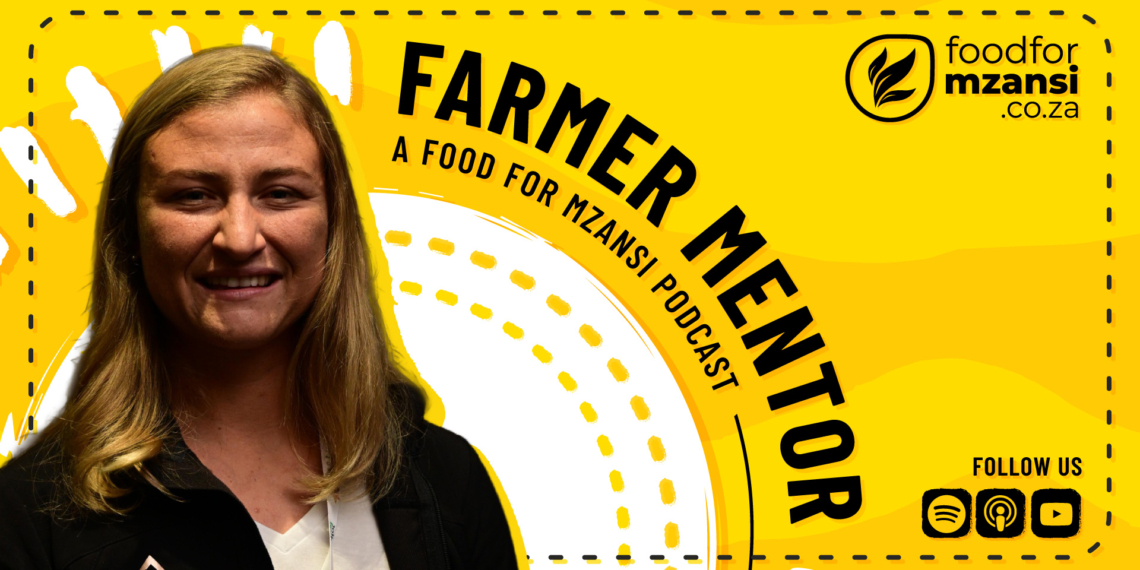
Transitioning to regenerative agriculture doesn’t require an overnight overhaul. In this Farmer Mentor episode, researcher Liane Erasmus explains how starting small with high-density grazing and adaptable practices can transform livestock management.
For Liane Erasmus, regenerative agriculture is not a new trend or an imported concept. It is rooted in the lessons she learned growing up on a farm outside Rustenburg in North West, where managing veld, livestock and grazing through the seasons was simply part of everyday farming life.
Now working in regenerative agricultural research, Erasmus believes farmers can build profitable businesses while restoring the natural resources on which agriculture depends.
After studying animal science and grassland science at the University of the Free State, Erasmus returned to the family farm and after a year also joined a regenerative agricultural research team.
“I grew up on a farm and had the privilege of farming with my parents and grandparents,” she says. “With livestock, you had to plan for winter, manage camps and think about how cattle moved over the land. That was the foundation of how I learned to farm.”
When she joined a regenerative agricultural research team, she gained a deeper understanding of the farming system.
Although she first encountered the term “regenerative agriculture” during her research career, she realised many of its principles had always formed part of good farming practice.
“For me, regenerative farming is about looking at how nature works and trying to mimic that in your farming system. It is about building up rather than breaking down. Nature provides many things for free, and farmers need to ask how they can use those natural processes to work for them,” she says.
Related stories
- What we’re missing in regenerative farming: A new way to learn
- Carbon credits 101: A guide to regenerative farming & income
- Regenerative farming: Healthy soil, healthy food, healthy profits
- Farmers, researchers must walk regenerative journey together
Every farm is different
While regenerative agriculture is often associated with crop production and soil health, Erasmus says livestock farmers can also benefit through improved grazing management and better veld utilisation.
However, she stresses that there is no universal blueprint.
“There is no recipe that works for everyone,” she says. “Every farmer has different challenges, different climates and different environments. You have to look at your own farm and ask how you can implement regenerative practices in a way that works for your situation.”
On Erasmus’s North West farm Riger Boerdery, implementing higher-density grazing brought practical challenges. The rugged landscape made moving cattle more difficult, while additional fencing, water points, pipelines and pumps required careful planning and investment.
“Water is easy when it is on flat ground, but taking it up a mountain is another matter,” she says. “You need bigger pumps, pipelines and tanks. Those were some of the basic challenges we had to work through.”
The transition also required staff to understand and buy into the new grazing system. Although both workers and livestock needed time to adapt, concentrating cattle in smaller camps has improved herd management, reducing the time needed to inspect the herd from half a day to just one or two hours.
Introducing a different way of farming also meant convincing family members that the investment would be worthwhile.
“There was a family challenge too. You have to communicate openly and make sure everyone understands the vision and why you are making changes.”
Start where you are
For farmers interested in regenerative agriculture, Erasmus encourages taking gradual steps rather than trying to transform the entire farm at once.
“If finances are a challenge, take it step by step,” she says. “The money is not going to rain on you. You have to work towards it.”
She says patience and adaptability are among the most important qualities for farmers adopting regenerative practices.
“It will not happen overnight. You may not be able to have the best of everything tomorrow, but you can do what you can with the resources you have now. Do not become discouraged if the process feels slow.”
Erasmus encourages farmers to stay focused on their long-term goals rather than outside opinions. She believes meaningful change happens gradually, with improvements to farming practices and financial sustainability achieved one step at a time.
For her, regenerative agriculture is ultimately about making farming decisions today that leave the land healthier and more productive for future generations.
READ NEXT: Drought and heatwaves force SA maize farmers to adapt or switch