Tuesday, October 20, 2026
SUBSCRIBE
22 GLOBAL MEDIA AWARDS
Food For Mzansi
  • News
  • Changemakers
  • Lifestyle
  • Farmer’s Inside Track
  • Food for Thought
No Result
View All Result
  • News
  • Changemakers
  • Lifestyle
  • Farmer’s Inside Track
  • Food for Thought
No Result
View All Result
Food For Mzansi
No Result
View All Result
in Advertorial, Food For Mzansi TV

Grow your agribusiness: Business benefits of diversification

by Staff Reporter
29th August 2020
Share on FacebookShare on TwitterShare on WhatsApp

You’ve probably heard bankers and businesspeople talking about diversifying their business. They all say that diversification is a key strategy to success, but wat does that actually mean? And what role does it play in the agricultural sector? On today’s episode of Food For Mzansi TV, we chat to MC Loock, senior manager of agribusiness at Standard Bank, about diversification and how it can benefit the agricultural sector, especially at farm level.

What’s so cool about having a diversification strategy?

MC Loock, senior manager of agribusiness at Standard Bank. Photo: Supplied.
MC Loock, senior manager of agribusiness at Standard Bank. Photo: Supplied

One of the main reasons why a diversification strategy is important is that it reduces the risk in any portfolio. Diversification as a risk management strategy includes a range of assets and investments in a portfolio in order to reduce risks to lower than that of a single asset holder.

But what does that actually mean? In essence, it means that having multiple assets can reduce your risk, because you aren’t solely dependent on just one asset.

A diversification strategy will also improve your agribusiness’s adaptability. As the market changes, so will your consumers’ needs. If your business doesn’t adapt in order to meet those new needs, you’re leaving money on the table.

Keep this in mind when diversifying your business

Diversification is essentially about creating new income streams. A lot of African economies are heavily reliant on the primary sector of mining and agriculture. In South Africa, however, the secondary and tertiary sectors are much more developed than the primary sector which leaves the country less vulnerable to a downturn in the commodity market. That’s all well and good, but how do you start diversifying your business?

  • Use the resources you have available to you: The best place to start is with your available resources. This includes the types of assets you’ve invested in, the potential of the land, the location of the property, the climatic conditions during production season, etc. Take a look at the resources you have at your disposal, and ask yourself “which of these resources can I use, and how?”
  • Use your assets to shift towards multiple sources: The question you have to ask yourself is, how can you use your current assets to shift away from a single income source to multiple sources? (Tune into the episode of Food For Mzansi TV where Loock gives a good example of how to diversify, using livestock as an example). It is all about the way you grow your business and the partnerships you foster, and that all whilst reducing risk. Bear in mind that sometimes you might need additional skills and infrastructure for sufficient diversification.

Next time we’ll take a look at how to optimally leverage existing resources. We will also look at what role growth plays in diversification, as well as how to calculate risk.

[adsanity id=”18569″ align=”alignnone”/]
Staff Reporter

Researched and written by our team of writers and editors.

Tags: Agri-businessBusiness managementStandard Bank
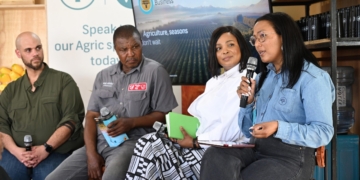
The panellists at FNB Business’s “Farming together” discussion at the Royal Show explored how market access, mentorship, financial discipline and strong commercial relationships can help farmers build sustainable businesses. Featured from the left are Bertram July (FNB’s distribution sales lead), commercial farmer Shakes Shabalala; Sandy Gumede (co-founder of Zulu Girl Wines), and Janis Robson (FNB’s head of development and SME business development). Photo: Food For Mzansi
News

FNB puts relationships at the heart of commercial farming

by Staff Reporter
17th October 2026

From buying a farm with cattle to building a wine brand from scratch, entrepreneurs shared how strong relationships, market access...

Read moreDetails
Agri Skills Transfer students gain hands-on experience at the institution’s Cullinan Farm Training Centre, where agricultural theory meets the realities of commercial production. Photo: Supplied/Food For Mzansi

Build your future in agriculture with Agri Skills Transfer

17th October 2026
Durbanville Hills tastes sweet success at Michelangelo Awards

Promising early conditions predicted for 2027 SA wine harvest

17th October 2026

Reclaiming the kraal: Cultural heritage sparks a farming dream

16th October 2026

How animal welfare and human rights shape food security

16th October 2026

Reality check: What SA agri interns really experience on the farm

This week’s agri events: 19 – 23 October

Land Bank must step up support for farmers, says Aucamp

How animal welfare and human rights shape food security

Agda conference puts inclusive agricultural growth in focus

Join Food For Mzansi's WhatsApp channel for the latest updates!

JOIN NOW!
Next Post
Grow your agribusiness: How to leverage your existing resources

Grow your agribusiness: How to leverage your existing resources

THE NEW FACE OF SOUTH AFRICAN AGRICULTURE

With 21 global awards in the first six years of its existence, Food For Mzansi is much more than an agriculture publication. It is a movement, unashamedly saluting the unsung heroes of South African agriculture. We believe in the power of agriculture to promote nation building and social cohesion by telling stories that are often overlooked by broader society.

Fixing SA’s agricultural visa system to protect seasonal harvests

SA and Namibia reevaluate livestock trade after FMD outbreak

Agda conference to tackle finance, market access and agri growth

Reluctant farmer scales EC cabbage enterprise to supply Spar

Reality check: What SA agri interns really experience on the farm

This week’s agri events: 19 – 23 October

  • Awards & Global Impact
  • Our Story
  • Contact Us
  • Cookie Policy
  • Privacy Policy
  • Copyright

Contact us
Office: +27 21 879 1824
News: info@foodformzansi.co.za
Advertising: sales@foodformzansi.co.za

Contact us
Office: +27 21 879 1824
News: info@foodformzansi.co.za
Advertising: sales@foodformzansi.co.za

  • Awards & Global Impact
  • Our Story
  • Contact Us
  • Cookie Policy
  • Privacy Policy
  • Copyright

Chat Options

About this assistant

This feature generates automated answers summarised from Food For Mzansi articles. By using it, you are interacting with an AI system (provided by Google), not a human. AI can make mistakes. Please refer to the source articles for verification and citation purposes.

Our staff do not check or moderate Lerato’s answers in advance, but may review some later. Our journalists continue to write and edit all the articles Lerato uses as sources.

To estimate unique and returning web users, we store a random browser ID in this browser. WhatsApp users are counted by phone number. The same person using both channels may be counted twice.

I'm Lerato, your AI assistant!
No Result
View All Result
  • News
  • Changemakers
  • Lifestyle
  • Farmer’s Inside Track
  • Food for Thought

Copyright © 2026 Food for Mzansi