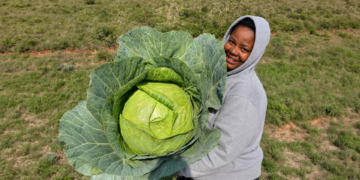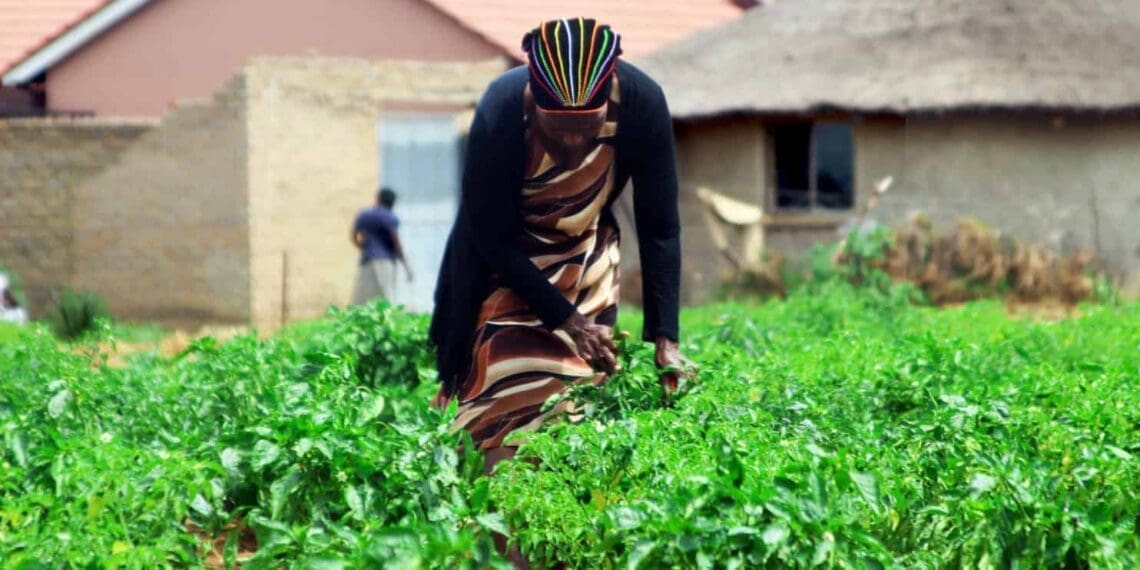
 A 61-year-old organic farmer, Thembeni Eunice Nxumalo, whose genes are stubbornly resilient towards ageism and wrinkles, lives on Althea farming plot, 11km away from De Deur, Gauteng. “The reason I look fresh and younger than my age is because,” she pauses with a smile, “I am always working on the farm and I eat nutritious organic vegetables.”
In 2014, the 5-hectare plot on which she lives unexpectedly rerouted and changed her life for good after she bought tomato and cabbage seed packets, each costing R13,99 at her local Shoprite store. This mother of four says she then began planting on a small garden. The seeds planted in this richly dark soil “…turned out to produce very big cabbages and tomatoes. People were excited and started buying them.”

“Agriculture is alive!” she exclaims. “In late 2014, I attended an event in Boksburg where other black women agriculturists were given awards. I was more inspired and that’s when I realised that it is possible to make a living through farming.”
A year later, Nxumalo officially registered her agricultural business, Althea Agricultural Holdings, which she runs along with her two children. She employs four permanent staffers, two of which reside on the plot.
“For now, due to shortage of resources and manpower, I am only able to utilise 2 hectares of this land,” she says. “From time to time, when the workload becomes overwhelming, I supplement the permanent staff with casual workers until the required work is finished.”
Now this small-scale farmer feeds many families and communities around Johannesburg. On the farm she plants beetroot, cabbages, three types of chillies, green peppers, carrots, bush beans, onions and maize. She also processes chilli into chilli sauce. “People love it! It has that thing you know. I mean, it makes your taste buds want it over and over again,” she smiles, revealing a top incisor covered with gold.
Nxumalo mostly sells her produce to loyal clients and others who sell vegetables to different communities around the city. She plants large quantities of beetroot and carrots, however, because of a client that regularly buys bulk quantities from her. The client, she says, buys the sweet-tasting produce to make beetroot and carrot juice.

Driven by passion and a spirit of “imbokodo” (a word from the Nguni languages to describe women), Nxumalo’s commitment in her farm work has attracted some companies to sponsor her when she needs certain resources.
Nxumalo says that since April 2016, Rand Water, a state water distribution company that reports to the Department of Water and Environmental Affairs, has had a positive impact towards the success of her business.
When she began farming, “…we were using watering cans, but Rand Water gave me six irrigation lines and two tunnels which enabled me to plant a lot of vegetables, especially during winter when frost destroys my crops.” Additionally, Rand Water donated two water tanks, each with a storage capacity of 5 000 litres.
Last year, she says the South African Pecan Nut Association (SAPPA) gifted her with 30 pecan nut trees. Pecan nuts are one of the healthiest nuts, preventing stroke and coronary artery disease, and also contains oleic acid, which has been found to reduce the risk of breast cancer.
As part of SAPPA’s empowerment projects, new farmers are also given, amongst others, technical advice on pecan nut farming. The condition for the donation was that no more than five trees from the donated 30 trees should die.

“These pecan nuts are my lifetime investment. They will start producing after three to six years. I know once the trees start producing, it will be an ever-lasting produce,” she says passionately, removing weeds from a stem of one pecan nut tree. “By God’s grace, only two trees have died so far. SAPPA said they are pleased with my commitment, and in total they want to donate 100 pecan nut trees. This investment will be reaped by my children and grandchildren. It is my legacy.”
Nxumalo says she struggles to tap into big retailers around Johannesburg.
“The market is a big challenge,” she says. “Every year, everything we plant turns out well, but at the end of the day you lose. You end up selling produce with a price close to nothing. For now, we sell our produce at City Deep (the Joburg Market).”
“What makes it more difficult is that I must have a budget for petrol, and to buy packaging boxes at City Deep. Once that is done, I have to go back again to sell the produce, but it also becomes expensive for me as they are the ones who decide what the price of the produce would be and it fluctuates every now and then.”
She says her goal is to become a renowned commercial farmer, but for now she’s unable to farm the entire 5-hectare plot as it is not securely protected. “In 2017, I asked someone to do a quotation for a palisade fence. He said it would cost me over R200 000 and additional money for labour. I can’t afford this now. When I approached Rand Water, they also told me that the fence will be over R300 000.”

Without a properly fenced plot, Nxumalo says, a high rate of crime from surrounding communities, where a considerable number of residents are unemployed, keeps her business from reaching its full potential.
Nevertheless, with enthusiasm and optimism in her bone marrow, she’s looking forward to outmanoeuvring all the challenges set to make her fail. “I am going to be a big commercial, female farmer,” she says.
Looking back at where she started, “Everything is like I am dreaming. I am amazed by the fact that I started with a five-metre garden, but look at where I am today. Though challenges are bound to occur, the future remains bright and promising.”