Thursday, July 9, 2026
SUBSCRIBE
22 GLOBAL MEDIA AWARDS
Food For Mzansi
  • News
  • Changemakers
  • Lifestyle
  • Farmer’s Inside Track
  • Food for Thought
No Result
View All Result
  • News
  • Changemakers
  • Lifestyle
  • Farmer’s Inside Track
  • Food for Thought
No Result
View All Result
Food For Mzansi
No Result
View All Result
in It Takes a Village

How Thanda helped one KZN family beat the cost-of-living crisis

As the cost-of-living crisis deepens, more South African families are turning to home food gardens to put nutritious meals on the table and earn extra income. In rural KwaZulu-Natal, Zandile Shinga's thriving vegetable garden shows how regenerative farming is helping households build resilience one harvest at a time

by Staff Reporter
9th July 2026
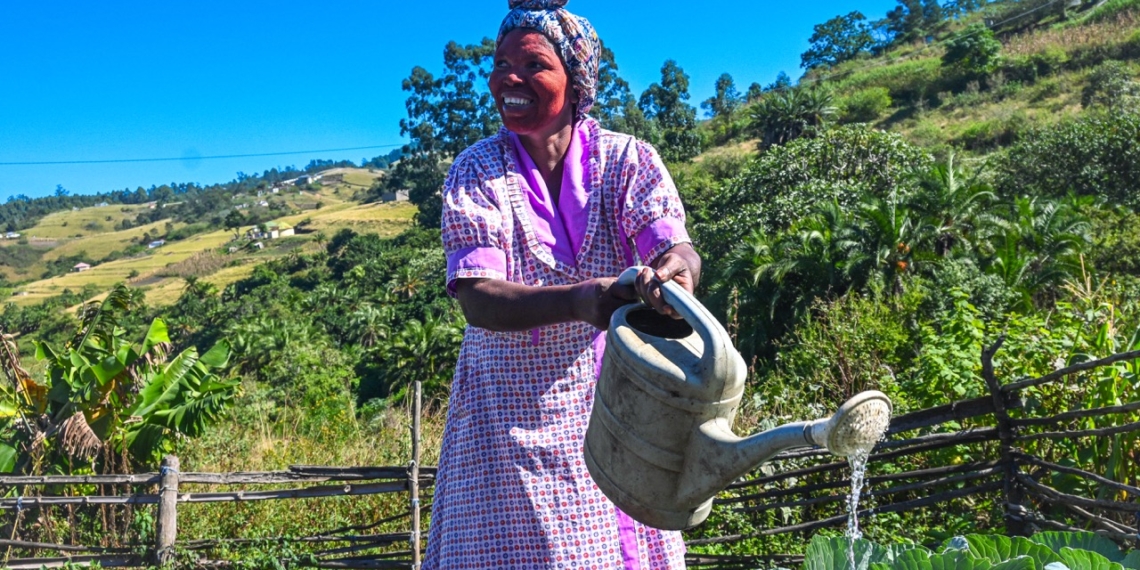
What started as a small backyard garden has become a source of food security and financial independence for Zandile Shinga. She waters her cabbages at her plot in ePlazini, where Thanda is helping families build resilience through regenerative gardening. Photo: Supplied/Food For Mzansi

What started as a small backyard garden has become a source of food security and financial independence for Zandile Shinga. She waters her cabbages at her plot in ePlazini, where Thanda is helping families build resilience through regenerative gardening. Photo: Supplied/Food For Mzansi

Share on FacebookShare on TwitterShare on WhatsApp

For years, buying fresh vegetables meant another expense that 51-year-old Zandile Shinga simply could not afford.

Today, the mother from ePlazini near Mtwalume in KwaZulu-Natal harvests much of her family’s food from her own backyard. Better still, when her crops produce more than her household needs, she sells the surplus to neighbours.

In one week alone, she earned R1 250 from selling green peppers and chillies.

“Farming has helped me become independent,” says Shinga. “The garden feeds my family, and when I have extra produce to sell, I can earn money for things my daughter needs, like school uniforms and stationery. It has made a real difference in our home.”

Her story comes at a time when many South African households are struggling to keep up with rising living costs. 

Food inflation, unemployment and stagnant incomes continue to place enormous pressure on family budgets, prompting growing interest in home food production as a practical way to improve food security while creating small income opportunities.

Shinga joined the Household Gardening Programme run by community-based non-profit organisation Thanda in 2023.

Based in rural KwaZulu-Natal, Thanda works alongside communities to build long-term resilience through programmes focused on early childhood development, child and youth development, and food security and economic development.

The organisation’s household gardening initiative equips families with regenerative farming skills that enable them to grow nutritious food using affordable, sustainable methods.

Rather than relying on expensive agricultural inputs, participants learn practical techniques such as composting, mulching, seed saving and natural pest management.

These skills have already paid off for Shinga. When pests recently threatened her crops, she did not have to buy chemical pesticides. Instead, she used organic methods, including sawdust and chilli-based treatments, that she learnt through the programme.

Angela Larkan, executive director and co-founder of Thanda, says home gardens have become much more than a way to grow vegetables.

“Too often, food gardens are viewed solely through an agricultural lens, but their impact is entirely social and economic,” she says.

“When a household grows its own food, they are no longer entirely dependent on cash to survive an unstable economy. At-home food production, whether in a rural homestead or a small container garden, offers a practical way to reclaim agency.”

Food security starts at home

The household gardening programme was launched in 2022 in response to growing concerns about food insecurity in vulnerable communities.

According to Thanda, when household income can no longer cover the cost of a nutritious food basket, families often cut back first on the quality and diversity of what they eat.

This can have serious consequences for children’s health and development, particularly during pregnancy and the first 1 000 days of life.


Related stories

  • SA’s water crisis puts farmers and food security at risk
  • Foundation turns small-scale farmers into food security champions
  • More than dirt: Seven ways to reverse land degradation
  • KZN agriculture shines at Premier’s Excellence Awards

Larkan says ensuring children receive adequate nutrition starts long before they reach school age.

“Prevention begins long before a child enters a classroom,“ she says.

“When households have steady access to diverse, nutritious foods, they are better able to support healthy pregnancies and early childhood development. But when household budgets stretch to the limit, families often have zero room left to absorb market shocks. Home-grown food is no longer a hobby; it is a critical necessity for survival.“

The programme has since trained more than 650 household gardeners, with participants also learning how to grow protein-rich foods alongside vegetables to improve dietary diversity and strengthen household resilience.

For Thanda, the work extends beyond helping families produce food. By combining practical skills with community development, the organisation aims to strengthen livelihoods, improve nutrition and create pathways out of poverty that can be sustained for generations.

Six simple ways to start your own food garden

Thinking about growing your own food? Thanda recommends these practical steps:

  • Start with easy, high-yield crops such as spinach, beans, tomatoes and chillies.
  • Build healthy soil by composting kitchen scraps and garden waste.
  • Apply mulch, including grass clippings or dry leaves, to retain moisture and reduce water use.
  • Save seeds from healthy plants for the next growing season.
  • Manage pests naturally using homemade chilli sprays or ash barriers.
  • If space is limited, grow vegetables in containers, old tyres or other recycled containers.

READ NEXT: KZN agriculture shines at Premier’s Excellence Awards

Sign-up for the latest agricultural news delivered straight to your inbox every day with Mzansi Today!

Staff Reporter

Researched and written by our team of writers and editors.

Tags: cost of foodFood GardenFood pricesInform meKwaZulu-Natal
Effective calf management starts before calving and continues long after birth, with healthy cows, quality colostrum, clean environments and close daily monitoring forming the foundation for stronger, more productive animals. Photo: Pexels
Farmer's Inside Track

How to improve calf survival with better colostrum management

by Patricia Tembo
7th July 2026

The first hours after calving can shape a calf’s survival, health and future productivity, making careful management of both the...

Read moreDetails
KZN agriculture shines at Premier’s Excellence Awards

KZN agriculture shines at Premier’s Excellence Awards

7th July 2026

Is your farm’s data safe? The hidden cyber risks in agriculture

7th July 2026
The countdown to Nampo Cape 2026 is on as Bredasdorp in the Western Cape prepares to welcome thousands of farmers, agribusinesses and visitors for four days of innovation, networking and knowledge sharing. Photo: Supplied/Food For Mzansi

The countdown is on for Nampo Cape 2026 in Bredasdorp

7th July 2026
Anesca Achilles, marketing co-ordinator of Visio Vintners, with the Decanter awarded wine. Photo: Supplied/Food For Mzansi

Visio Vintners wins gold at Decanter World Wine Awards

6th July 2026

How Thanda helped one KZN family beat the cost-of-living crisis

What a rural chilli farm says about possibility and hope

This week’s agri events: 06 – 10 July

Agri shows remain the heartbeat of rural SA, say stakeholders

Parliament finds farm equity scheme failures run nationwide

Join Food For Mzansi's WhatsApp channel for the latest updates!

JOIN NOW!
Next Post
Tucked away in the North West province, the Deelpan Multi-Functional Agri-Node is quietly proving what is possible when rural communities are given the chance to build. Photo: Supplied/Seriti Institute

What a rural chilli farm says about possibility and hope

THE NEW FACE OF SOUTH AFRICAN AGRICULTURE

With 21 global awards in the first six years of its existence, Food For Mzansi is much more than an agriculture publication. It is a movement, unashamedly saluting the unsung heroes of South African agriculture. We believe in the power of agriculture to promote nation building and social cohesion by telling stories that are often overlooked by broader society.

What a rural chilli farm says about possibility and hope

How Thanda helped one KZN family beat the cost-of-living crisis

Barnard Mohair: Weaving EC agriculture into global fashion

Gauteng farmers urged to strengthen value-chain participation

Global food prices ease as grain and sugar costs fall

Simphiwe Hlubi: Why multi-stream income is the future of farming

  • Awards & Global Impact
  • Our Story
  • Contact Us
  • Cookie Policy
  • Privacy Policy
  • Copyright

Contact us
Office: +27 21 879 1824
News: info@foodformzansi.co.za
Advertising: sales@foodformzansi.co.za

Contact us
Office: +27 21 879 1824
News: info@foodformzansi.co.za
Advertising: sales@foodformzansi.co.za

  • Awards & Global Impact
  • Our Story
  • Contact Us
  • Cookie Policy
  • Privacy Policy
  • Copyright

Chat Options

I'm Lerato, your AI assistant!
No Result
View All Result
  • News
  • Changemakers
  • Lifestyle
  • Farmer’s Inside Track
  • Food for Thought

Copyright © 2024 Food for Mzansi

This website uses cookies. By continuing to use this website you are giving consent to cookies being used. Visit our Privacy and Cookie Policy.