Can a modern farmer rely on just one income stream? Gauteng farmer Simphiwe Hlubi doesn’t think so. In this edition of Farmer Mentor, he shares how he is building a sustainable agricultural legacy through smart diversification, resourcefulness, and expert agronomy skills.
For Gauteng farmer Simphiwe Hlubi, farming is more than a livelihood; it is a lifelong calling shaped by family, early exposure to agriculture and a vision of building a lasting legacy.
Raised in rural KwaZulu-Natal, he grew up planting crops and caring for livestock with his family, experiences that laid the foundation for the diversified farming business he operates today.
“I grew up surrounded by agriculture. We had land where we planted maize and sugarcane, and we also kept livestock. Being exposed to farming from a young age is where my love for agriculture began,” he recalls.
Although he initially planned to study mechanical engineering, advice from his mother changed his career path.
“She encouraged me to pursue something related to food production. She always said that if you are involved in feeding people, you will never go hungry,” he says.
Related stories
- Matjee Mokgoadi is turning Limpopo farming into serious business
- Limpopo grain farmer combines business brains with farming brawn
- Start small, grow big: Zen Teitge’s blueprint for sustainable farming
- Eggsellent growth: How Lebo Mashigo built a poultry empire
Building a solid farming foundation
Hlubi went on to complete a national diploma and BTech in agricultural management at the Central University of Technology (CUT), specialising in animal and plant sciences. Practical training on a commercial dairy and livestock farm, followed by graduate employment with McCain Foods as an agronomist, equipped him with valuable technical skills.
“Agronomy gave me a strong understanding of crop production and the science behind farming. Those skills have been invaluable in helping me make informed decisions on my own farm,” he says.
While building his professional career, Hlubi steadily invested his savings into livestock, purchasing cattle and leasing farmland with another farmer from KwaZulu-Natal before securing his own property.
Diversifying for sustainability
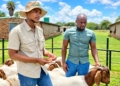
In 2024, Hlubi established his own 23-hectare farm in Rayton, Gauteng, where he now produces Boer goats, sheep and broiler chickens, while operating a small feedlot. He has also expanded breeding operations onto family-owned land in KwaZulu-Natal.
“Most of our breeding animals are now based in KwaZulu-Natal because we have more grazing land there. The Gauteng operation focuses more on trading livestock, feedlotting and generating cash flow.”
For Hlubi, diversification has become the cornerstone of financial sustainability. “I don’t believe a modern farmer can rely on a single income stream. Multiple revenue streams are essential for sustainability.”
Alongside small-stock production, broiler chickens provide quicker returns, while livestock trading helps maintain cash flow between breeding cycles.
“Goat farming can be profitable, but breeding takes time. You still have daily expenses that need to be covered. Broiler production provides quicker turnover, while livestock trading helps maintain cash flow,” Hlubi explains.
Managing costs and overcoming challenges
Hlubi believes resourcefulness is essential for profitability. One of his cost-saving strategies has been replacing commercial fertiliser with livestock manure when producing maize.
“Instead of relying entirely on purchased fertiliser, I collect manure from feedlots and use it to improve soil fertility. It’s a practical way of reducing input costs while making use of available resources,” he said.
Despite careful planning, he says market access remains one of the biggest hurdles for emerging farmers.
“The biggest challenge is getting into new markets. You can produce quality products, but if you don’t have access to the right markets, growth becomes difficult,” he said.
READ NEXT: How farmers can use weather technology to adapt to climate risks