Gauteng’s agricultural sector is increasingly recognised as a strategic contributor to food security, employment creation and economic resilience, despite the province’s largely urban character.
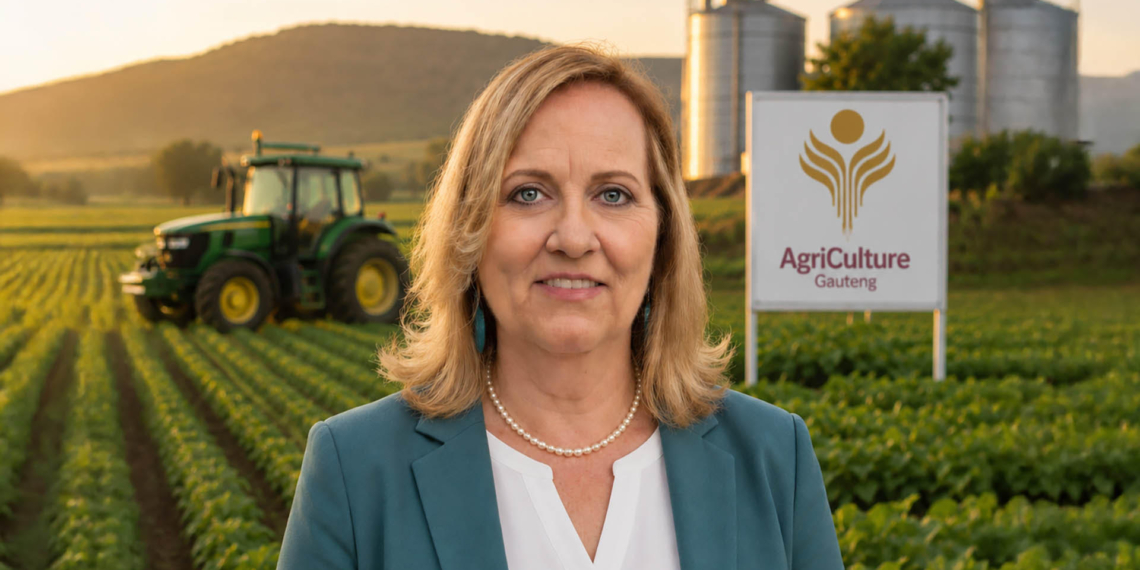
In an interview with Food For Mzansi, Dr Dalene Louw, chief executive of AgriCulture Gauteng, outlines the opportunities, challenges and partnerships shaping the future of farming and agro-processing in the province.
Patricia Tembo: Gauteng is South Africa’s most urbanised and populated province. What unique opportunities does this create for the agricultural sector, and how can farmers capitalise on them?
Gauteng’s agricultural opportunity lies precisely in its urban character. Although the province has a relatively small agricultural land base, it is located at the centre of the country’s largest consumer, logistics, finance, retail and agro-processing ecosystem.
For farmers, this creates a powerful locational advantage. Producers are close to fresh-produce markets, retailers, hospitality buyers, food manufacturers, export logistics, institutional procurement channels and a large urban consumer base.
This reduces transaction costs, shortens supply chains and creates opportunities for higher-value production such as vegetables, poultry, dairy, floriculture, hydroponics, controlled-environment farming, niche livestock, herbs and specialised horticulture.
The real economic opportunity is therefore not only primary production, but value-chain positioning.
Gauteng farmers must increasingly operate as agribusiness enterprises by producing for identified markets, adding value, improving packaging, adopting digital traceability and linking into agro-processing platforms.
Related stories
- Skills, tech and inclusion take centre stage at Gauteng farmers’ day
- Kgodiso Development Fund invests R240m in black farmers
What are the biggest challenges currently facing farmers in Gauteng, and how is AgriCulture Gauteng helping its members navigate these issues?
Farmers in Gauteng face a complex cost-price squeeze. Input costs such as fertiliser, feed, fuel, electricity, labour, finance and logistics continue to rise faster than many farm-gate prices. This erodes margins and increases the economic vulnerability of both commercial and emerging producers.
Climate volatility is also becoming a structural risk. Drought, heat stress, veld fires, flooding, water scarcity and erratic seasonal patterns directly affect production planning, yields, grazing capacity and biosecurity. Farmers also face biosecurity threats, market-access constraints, rural crime, infrastructure weaknesses, water insecurity and increasing regulatory complexity.
AgriCulture Gauteng’s role is to assist farmers through advocacy, coordination and practical economic enablement.
We work to connect members with government, commodity organisations, agribusinesses, research institutions and development partners.
Our work includes supporting market access, agricultural training, producer mobilisation, regenerative agriculture, carbon-smart farming, fire resilience and disaster-risk reduction.
How important are partnerships in driving agricultural growth, and where do you see opportunities for stronger collaboration?
Agricultural growth is fundamentally dependent on institutional collaboration. No single actor can resolve the structural constraints facing the sector. Farmers require markets, finance, infrastructure, research, training, veterinary systems, logistics and enabling policy.
There are significant opportunities for stronger collaboration in agro-processing expansion, climate-smart and regenerative agriculture, carbon-market readiness, biosecurity and animal-health systems, and the integration of emerging farmers into commercial value chains.
Transformation must be economically viable, not symbolic. It must build productive farmers who can participate in formal, competitive and sustainable markets.
What role can agriculture play in strengthening the provincial economy?
Agriculture can strengthen Gauteng’s economy by functioning as a strategic bridge between food security, industrialisation, employment and spatial economic development.
Gauteng’s comparative advantage lies in the integration of farming with manufacturing, finance, technology, transport and consumer demand. By converting primary commodities into higher-value products, the province can retain more value locally, create jobs, reduce food-system leakages and expand participation by small and medium enterprises.
Agriculture must therefore be seen as an urban economic resilience strategy. It can support township economies, peri-urban production, school and community gardens, fresh-produce aggregation, local procurement, food manufacturing and nutrition security.
What is your vision for agriculture in Gauteng over the next five to ten years?
My vision is for Gauteng to become Africa’s leading province for innovative, inclusive and climate-resilient agriculture.
Over the next decade, agriculture in Gauteng must move beyond a narrow production model towards an integrated food-systems model. This means connecting land, water, technology, markets, processing, logistics, finance, skills and sustainability into one coherent provincial agricultural economy.
Key priorities include expanding agro-processing and value addition, scaling regenerative agriculture and carbon-smart farming, strengthening fire resilience and climate-risk preparedness, supporting local food systems through the Gauteng Zero Hunger Programme, and attracting young people into agriculture.
Agriculture must be positioned as a modern economic sector with opportunities across production, processing, logistics, research, finance and agritech.
READ NEXT: Market knowledge is the new superpower for SA farmers