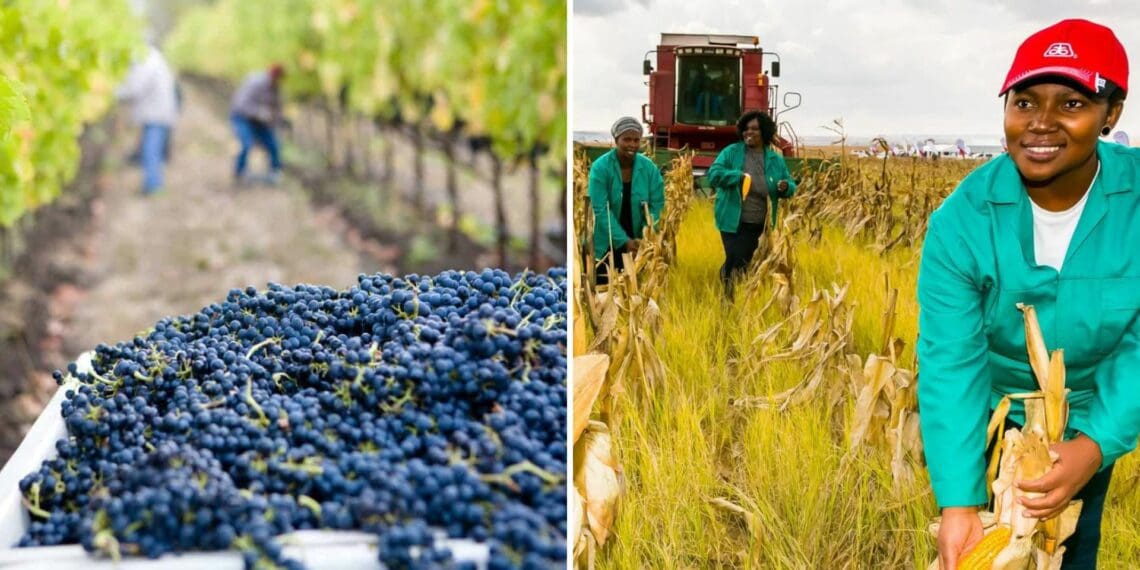
The Agricultural Business Chamber of South Africa (Agbiz) paints a different picture for maize and wine grapes, two of South Africa’s most important crops. While the outlook for wine is far from positive, the near-term outlook for Mzansi’s maize industry is somewhat better looking.
According to Agbiz chief economist Wandile Sihlobo, the country’s agricultural sector and entire food, fibre, and beverages value chain remain on shaky ground because of its dependency on a consistent energy supply.

Preliminary production estimates from the United States department of agriculture (USDA) suggest that South Africa’s 2022-2023 maize crop could reach 15.6 million tonnes. The crop estimates committee (CEC) holds a somewhat cautious view, estimating around 14.0 million tonnes.
“Still, this harvest would be well above the annual consumption of around 11.8 million tonnes and keep South Africa’s status as a net exporter of maize,” said Sihlobo.
Projected harvests could still contribute towards softening maize prices from levels seen in previous years, Sihlobo highlighted.
Poultry, livestock industries to benefit
The reason for the lower yield estimates compared to 2021-2022 levels, is because maize farmers had a rocky start to the maize season. Farmers competed with excessive rains which slowed down plantings by almost a month in some regions.
However, this proved beneficial when parts of the country were confronted with heatwaves in the past two weeks, as the soil moisture was reasonably high and cushioned the crop.
According to Sihlobo, this is the case for roughly 80% of rainfed regions of maize.
“The critical drivers of maize prices in the past season were global, such as drought in South America, rising demand in China, and the Russia-Ukraine war.
“With the global grain prices having softened in the past few months, that trend will likely filter into the South African market, even if this is to a more limited extent than what we see in the world market.”
“Government interventions to ease this burden are crucial as there are serious food security risks.”
Both white and yellow spot maize prices and the July contract months are below R5 000 per tonne. And according to Sihlobo, these price levels benefit consumers and the poultry and livestock industries, which have faced higher feed costs over the past few years.
“These two industries face unique challenges from load shedding and its associated costs; thus, any minor relief in feed prices would be a welcome development.”
ALSO READ: Farmer 101: How to master maize cultivation
Lower volumes predicted for wine
Sihlobo painted a slightly different picture for Mzansi’s wine industry. According to him wine production could be lower than 2022 levels, with preliminary estimates pointing at an output of around 800 million litres.
This is because of lower yields projected by the South African Wine Industry Statistics set to release its production estimates later in February.
“This will add pressure to an industry still recovering from the slump through the worst of the Covid-19 pandemic, where the ban on sales at various intervals had a severe negative financial impact,” Sihlobo pointed out.
The severe impact of load shedding is evident in the wine industry, adding a lot additional financial strain to farming businesses.
“This industry is labour-intensive. Therefore, any additional financial strain in an already low-profit environment could negatively influence employment conditions, particularly seasonal labour,” cautioned Sihlobo.
One effective response measure to assist the wine industry, would be for the National Treasury to review the excise tax burdens for wine, Sihlobo said. These are currently at 11% and this is well above the other emerging markets’ duties on wine producers.
“Government interventions to ease this burden are crucial as there are serious food security risks. Beyond the challenges presented by the power crisis, weather conditions have created varying outlooks across different sub-sectors.”
Although the wine industry is on a recovery path, a lower wine grape harvest and the excise tax will continue to weigh on the sector.
READ NEXT: Dear Didiza’s task team, farmers want solutions
Sign up for Mzansi Today: Your daily take on the news and happenings from the agriculture value chain