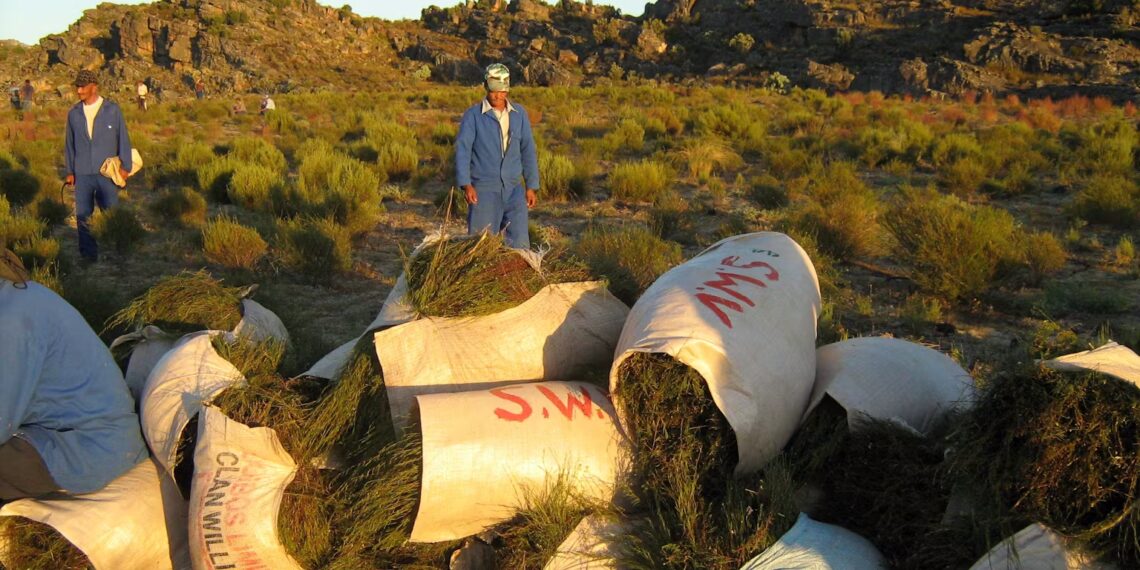
A ground-breaking benefit-sharing agreement was signed in 2019 between South Africa’s lucrative rooibos herbal tea industry and two organisations representing Indigenous San and Khoi people.
Indigenous San and Khoi – the oldest known populations of southern Africa – are traditionally hunter-gatherers and pastoralists. Their traditional knowledge also contributed towards the development of the rooibos tea industry.
Today, the commercial rooibos tea industry sells more than 22 000 tons of tea every year and has an annual export value of over US$50 million.
Although apartheid ended in 1994, the rooibos tea industry is still dominated by white-owned companies. These companies benefited from years of subsidies and protection by the apartheid government. Rooibos farmers who were classified as “Coloured” (an apartheid-era race term imposed on indigenous Khoi-San and other ethnically diverse oppressed people of colour) were excluded from the industry during this time.
The 2019 access and benefit-sharing agreement was meant to change that. It is legally binding, and sets out how those who hold traditional knowledge about rooibos will benefit from the industry.
Access and benefit-sharing agreements like this one are governed by global conventions and protocols. The main aim is to stop genetic resources and traditional knowledge from being used in commercial products without consent or compensation for the traditional knowledge holders and resource owners. They also aim to prevent biopiracy. In other words, they aim to strengthen the rights of Indigenous peoples and local communities over their natural resources.
Related stories
- Khoi and San receive first R12m. share of rooibos sales
- Podcast: Sandy soil is best for rooibos tea farming
- New study unlocks rooibos power for fish farming
Many national laws now require companies to set up these agreements. In this sense, the 2019 rooibos benefit-sharing agreement was historic because it formally recognised, for the first time, the role of San and Khoi traditional knowledge in the development of the rooibos industry.
We are anthropologists, sociologists, environmental scientists, indigenous heritage practitioners and policy researchers. We’ve carried out decades of participatory action research with small-scale rooibos farmers and other Indigenous groups.
Our research found that the 2019 rooibos agreement has not changed who owns and benefits most from rooibos. Control remains vested in an industry set up during colonialism and apartheid. This is because the white-dominated industry still owns most of the tea lands and cultivates about 93% of rooibos tea today. This allows the same commercial farmers and industry players to continue to dominate the market.
Recognition for indigenous farmers
Less than 7% of rooibos tea lands are today controlled by indigenous farmers. As a result, they’re only able to produce about 2% of South Africa’s rooibos tea.
Our research also found that the rooibos agreement does not grapple with local contexts and struggles over identity. While some small-scale farmers identify as Khoi-San and “first nation”, they do not always recognise the authority of the councils endorsed by the government to represent them. Other small-scale farmers do not feel a connection to a Khoi-San identity at all, instead identifying with a “Coloured” heritage.
These problems need to be solved now because other South African plant industries based on traditional use, such as buchu, an indigenous shrub used widely in the herbal, flavour and fragrance industries, and honeybush tea, have begun adopting the rooibos benefit-sharing model.
For biodiversity-based economies to transform, they must go beyond agreements about sharing access to plants and profits from their sale. Government must recognise local guardians of biodiversity and redistribute land, and along with industry, must embrace economic transformation. If they don’t, they run the risk of securing benefits only for the few who are politically connected and organised.
A flawed process
In 2010, the South African San Council claimed the right to benefit from rooibos and honeybush. They were later joined by the National Khoisan Council, a body initiated by former president Nelson Mandela in 1999 as a way of including Khoi-San historical leadership in post-apartheid South Africa.
Government-commissioned research at the time urged the commercial rooibos tea industry to negotiate benefit-sharing agreements with the two organisations or risk losing its licence to operate.
However, these two groups do not represent all Khoi-San groups. Many small-scale rooibos farmers, who have deep historical connections to the plant and its traditional knowledge, weren’t part of the negotiations for the agreement. Small-scale rooibos farmers are typically ethnically diverse descendants of San, Khoi, former slaves, and European settlers.
They were eventually included in the final agreement as “rooibos indigenous farming communities”, but only through the National Khoisan Council and not in their own right.
The agreement offered some reparation for past injustices by establishing a “traditional knowledge levy” of 1.5% of the price that farmers receive. The levy – about US$700 000 per year – is paid to the South African San Council and National Khoisan Council.
What’s missing
The agreement has been cited as an example of best practice in equitable business. Yet small-scale rooibos farmers receive just 5% of the benefits. And they are also expected to pay towards the levy because they produce rooibos tea. Overall, they benefit little from access and benefit sharing.
The agreement doesn’t include everyone who holds traditional knowledge about rooibos, and therefore not every indigenous rooibos grower benefits. It assumes that traditional knowledge is confined to specific groups. In contrast, research has found that indigenous knowledge is shared across groups. It evolves and takes different forms over time.
The effect of the rooibos agreement is that small-scale indigenous farmers are less empowered. They need to find the resources to organise across large distances and find ways to get legal support if they are to benefit equally.
More widely, our research shows that the agreement has introduced a new, intervening role for the state. In this case, the state rewarded ethnically defined beneficiaries. This raises questions about the power of the state and how it controls who is entitled to receive information, knowledge and benefits.
What next?
The rooibos agreement has given recognition and economic benefits to some Indigenous groupings. It’s been hailed as a transformation milestone, but has not brought about the changes needed to address social and economic inequities. Real change would include equal access to land, a more inclusive industry, and the wider sharing of economic benefits.
Access and benefit sharing is due for radical rethink. It needs an inclusive, bold, caring and imaginative approach that should be co-designed with communities from the outset. It needs an approach that is rooted in local context. Only this will create new possibilities for inclusive economic power, sustainability and recognition.
- This article was first published by The Conversation. It was written by Rachel Wynberg, Professor and DSTI/NRF SARChI bio-economy research chair, University of Cape Town; June Bam-Hutchison, Professor in education rights and transformation, University of Johannesburg; and Sarah Ives, instructor of anthropology, City College of San Francisco.
READ NEXT: Rooibos remedy leads couple to create thriving skincare line