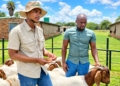
Dimpho Xaba is a man of many hats – not just a farmer, but also a lecturer, beekeeper, and community leader. On his farm in Pretoria North, the crunch of gravel underfoot, the rich scent of fresh soil, and the hum of bees reveal the many layers of his bustling enterprise.
Xaba farms on 136 hectares, and his land is home to a variety of crops, including wheat, maize, soya, and potatoes, along with a thriving beekeeping operation. His passion for farming is deeply rooted in his upbringing.
“I grew up in a small farming town in Brits in North West. Brits is one of the best vegetable-producing towns in the country,” he mentions with a nostalgic smile.
“When I passed the farms in Brits going to town, I got inspired seeing the vegetables growing up until they were in the market. So when I went to university, I chose to do a national diploma in crop production. That’s where the journey started, and I never stopped up until today.”
Walking through the fields of his farm, the Tshwane University of Technology (TUT) lecturer points to a field of wheat, stating that it is his favourite winter crop. “We use the latest farming practices and aim to be sustainable,” he says.
“One method we employ is minimal soil disturbance, which helps maintain soil health. We also practice crop rotation and incorporate legumes to recycle nutrients in the soil.”

Sweetening the deal
Xaba plants grain on a large scale and sells it at open markets, delivering to silos in Brits or Bronkhorstspruit. Alongside 51 hectares of irrigated wheat, he maintains 15 hives, which produce honey and aid in crop pollination.
“When I was still working at the Tshwane University of Technology farm, I once attended a big conference at Bella Villa. That’s where I got inspired by beekeeping. Though I knew that bees were important for pollination, I never thought I could make money out of them.
“We are currently producing honey and selling propolis to various stakeholders. We are benefiting a lot because they contribute about 80% as pollinating agents, so they are also assisting us to increase the yield on the farm.”
Bridging theory and practice
Xaba’s passion for agriculture extends beyond his farm, highlighting the importance of education in the industry. “Farming and education interlink,” he says.
As an agronomist and lecturer, he bridges theory and practice, ensuring students receive up-to-date information. “We do research, teaching, and learning at the university,” Xaba explains.
Practical application reveals changes in crop growth methods. His role requires industry interaction, balancing university hours with industry engagement to stay current and relevant in both fields.
Xaba is also involved with the Youth in Agriculture and Rural Development (YARD). This dynamic organisation promotes the involvement of young people in agriculture.
When speaking about why he does what he does, Xaba’s eyes light up. “Remember, these soils have been ploughed for years, so we always strive to be sustainable so that this land can be used by other generations to come,” he says.

Rolling with the punches
Xaba acknowledges challenges in farming, such as high machinery costs, power cuts, and theft. Yet, his spirit remains undeterred, driven by passion.
“Implements and tractors are very expensive, especially for new farmers. Without them, you rely on others and are often considered the least. Sometimes they compromise your produce, and you end up planting late or harvesting late because you are depending on other people.
“Another challenge that we had was load shedding. I hope it won’t come back because it’s going to push us out of farming. We lost so much because of it last year, and we’re hoping that we’re going to recover now.”
Theft is another challenge. His potatoes were recently stolen, and electric cables frequently go missing. “Though we have police, in the farming communities, you will never see one.”
By employing locals and fostering relationships, Xaba hopes to mitigate these issues. Pointing to a malfunctioning water pivot, Xaba can’t help but laugh. “Such challenges keep me busy and away from societal problems.”
Xaba’s vision for the future of farming
Looking ahead, Xaba aims to expand his farm to a thousand hectares, incorporate vegetable production, and venture into small livestock farming. As an agronomist, he plans to practise what he studied and grow significantly in the next five years.
“We’re currently expanding into vegetable production because I also teach vegetable production at the university,” he says. “We are also going to expand in the future into livestock and sheep farming.”
Moreover, Xaba’s message to aspiring farmers is simple yet powerful – start.
“If you don’t start, you’re not going to record any progress. Most people are sitting there, saying they’re waiting for government funding. You just need to start.
“When you start, remember, this is business, unfortunately, so even if you like cattle, if you have an opportunity to produce grains, start. You will meet something you love along the way. So start and don’t choose, because this is all business.”
READ NEXT: Prodigal farmer returns home to rebuild cattle herd
Get Stories of Change: Inspirational stories from the people that feed Mzansi.