If you’re a crop farmer, switching to precision irrigation could be one of the best decisions you ever make. But only if you select the right system and connect with the necessary experts, says Netafim technical advisor Gary Frances.
Get the best possible system for the money that you have available. After all – you don’t want to spend money on an irrigation solution that later turns out to be a burden.

It’s a word to the wise from Gary Frances, technical advisor for Netafim in KwaZulu-Natal. Netafim specialises in precision irrigation solutions that help farmers grow more with less.
The benefits of precision irrigation – delivering the right amount of water and nutrients exactly where and when the plant needs it for optimal production – are undeniable.
Frances warns, however, that precision can only be achieved in the field if precision had been part of the equipment selection process from the start.
He explains that a host of factors influence how well an irrigation system will fulfil its purpose, and that farmers simply cannot achieve optimal water usage if they fail to consider all of them.
Agronomy-related variables usually include the type of crop, climate, soil type and topography, water availability, and water quality.
Sprinklers vs drippers
“We start by deciding between a sprinkler irrigation system or a drip irrigation system,” Frances says. While micro-sprinklers can wet larger soil volumes and make irrigation management less intensive, higher evaporation losses occur, especially in dry and windy conditions.
Drip irrigation, on the other hand, offers a much higher water use efficiency and efficient way to deliver nutrients. “Drip irrigation offers very low flow rates,” Frances says, “which means you can use it even if you have limited water available.”
Some drawbacks, are however, that emitters clog more easily and cannot be as easily spotted as clogged sprinklers. This means that more expensive filtration systems are often necessary, and even more so when water quality is poor. When soil is poor, there’s an added risk of uneven moisture distribution.

Soil type
Next, farmers need to consider soil type and topography. There are significant differences in how clay-like and sandy soils retain water and this will inform the flow rates and spacing of the sprinklers or drippers. “You don’t want to put down too high a flow of water on a sandy soil, for example,” says Frances, “as all that water will be moving past the root system, wasting water and wasting fertiliser.”
Farmers would also want to prevent runoff or an uneven distribution of water and nutrients in areas where the ground is sloped, for instance.
From filter to emitter
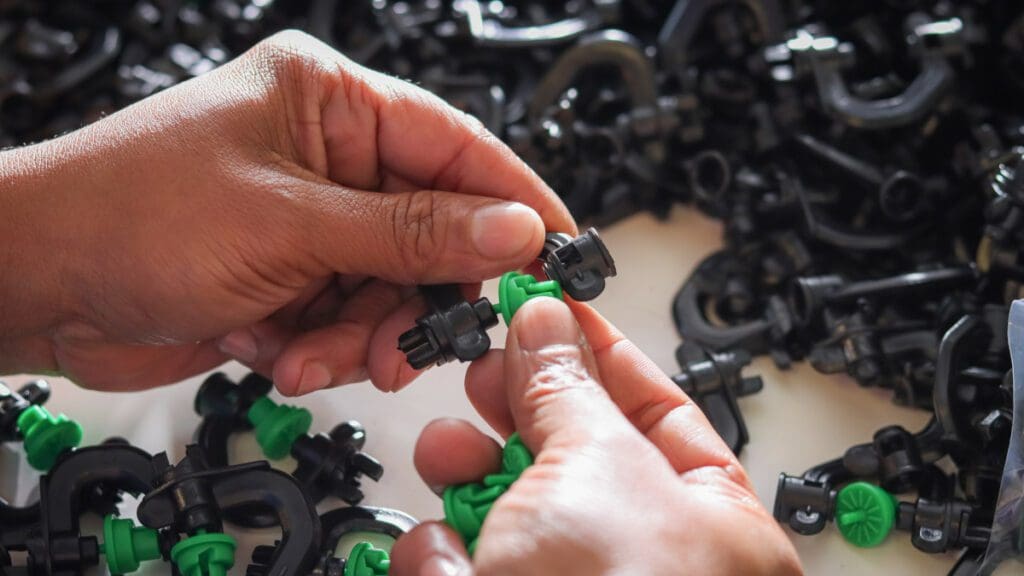
Farmers who have opted for a sprinkler system, will have to narrow down their choice to the type of sprinkler as well, while filtration could make or break any irrigation system regardless of type.
Sprinkler type will be informed by the water needs and spacing of the crops, for instance, while filtration will depend largely on water quality, and even more so when water quality is poor.
Within the farmer’s means
Another set of variables will influence the final choice: the farmer’s own circumstances and expertise. Here, it’s important to consider the practical implications of installing and maintaining a new irrigation system.
Apart from the initial capital, farmers should keep the running costs and maintenance costs in mind, along with the capacity of the team to manage maintenance and scheduling, and security factors such as the risk of theft.
Most importantly, says Frances, it is vital that farmers do proper research, call in the help of experts as far as possible, and be well informed when they make their final decision.
“Don’t just walk into the nearest shop, pick up a sprinkler and then go and use it in your field. You don’t want to spend the money and then find out a year down the line that you’ve put in a sprinkler system in a high-wind area and now you’re losing 30 to 40% of your water and fertiliser through evaporation.
“Talk to us. Get the best advice. In the long term it will save you a lot of money.”
• To hear Frances elaborate on precision irrigation solutions and selecting the right equipment for your farm, listen to the latest episode of Farmer’s Inside Track. For more information on Netafim South Africa, click here.
Full podcast episode:
Spotify
Apple Podcasts
Google Podcasts
ALSO READ: Yes, precision irrigation is possible on a budget
Sign up for Farmer’s Inside Track: Join our exclusive platform for new entrants into farming and agri-business, with newsletters and podcasts.